

On this page
Physics gives a wavelength in angstroms. Chemistry gives a bond length in angstroms or nanometres. Biology gives a cell size in microns. They all measure length, but because the units change between chapters, it is easy to lose marks to a slipped decimal point. The good news is that only two conversion factors connect all three units, and once you know roughly how big atoms, light waves and cells are, you can check any answer in a few seconds.
What is an angstrom in nanometres?
An angstrom (Å) is exactly 0.1 nanometre, or 10⁻¹⁰ metre, according to the NIST Guide to the SI, chapter 5. NIST lists the angstrom as a unit outside the SI and discourages its use, but you will still meet it in textbooks and exam questions on atoms, bonds and X-rays.
The nanometre and micrometre are ordinary SI units. The BIPM table of SI prefixes defines nano (n) as 10⁻⁹ and micro (µ) as 10⁻⁶. So 1 nm = 10⁻⁹ m and 1 µm = 10⁻⁶ m.
"Micron" is the old name for the micrometre. The same NIST guide says "micron" should be avoided and that the correct name is micrometre (µm). In your answers, write µm.
How do you convert angstrom to nanometre and micron?
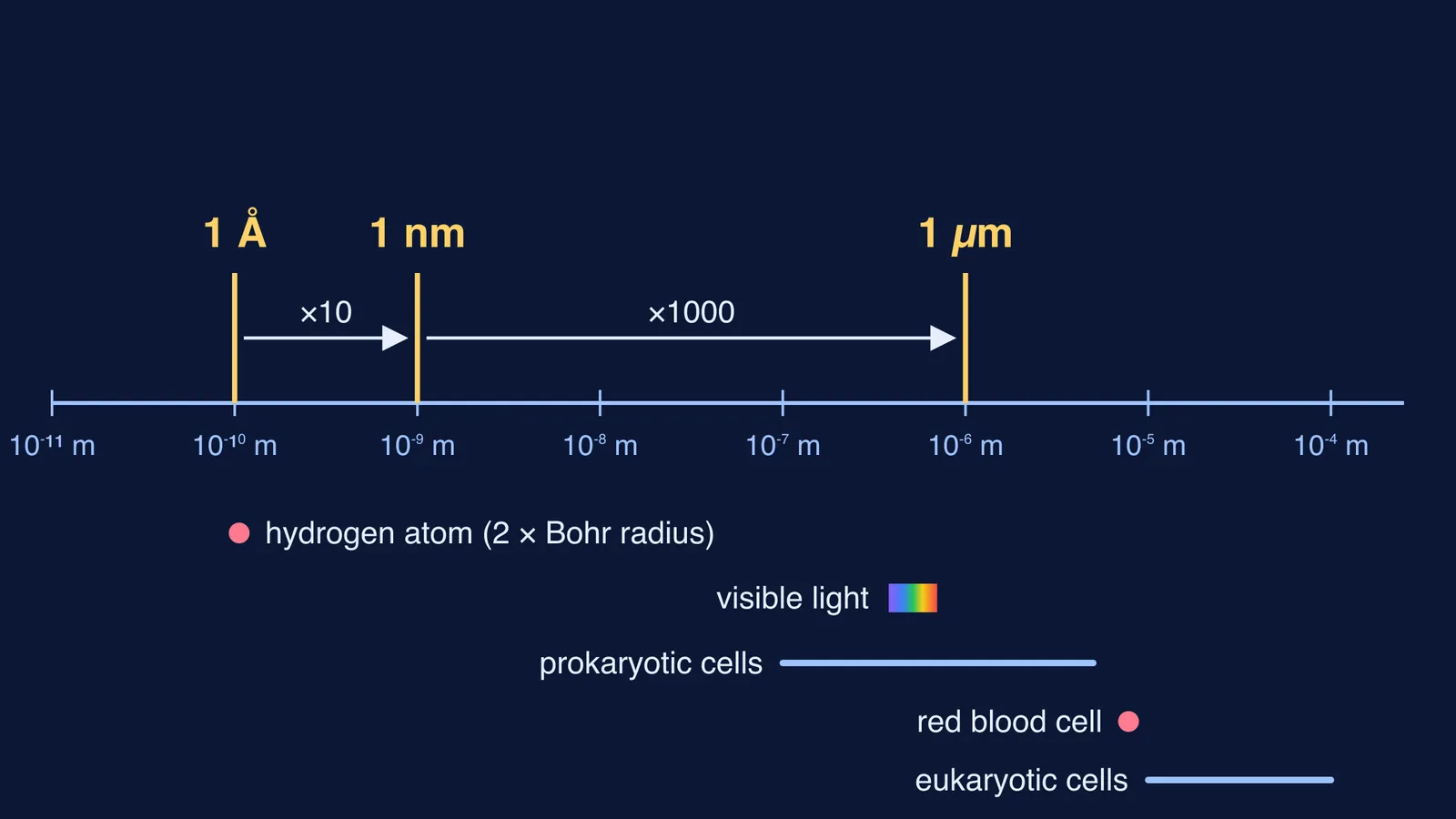
Think of a ladder with three rungs: Å, nm, µm. Each rung is bigger than the one below it, by the factors in the NIST and BIPM definitions above.
Å to nm: divide by 10 (because 10 Å = 1 nm).
nm to µm: divide by 1000 (because 1000 nm = 1 µm).
Å to µm directly: divide by 10,000 (because 10 × 1000 = 10⁴).
Going down the ladder (µm to nm to Å), multiply by the same factors instead.
A quick sense check: a bigger unit always gives a smaller number. If you convert Å to µm and the number gets larger, you have multiplied when you should have divided.
How many nanometres and micrometres is 5000 Å?
A question gives green light as 5000 Å. In nanometres: 5000 ÷ 10 = 500 nm. In micrometres: 500 ÷ 1000 = 0.5 µm. In metres: 5000 × 10⁻¹⁰ = 5 × 10⁻⁷ m. All four numbers describe the same length.
How many angstroms wide is a red blood cell?
A healthy human red blood cell has an average diameter of 7.8 µm, according to a 2010 study in Biophysical Journal. Going down the ladder: 7.8 × 1000 = 7800 nm, and 7800 × 10 = 78,000 Å. Writing a cell in angstroms is legal but clumsy, which is exactly why biologists use µm.
If you want more practice with the powers of ten in step 3, our guide to scientific notation in chemistry calculations walks through multiplying and dividing exponents.
How big are atoms, light waves and cells in these units?
These reference sizes, all from the sources linked beside them, let you check whether an answer is reasonable.
Atoms (angstroms): the Bohr radius, the radius of a hydrogen atom in its ground state in Bohr's model, is 5.29 × 10⁻¹¹ m, according to NIST CODATA 2022. That is 0.529 Å, so a hydrogen atom is about 1 Å across.
Visible light (nanometres): the human eye typically detects wavelengths from 380 to 700 nm, according to NASA. That is 3800 to 7000 Å, or 0.38 to 0.70 µm.
Cells (micrometres): prokaryotic cells are 0.1–5.0 µm in diameter, and eukaryotic cells are 10–100 µm, according to OpenStax Concepts of Biology.
So each unit fits one world: angstroms for atoms, nanometres for light, micrometres for cells. A hydrogen atom is several thousand times smaller than a wavelength of visible light, and a red blood cell is more than ten times wider than that wavelength.
For biology-specific sizes, such as viruses and membranes, see our piece on micrometre vs nanometre for cells, viruses and membranes.
Which unit should you use in an answer?
Use the unit the question uses unless it asks for another. If you get to choose, pick the one that gives a number between about 0.1 and 1000. Here is a quick check to run before you write the final line:
Did I convert everything to one unit before adding, subtracting or putting it into a formula?
Did I divide when going to a bigger unit?
Is the size sensible? Compare it with the reference sizes above: atoms in angstroms, visible light in hundreds of nanometres, cells in micrometres.
In formulas such as c = fλ, did I convert to metres first?
Units mistakes often come from earlier rungs of the same ladder. If km, m, cm and mm still feel shaky, start with the ×10 ladder for metric units.
If you keep getting a wavelength or diffraction problem wrong by a power of ten, the Fermi Problem Library has worked problems with a step-by-step solver that explains the reasoning, so you can see where the conversion goes wrong.


