

On this page
Questions asking for “a unit vector perpendicular to both a and b” turn up in Class 12 vector algebra and JEE Main practice. They need three moves: take the cross product, divide by its length, and decide the sign. The same idea then gives you the normal to a plane in 3D.
What is the formula for a unit vector perpendicular to two vectors?
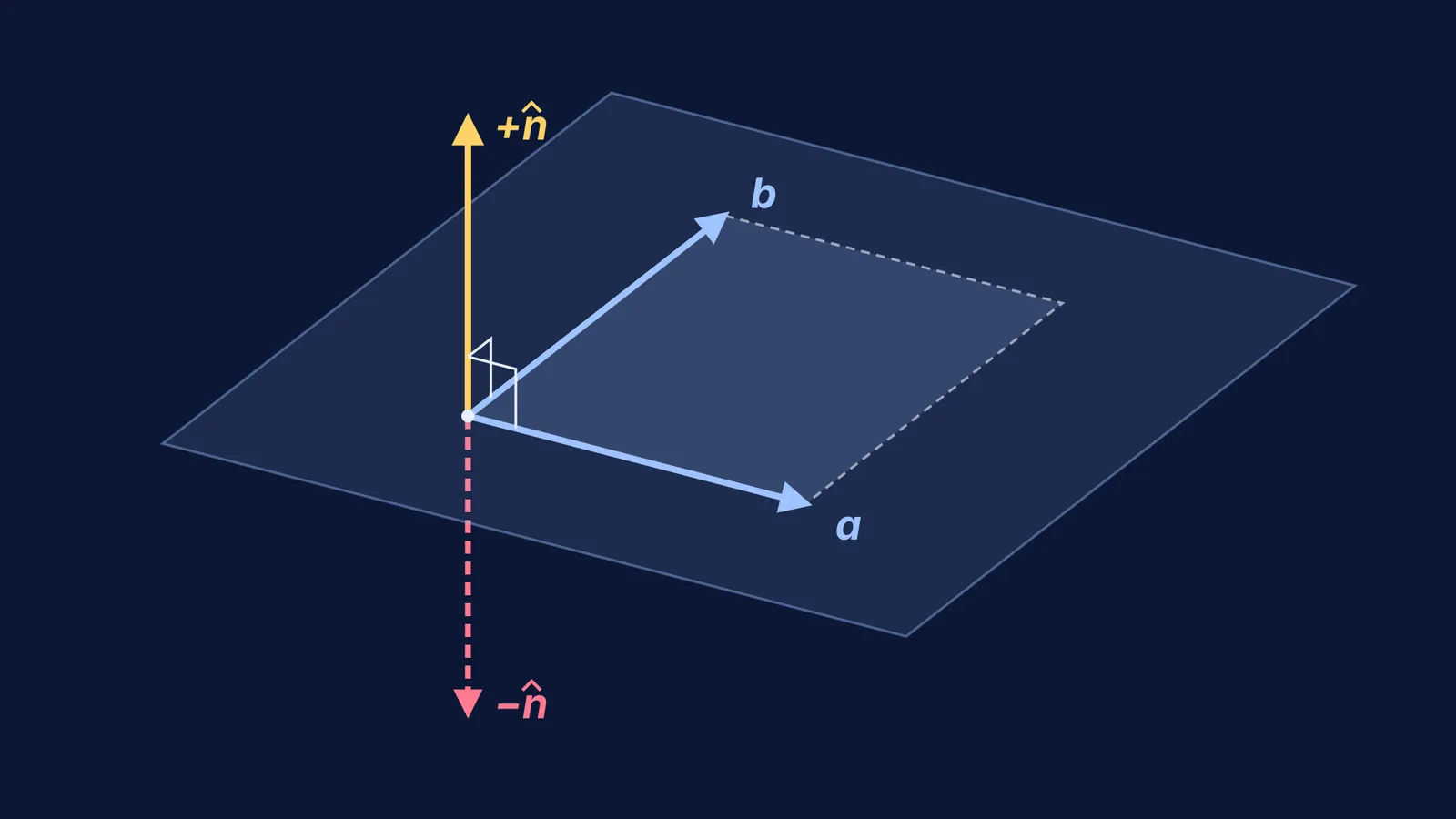
The NCERT Class 12 Mathematics textbook defines the vector product as a × b = |a||b| sin θ n̂, where n̂ is a unit vector perpendicular to both a and b such that a, b and n̂ form a right-handed system (NCERT, Vector Algebra chapter).
The cross product of two vectors is orthogonal to both of them, and its length |a × b| = |a||b| sin θ equals the area of the parallelogram with a and b as adjacent sides (OpenStax Calculus Volume 3, section 2.4).
So a × b already points the right way; divide by its length to get n̂ = ±(a × b)/|a × b|.
Worked example: a = î − k̂ and b = 2ĵ + k̂
Write the components: a = (1, 0, −1) and b = (0, 2, 1).
Expand the determinant. The î part is (0)(1) − (−1)(2) = 2. The ĵ part is −[(1)(1) − (−1)(0)] = −1. The k̂ part is (1)(2) − (0)(0) = 2. So a × b = 2î − ĵ + 2k̂.
Find the magnitude: |a × b| = √(4 + 1 + 4) = √9 = 3.
Divide: n̂ = ±(2î − ĵ + 2k̂)/3, that is ±(2/3, −1/3, 2/3).
Check: n̂·a = (2 + 0 − 2)/3 = 0, n̂·b = (0 − 2 + 2)/3 = 0, and the length is √(4 + 1 + 4)/3 = 1.
Step 5 is quick and catches a common slip: a wrong sign on the ĵ term.
Why is the answer ± and not one vector?
A plane has two perpendicular directions, one on each side. NCERT's Example 23 finds −(1/√6)î + (2/√6)ĵ − (1/√6)k̂ from (a + b) × (a − b), and its note says the other answer, (1/√6)î − (2/√6)ĵ + (1/√6)k̂, comes from (a − b) × (a + b) (NCERT, Vector Algebra chapter). Swapping the order flips the sign because a × b = −(b × a), as our post on why reversing a cross product flips its sign explains.
Which sign to write depends on the wording:
“Find a unit vector perpendicular to a and b”: either sign; ± shows you know both.
“In the direction of a × b” or “right-handed system”: only +.
“Find all unit vectors”: give both.
For the right-handed case, point the fingers of your right hand along a and curl them toward b; your thumb points along a × b (OpenStax, section 2.4).
For nonzero vectors, a × b = 0 exactly when they are parallel (NCERT); see when the cross product is zero for parallel vectors.
How do you use it to find the normal to a plane?
A plane through the point (x₀, y₀, z₀) with normal vector (A, B, C) has the scalar equation A(x − x₀) + B(y − y₀) + C(z − z₀) = 0 (OpenStax Calculus Volume 3, section 2.5). The cross product of two vectors lying in the plane supplies that normal.
Take the points P(1, 1, 1), Q(2, 1, 0) and R(1, 3, 2). Then PQ = (1, 0, −1) and PR = (0, 2, 1), the same a and b as above, so the normal is 2î − ĵ + 2k̂ and the plane is 2(x − 1) − (y − 1) + 2(z − 1) = 0, or 2x − y + 2z = 3. Substituting Q and R gives 3 both times.
Here dividing by the length pays off. Divide the equation by 3 to get (2/3)x − (1/3)y + (2/3)z = 1: the coefficients are the unit normal, and the right-hand side is the plane's distance from the origin. The point-to-plane distance formula in OpenStax section 2.5 agrees: |−3|/3 = 1. The same trick gives a line perpendicular to two lines in 3D.
What should you check before writing the final answer?
Is a × b zero? Then the vectors are parallel; say so.
Did the ĵ term get its minus sign?
Are both dot products zero?
Is the length 1?
Does the question fix the sign?
If you keep failing check 2 or 3, the expansion is usually the problem. The Fermi Problem Library has worked problems with a step-by-step solver that explains the reasoning rather than printing an answer, so you can compare your expansion line by line. If the right-handed system itself feels shaky, the Fermi Concept Library gives each mathematics concept its own lesson and its place in the map.
Try one now: find a unit vector perpendicular to î + ĵ and ĵ + k̂, then run the five checks. You should get ±(î − ĵ + k̂)/√3.


