

On this page
Under a single small LED, your hand's shadow has a crisp edge. Under a tube light, the edge goes soft. Light travels in straight lines in both cases; what changes is the size of the source. That explains the umbra, the penumbra and why a solar eclipse can be total or partial.
What are umbra and penumbra?
The umbra is the darkest part of a shadow, where the whole source is hidden; the penumbra is the paler part, where only some of it is hidden. NASA's glossary of solar eclipse terms applies this to the Moon's shadow: from within the umbra the Sun is completely blocked, and from within the penumbra only partially.
Why does a point source give only an umbra?
A point source sends one ray to each point on the screen. Blocked or not, every point is fully dark or fully lit, so the edge is sharp.
Similar triangles give the size. Put an opaque disc of diameter d a distance x from the source, with the screen a further s behind it; the shadow's diameter is d(1 + s/x). A 4 cm disc with x = s = 30 cm casts an 8 cm shadow, all umbra. The same triangles help you find a pole's height from its shadow.
How does an extended source form umbra and penumbra?
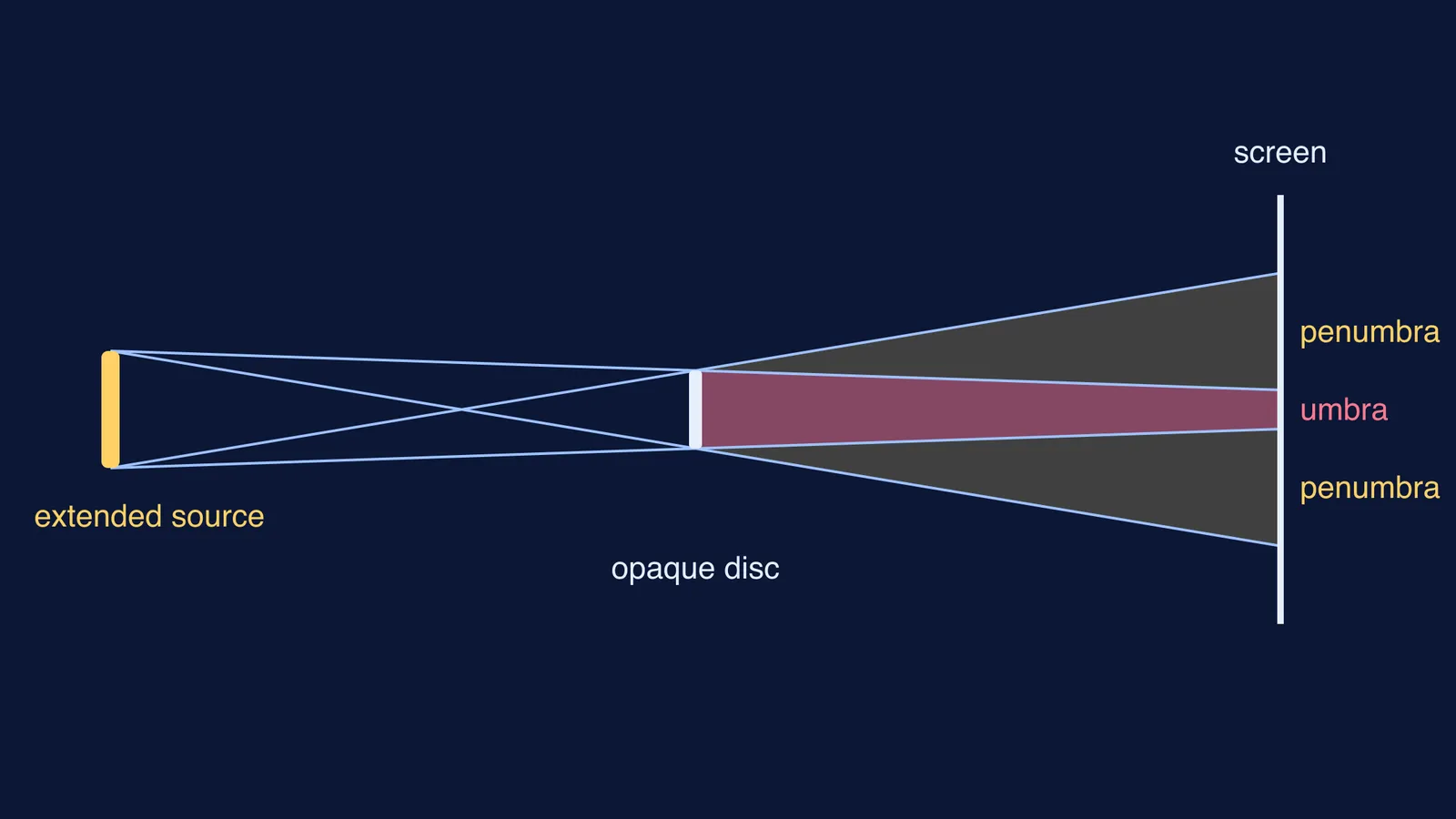
Treat a wide source as many point sources side by side, each throwing its own slightly shifted sharp shadow. Where all of them overlap you get the umbra; where only some overlap you get the penumbra, which fades from dark to fully lit. Two pairs of edge rays mark the boundaries:
Umbra edges: top of source to top of object, bottom to bottom. They do not cross before the object; if the source is wider, they meet behind it, at the umbra's tip.
Penumbra outer edges: bottom of source to top of object, top to bottom. These cross between source and object.
Worked example: a lamp, a disc and a wall
Take a flat glowing lamp face D = 6 cm wide, with the same disc and distances. Similar triangles on the edge rays give:
Umbra diameter = d − (D − d)(s/x) = 4 − 2 × 1 = 2 cm
Penumbra outer diameter = d + (D + d)(s/x) = 4 + 10 × 1 = 14 cm
The point source gave one 8 cm shadow; the lamp gives a 2 cm dark core inside a soft 14 cm patch. Slide the screen back to s = 60 cm and the umbra shrinks to 4 − 2 × 2 = 0. Beyond that, the centre of the screen sees a thin ring of lamp around the disc.
Why is a solar eclipse total for some people and partial for others?
Swap in the Sun as the source and the Moon as the disc. From NASA's fact sheets: the Sun has a mean radius of 695,700 km at a mean distance of 149.6 million km; the Moon has an equatorial radius of 1,738.1 km, an orbital semimajor axis (average distance) of 384,400 km and a mean perigee of 363,300 km; Earth's mean radius is 6,371 km.
Setting the umbra diameter to zero gives the length of the Moon's umbra: about 149.2 million km (Sun to Moon at new moon) × 1,738.1 ÷ (695,700 − 1,738.1), or roughly 374,000 km.
At mean distance, the Moon's centre is about 378,000 km from the nearest point on Earth, so the umbra falls about 4,000 km short. Nobody sees a total eclipse; NASA's glossary calls this an annular eclipse.
Near perigee the gap shrinks to about 357,000 km, the umbra reaches the ground, and people inside it see a total eclipse.
NASA's eclipse geometry page says the Sun is about 400 times bigger than the Moon and about 400 times farther away, so the two look almost the same size in our sky, which is why the umbra only just reaches us. It adds that a typical umbral path may be less than 50 miles wide, while the penumbral zone can span a thousand miles or more. Before you watch one, read how to watch a solar eclipse safely.
How do you draw umbra and penumbra in an exam?
Label the source's ends A (top) and B (bottom), and the object's ends P (top) and Q (bottom).
Extend A–P and B–Q to the screen. The umbra lies between them.
Extend B–P and A–Q to the screen. They cross before the object; the penumbra lies between them and the umbra lines.
Shade the umbra dark, the penumbra lighter, and label both.
Our shadow simulation on why eclipses don't happen every month shows how these shadows decide whether an eclipse happens at all. For more, the Fermi Simulation Lab has interactive simulations for ideas easier to see than to read, the Fermi Concept Library gives each concept its own lesson, and the Fermi Problem Library has a step-by-step solver that explains the reasoning.
Next time a tube light casts a soft shadow, look for its dark core: the umbra.


