

On this page
You can name any angle's type from its size alone. The reflex angle trips students up, because your protractor stops at 180° and the angle you want is on the outside.
What are the types of angles by size?
The definitions below come from NCERT's Class 6 textbook, Ganita Prakash, Chapter 2: Lines and Angles, which takes a full turn as 360° and builds every other measure from it.
Acute angle: greater than 0° and less than 90°.
Right angle: exactly 90°, a quarter turn.
Obtuse angle: greater than 90° and less than 180°.
Straight angle: exactly 180°, a half turn, with both arms lying in one straight line.
Reflex angle: greater than 180° and less than 360°.
Whole angle (full turn): 360°.
The same chapter points out that acute means sharp and obtuse means blunt, which is a quick way to remember which is which.
Why do two arms always make two angles?
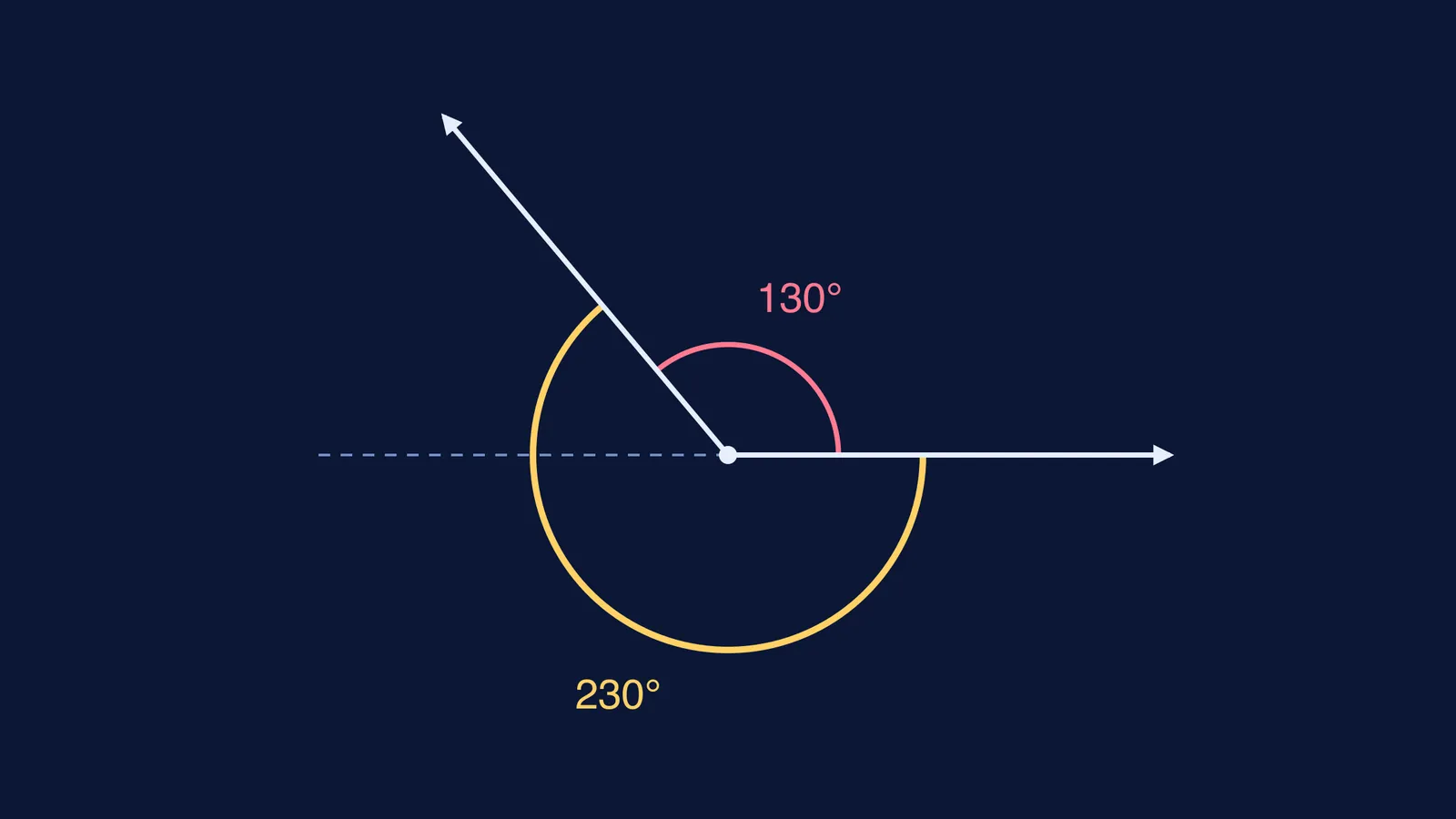
Draw two rays from one point and you have split the full turn into two parts. Because a full turn is 360° (NCERT, Ganita Prakash Chapter 2), the two parts always add up to 360°. If the smaller part is 130°, the larger part is 230°.
When a question just says "the angle", it usually means the smaller part, which is never more than 180°. When it asks for the reflex angle, it means the larger part, and the diagram shows the arc drawn on the outside. It is the same idea as finding unknown angles around a point that add up to 360°.
How do you measure a reflex angle with a protractor?
The protractor in your geometry box is usually a half circle divided into 180 equal parts, as the NCERT chapter describes (it notes that full-circle protractors with 360 parts also exist). A half-circle protractor cannot read a reflex angle in one go, so measure the inner angle instead, then subtract.
Put the centre of the protractor exactly on the vertex.
Line up one arm with the 0° mark on the base line.
Read where the other arm crosses, on the scale that starts at 0° on your first arm.
Subtract: reflex angle = 360° − inner angle.
Check that your answer is more than 180° and less than 360°.
Worked example 1, arms 130° apart: the protractor reads 130° for the inner angle, which is obtuse. The reflex angle is 360° − 130° = 230°. Since 230° lies between 180° and 360°, the answer passes the check.
Worked example 2, a clock at 4 o'clock: the twelve numbers on a clock share 360°, so each gap is 360° ÷ 12 = 30°; NCERT's chapter uses the same fact when it asks why the hands make 30° at 1 o'clock. At 4 o'clock the hands are four gaps apart, so the inner angle is 4 × 30° = 120°, which is obtuse. The reflex angle on the other side is 360° − 120° = 240°.
A second method to check your answer: extend one arm backwards through the vertex with a ruler. That makes a straight angle of 180°. Measure the extra part beyond that line and add: reflex angle = 180° + extra. In example 1, the extra part is 50°, and 180° + 50° = 230°. If the methods disagree, recheck your scale.
Which mistakes cost marks in angle questions?
Reading the wrong scale. A protractor carries two sets of numbers, so a 130° angle read from the other set looks like 50°. Always start from 0° on the arm you lined up.
Giving the inner angle when the arc is outside. Look at where the arc is drawn before you write anything.
Mixing up the boundaries. 90° is right and 180° is straight; neither is obtuse.
Judging by arm length. A teacher's note in the NCERT chapter warns that students sometimes think longer arms make a bigger angle. They don't: only the amount of turn between the arms counts.
Skipping the range check. A reflex answer below 180° or above 360° tells you a step went wrong.
If you keep landing on the inner angle when the question wants the reflex one, the Fermi Problem Library has worked problems with a step-by-step solver that explains the reasoning rather than printing an answer. To revise the angle types alongside related ideas, the Fermi Concept Library gives every mathematics concept its own lesson and its place in the map.
For parents: if the protractor itself is the problem, fix the tool before the types. Our home plan for a child struggling with a protractor and compass breaks it into short sessions.
Once the types are secure, the natural next step is angle pairs: practise complementary and supplementary angle problems.


