On this page
If your child's angles keep coming back marked wrong, or their circles look like eggs, the problem is usually not talent. Protractors and compasses have a few rules, and a child who was never shown them will guess. Each slip is easy to spot once you know where to look.
Why can't my child use a protractor properly?
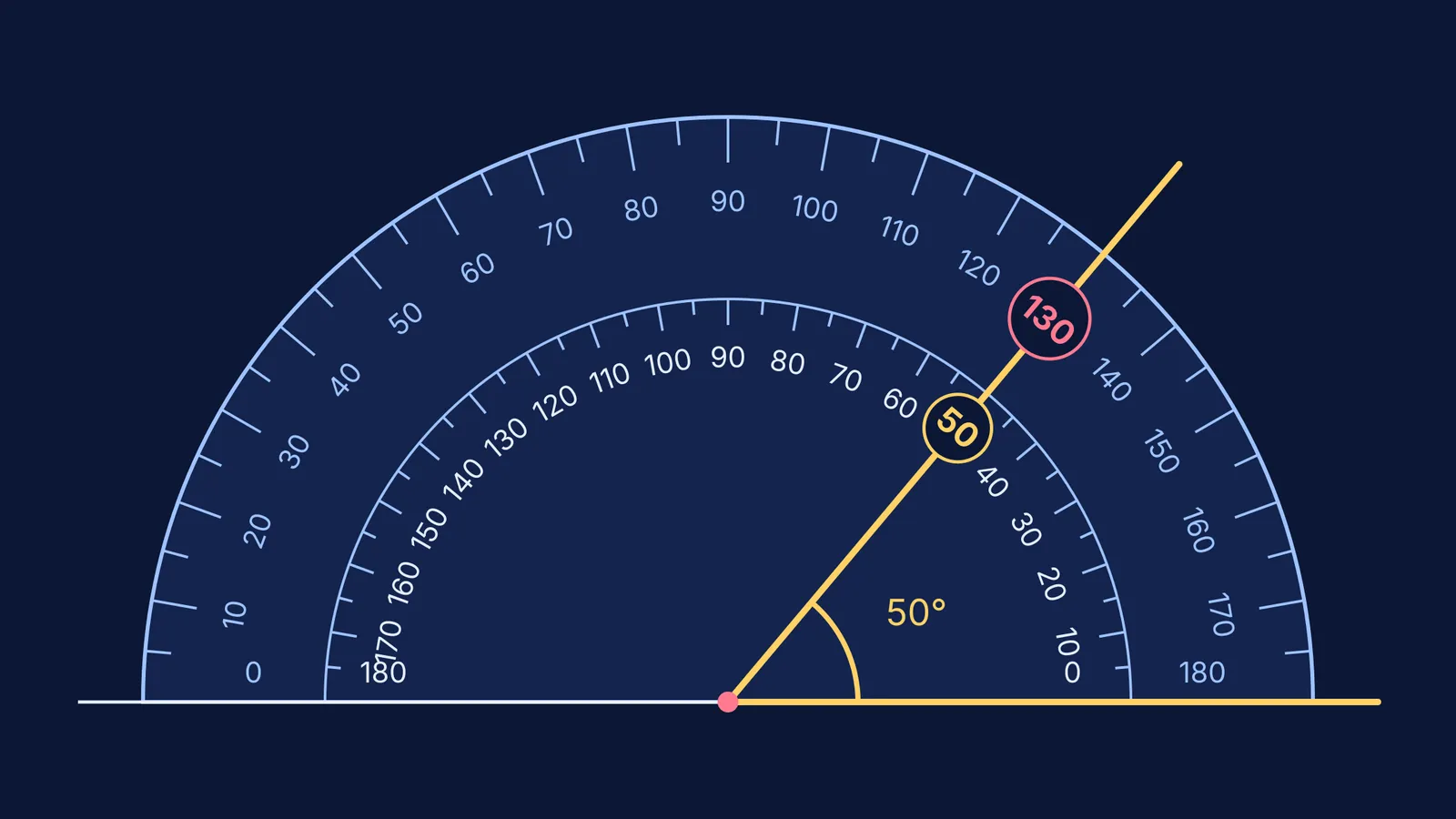
NCERT's Class 6 textbook *Ganita Prakash* points out that a protractor has two sets of numbers, "one increasing from right to left and the other increasing from left to right" (NCERT, Lines and Angles). The same chapter gives the method: place the protractor so the centre is on the vertex of the angle, and align it so that one arm passes through the 0° mark.
The Open University's course for teachers names the usual slip: learners "commonly make mistakes because they are not using the correct scale when measuring the angle between two lines" (OpenLearn, Teaching mathematics). Its advice is to read from the scale that starts at zero on the arm you lined up.
Your child is not alone. A qualitative study at one primary school observed that many pupils still had difficulty with problems on measuring lines and angles using a protractor (Insani and colleagues, 2023).
Watch your child measure one angle and look for these three slips:
Centre off the vertex. The small hole or cross on the straight edge sits next to the corner, not on it.
Base line not on an arm. The protractor is tilted, so neither arm passes through 0.
Wrong scale. They read whichever number the second arm crosses, without checking which row started at 0.
How do you tell 50° from 130° on a protractor?
In the picture at the top of this page, one arm lies along the base line and the other crosses the inner row at 50 and the outer row at 130. The inner row starts at 0 on the arm we lined up, so the answer is 50°. Two checks catch the error: the angle is sharper than a book's corner, so it is under 90°; and the two numbers on any line add to 180.
What goes wrong with a compass?
NCERT's Class 6 chapter *Playing with Constructions* defines the radius as the distance between the centre and any point on the circle. It says to set the radius by opening the compass against a ruler, and its hint for drawing is to "keep the point of the compass fixed moving only the pencil" (NCERT, Playing with Constructions).
A wobbly circle usually comes down to one of these:
The point moves. It is not pressed in, or pressure on the pencil side makes it skid.
The radius changes. Gripping the two legs squeezes them together. Hold the knob at the top instead.
The pencil is set wrong. If the lead sits much shorter than the point, the compass tilts. Line them up and use a sharp pencil.
The wrist twists awkwardly. It is fine to turn the paper slowly with the other hand.
A practice sheet of angles and circles to do at home
You need a pencil, ruler, protractor, compass and plain paper. The sheet follows the textbook, which asks children to draw angles in different orientations (NCERT, Lines and Angles) and to check that points on a circle really are the radius away from the centre (NCERT, Playing with Constructions).
You draw five angles: 30°, 50°, 90°, 120° and 160°, some opening left, some opening upward. Your child measures them.
Your child draws the same five, turning the base line each time.
Swap and measure each other's work. Agree that one degree out is fine.
Draw circles of radius 3 cm, 4 cm and 5.5 cm around one centre.
Mark four points on each circle and measure them from the centre. If one is off, ask whether the point moved or the legs did.
Finish with a picture made of circles and arcs, like the face and figures in the textbook.
If the idea underneath is shaky, the Fermi Concept Library has a lesson for each concept in mathematics to revisit before picking up the tool again.
How do I help without taking over?
Sit beside your child, not opposite, so you see the protractor the way they do, and ask instead of correcting: "Where is the centre sitting?" "Which row starts at zero on this arm?" "Is that angle bigger or smaller than a right angle?" If you have forgotten the rules yourself, our guide on helping with maths you have forgotten shows how questions can do the work.
For the syllabus side, see Class 6 lines and angles and compass constructions in Class 6.
Start with one angle and one circle tonight, and let your child check their own work.