

On this page
Questions like "a bag has 5 red and 3 blue balls, two are drawn, find the probability that both are the same colour" are a staple of Class 11 and 12 probability. They take three moves: split the event into cases, find each case, then add. The only thing that changes between versions is whether the first ball goes back in.
Why do you add P(both red) and P(both blue)?
"Same colour" means both red or both blue. Those two outcomes cannot happen in the same draw, so they are mutually exclusive.
For mutually exclusive events A and B, P(A or B) = P(A) + P(B), which the NCERT Class 11 probability chapter states as Axiom (iii) of probability. If the difference between mutually exclusive and exhaustive events is fuzzy, our explainer on mutually exclusive vs exhaustive events sorts it out.
So every version of this problem has the same skeleton:
P(same colour) = P(both red) + P(both blue)
The work is in finding each piece.
How do you find it without replacement, using combinations?
Without replacement, you are choosing 2 balls out of the bag at once, and order does not matter. That makes it a combinations problem: favourable selections divided by all selections. The NCERT Class 11 chapter uses the same method to choose a committee of two from four people, dividing by 4C2 (Example 8 in the Class 11 chapter).
For two balls, nC2 = n(n − 1)/2.
Worked example: 5 red and 3 blue balls, 8 in total.
All ways to choose 2 from 8: 8C2 = 28.
Ways to choose 2 red from 5: 5C2 = 10.
Ways to choose 2 blue from 3: 3C2 = 3.
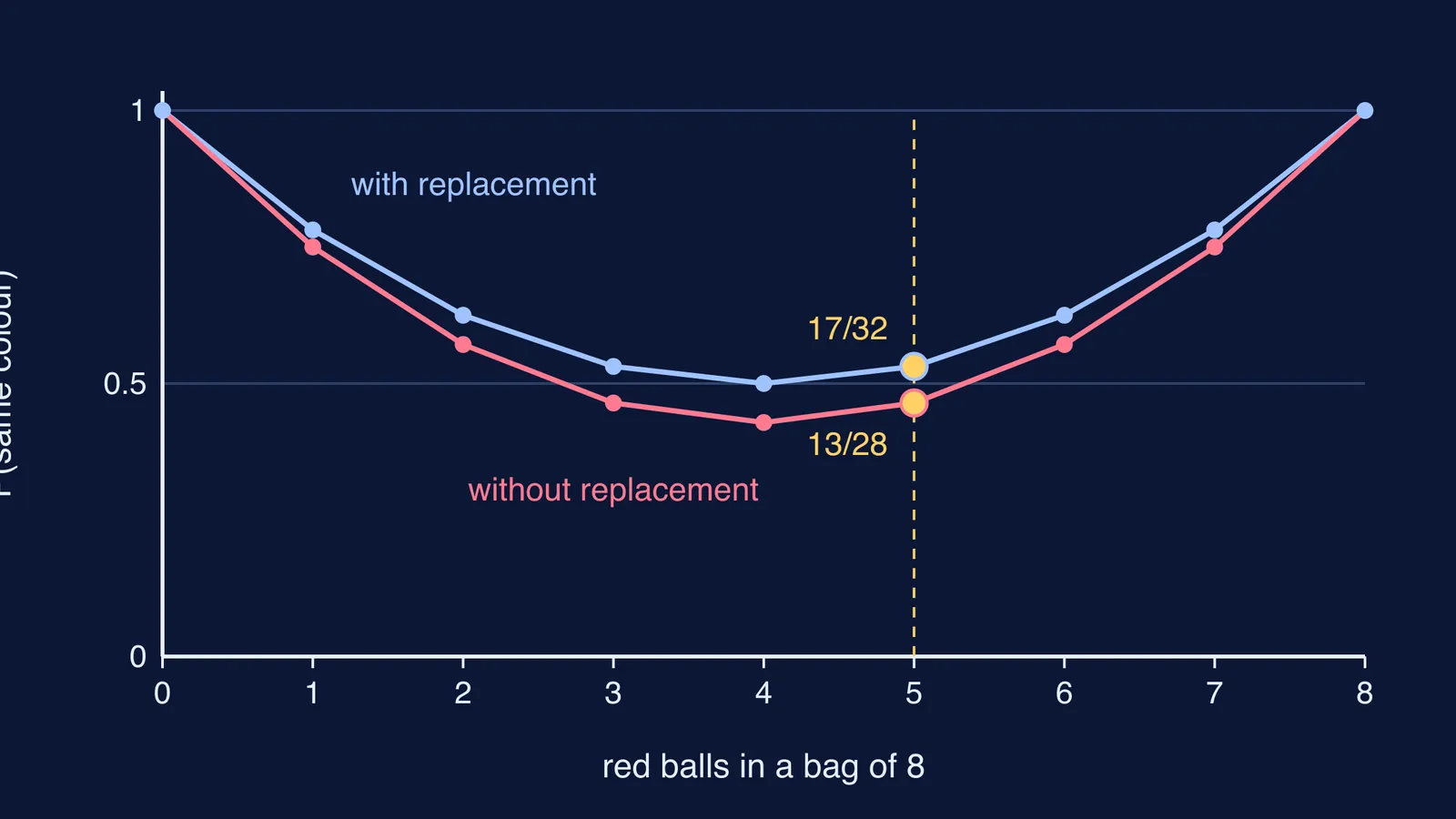
P(same colour) = 10/28 + 3/28 = 13/28, about 0.46.
You can check this by multiplying instead. P(red, then red) = 5/8 × 4/7 = 20/56 = 10/28. The second fraction is 4/7 because one red ball has gone and the bag now holds 7 balls. The NCERT Class 12 probability chapter solves this exact type of problem in Example 8: an urn with 10 black and 5 white balls, two drawn without replacement, gives P(both black) = 10/15 × 9/14 = 3/7. Combinations give the same answer: 10C2/15C2 = 45/105 = 3/7. For a closer look at chaining conditional fractions, see when to multiply probabilities.
To finish the NCERT urn as a same-colour question, add P(both white) = 5C2/15C2 = 10/105. The total is 55/105 = 11/21.
What changes with replacement?
With replacement, the first ball goes back before the second draw, so the bag is the same both times. The two draws are independent: the first result does not change the chance of the second. The Class 12 chapter defines independent events this way.
Same bag, 5 red and 3 blue, with replacement:
P(both red) = 5/8 × 5/8 = 25/64
P(both blue) = 3/8 × 3/8 = 9/64
P(same colour) = 34/64 = 17/32, about 0.53
Don't use nC2 here. Combinations assume each ball can be picked at most once. With replacement, the same ball can come out twice.
In the NCERT urn with replacement, P(same colour) = (10/15)² + (5/15)² = 4/9 + 1/9 = 5/9.
Why is "same colour" more likely with replacement?
In both bags above, the same-colour chance drops when you don't replace the ball: 17/32 against 13/28, and 5/9 against 11/21. Taking out a red ball leaves fewer reds, so a second red becomes less likely. The same happens with blue. The hero diagram shows this for every split of 8 balls: the with-replacement curve is never below the without-replacement one.
This also lets you check the size of an answer. If your without-replacement answer is bigger than the with-replacement one for the same bag, recheck your work.
The complement shortcut is explained step by step in probability of an event not happening.
A three-line check before you write the final answer
Cases: did you list every colour? With three colours, there are three "both" terms to add.
Replacement: without replacement, the second fraction has one less on top and on the bottom. With replacement, the fraction stays the same.
Size: does the answer lie between 0 and 1? Is it no higher without replacement than with replacement?
If you get the wrong number and can't see why, the Fermi Problem Library has worked problems with a step-by-step solver that explains the reasoning rather than printing an answer. Comparing each step with yours shows where the count went wrong. If nCr itself feels shaky, the Fermi Concept Library gives every concept in mathematics its own lesson, so you can revise combinations first.
Try this one yourself: 4 red, 4 blue, two drawn without replacement. Then check your answer against the point above 4 on the lower curve of the diagram.


