

On this page
You have three events and you want the chance that all of them happen. The short answer is “multiply”, but what you multiply depends on one question: does one event change the odds of the next? Get that wrong and you will write a tidy line of working that leads to the wrong answer.
What is the multiplication rule for three events?
The NCERT Class 12 Mathematics textbook, Chapter 13 (Probability) gives the general rule for three events E, F and G: P(E ∩ F ∩ G) = P(E) P(F|E) P(G|E ∩ F).
Read it left to right as a story. First, the chance that E happens. Then the chance that F happens, given that E already did. Then the chance that G happens, given that both E and F did. The same chapter notes that the rule extends in the same way to four or more events. The “just multiply” shortcut is a special case of it.
When can you just multiply P(A) × P(B) × P(C)?
Only when the events are independent, meaning that knowing one has happened tells you nothing about the others. Then every conditional probability equals the plain one, so P(B|A) = P(B), and the rule shrinks to P(A ∩ B ∩ C) = P(A) P(B) P(C). OpenStax Introductory Statistics states the two-event version the same way: if A and B are independent, P(A AND B) = P(A)P(B).
Typical independent set-ups are separate tosses of a coin, separate throws of a die, and draws with replacement. For example, the chance of rolling a six on each of three throws of a fair die is 1/6 × 1/6 × 1/6 = 1/216.
What if the three events are not independent?
Then each factor has to be updated for what has already happened. In Example 9 of the NCERT probability chapter, three cards are drawn one after another, without replacement, from a well-shuffled pack of 52, and you want the chance of king, king, then ace:
First card a king: 4/52.
Second card a king, given one king has gone: 3 kings are left in 51 cards, so 3/51.
Third card an ace, given two kings have gone: all 4 aces are left in 50 cards, so 4/50.
Multiply: 4/52 × 3/51 × 4/50 = 2/5525.
If you had treated the draws as independent and written 4/52 × 4/52 × 4/52 = 1/2197, your answer would be about 26% too high.
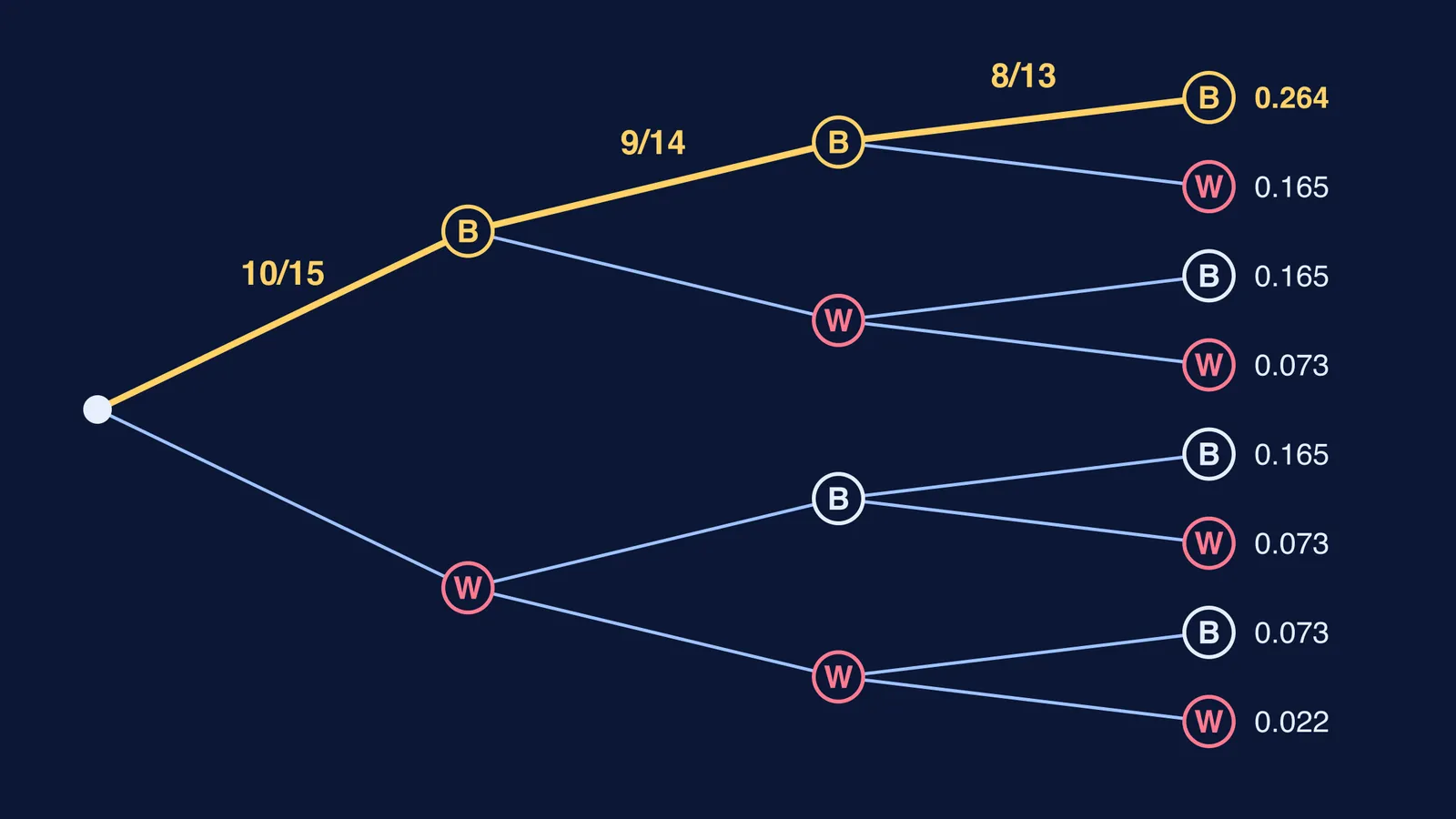
The tree at the top of this page does the same thing for an urn with 10 black and 5 white balls (the urn from NCERT’s Example 8, taken to a third draw). The yellow path is black, black, black: 10/15 × 9/14 × 8/13 = 24/91, about 0.264. Each fraction on that path is smaller than the one before because a black ball has left the urn.
Is checking each pair enough to prove independence?
No, and this is where careful students still slip. Toss two fair coins. Let A be “first coin shows heads”, B be “second coin shows heads” and C be “both coins show the same face”. Each has probability 1/2.
Every pair passes the test. A and B together means HH, probability 1/4 = 1/2 × 1/2. A and C together also means HH, 1/4. B and C together is again HH, 1/4. But all three together is only HH, probability 1/4, not 1/2 × 1/2 × 1/2 = 1/8. The events are pairwise independent but not mutually independent, so the shortcut fails. That is why the NCERT definition has a fourth condition.
A 30-second check before you multiply
Before you write any product of three probabilities:
Name the events in order: what happens first, second and third?
Ask whether the first outcome changes what is possible next. Drawing without replacement, choosing from a fixed group, or “given that” wording all mean yes.
If yes, write P(E) P(F|E) P(G|E ∩ F) and update the counts at every step.
If no, because the trials are physically separate (tosses, throws, draws with replacement), multiply the plain probabilities.
If the question asks you to prove independence, check all three pairs and the triple.
Sanity check: the answer can never be bigger than the smallest of the three single probabilities.
If step 2 is where your answers keep going wrong, work a few similar questions in the Fermi Problem Library, whose step-by-step solver explains the reasoning rather than printing an answer, so you can see exactly where the conditional probability enters. If the idea of conditional probability itself feels shaky, the Fermi Concept Library gives every concept in mathematics its own lesson.
Next time a question says “all three”, ask the one question first: does the first outcome change the second?


