

On this page
Students mix these two words up because both describe how a group of events sits inside the sample space S. But they answer different questions. Mutually exclusive is about overlap: can two of these events happen on the same trial? Exhaustive is about coverage: is there any outcome that none of them catches?
What is the difference between mutually exclusive and exhaustive events?
Two events are mutually exclusive if they cannot occur at the same time, which in set language means A ∩ B = φ (NCERT Class 11 Mathematics, Chapter 14).
Events E1, E2, ..., En are exhaustive if E1 ∪ E2 ∪ ... ∪ En = S, so at least one of them must occur every time the experiment is performed (NCERT Class 11 Mathematics, Chapter 14).
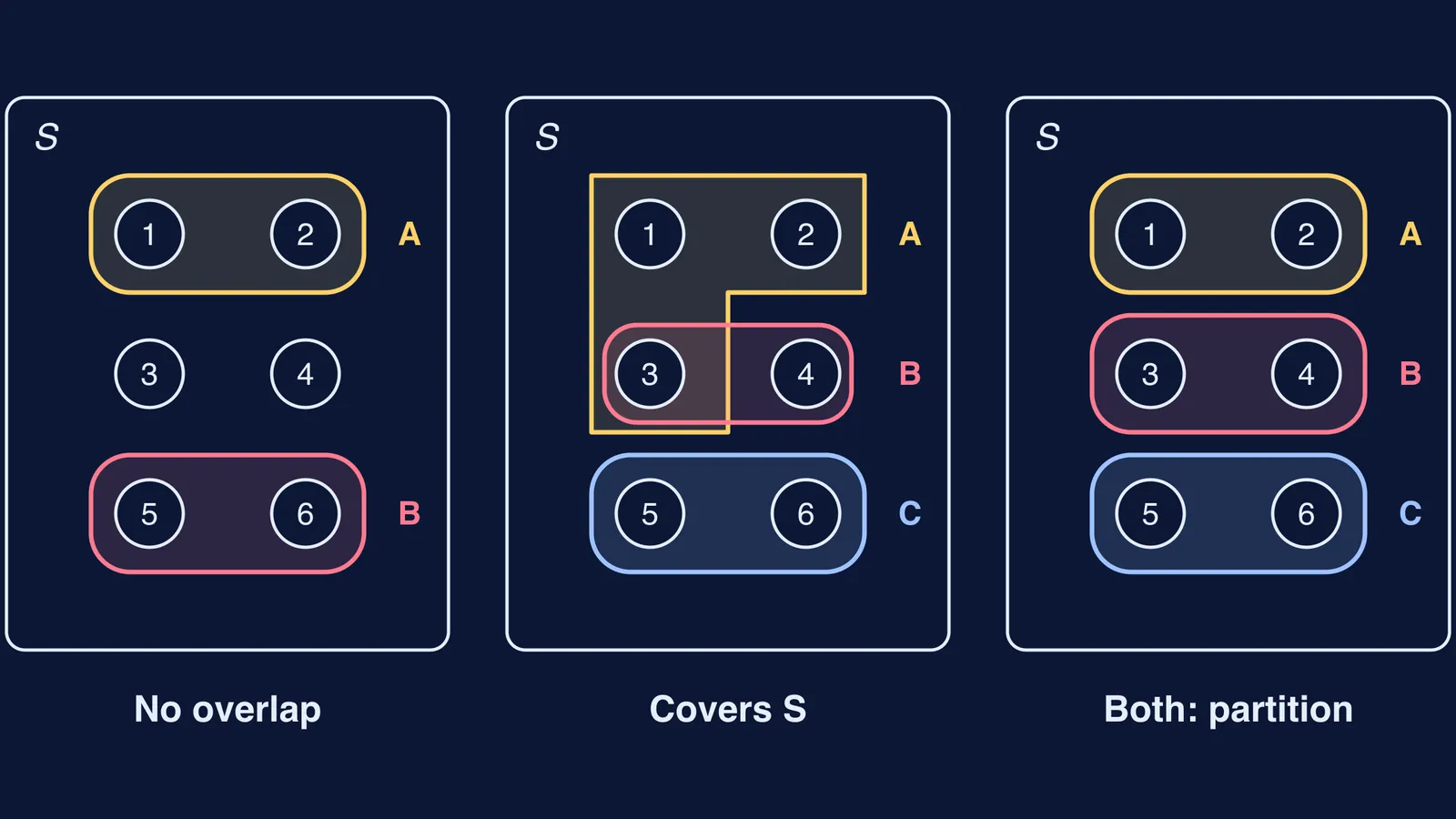
So mutually exclusive is a rule about pairs: no two events share an outcome. Exhaustive is a rule about the whole group: together they leave nothing out. Neither property implies the other. Roll one die, with S = {1, 2, 3, 4, 5, 6}:
Mutually exclusive, not exhaustive: A = {1, 2} and B = {5, 6}. They never happen together, but a roll of 3 or 4 is caught by neither.
Exhaustive, not mutually exclusive: NCERT's own example uses A = 'a number less than 4' = {1, 2, 3}, B = 'greater than 2 but less than 5' = {3, 4} and C = 'greater than 4' = {5, 6}. Their union is S, so they are exhaustive. But a roll of 3 is in both A and B, so they are not mutually exclusive.
Both: A = {1, 2}, B = {3, 4}, C = {5, 6}. No overlaps, nothing missing.
If you want a refresher on writing S and events as sets first, our guide to sample space and events in Class 11 starts from there.
Can events be both mutually exclusive and exhaustive?
Yes. NCERT's worked example tosses a coin three times and defines A = 'no head', B = 'exactly one head' and C = 'at least two heads' (NCERT Class 11 Mathematics, Chapter 14). Then A = {TTT}, B = {HTT, THT, TTH} and C holds the remaining four outcomes. The three sets are pairwise disjoint and their union is S.
The same chapter's axioms say P(S) = 1 and, for mutually exclusive E and F, P(E ∪ F) = P(E) + P(F). Put those together and the probabilities of a mutually exclusive and exhaustive set must add to exactly 1. With a fair coin, that is 1/8 + 3/8 + 4/8 = 1.
This gives you a free error check. If your cases add to more than 1, two of them overlap. If they add to less than 1, you have left an outcome out. The simplest set that is both is any event E with its complement E', which is why P(not E) = 1 − P(E) works.
What is a partition, and why does total probability need one?
The Class 12 textbook says E1, E2, ..., En form a partition of S if they are pairwise disjoint, exhaustive and each has nonzero probability (NCERT Class 12 Mathematics Part II, Chapter 13). It also notes that a sample space can have several different partitions.
The theorem of total probability in that chapter then states P(A) = P(E1)P(A|E1) + P(E2)P(A|E2) + ... + P(En)P(A|En). Each condition has a job:
Disjoint, so no part of A is counted twice.
Exhaustive, so no part of A is left out.
Nonzero probability, so each P(A|Ej) is defined.
What do right and wrong case splits look like?
NCERT's Class 12 chapter opens its Bayes' theorem section with Bag I (2 white, 3 red) and Bag II (4 white, 5 red), with one bag chosen at random. Take the cases E1 = 'Bag I chosen' and E2 = 'Bag II chosen'. Exactly one happens, so they partition S. Then P(white) = (1/2)(2/5) + (1/2)(4/9) = 1/5 + 2/9 = 19/45.
Now watch a partition fail. Throw two dice and find P(at least one six). A common split is 'first die shows 6' plus 'second die shows 6', giving 6/36 + 6/36 = 12/36. That is wrong, because (6, 6) sits in both cases. Fix it with disjoint cases: 'first die is 6' (6 outcomes) and 'first die is not 6, second die is 6' (5 outcomes). That gives 11/36, which matches 1 − 25/36 from the complement.
For more two-stage problems like the bag one, see our walk-through of total probability in bag problems.
How do you check your cases in an exam?
Before you add any probabilities, run this five-step check:
Write S, or at least count its outcomes.
Overlap test: could any two of your cases happen together?
Coverage test: is any outcome in none of your cases?
Sum test: do the case probabilities add to 1?
For total probability or Bayes, check that each case has a probability above zero.
If you keep losing marks because your cases overlap or miss something, the Fermi Problem Library has worked problems with a step-by-step solver that explains the reasoning rather than printing an answer. If the gap is the idea itself, the Fermi Concept Library gives each concept its own lesson and its place in the map.
Next time you split a problem into cases, run the overlap and coverage tests before you start adding.


