

On this page
Your Class 9 practical puts salt water, starch water, milk and chalk water side by side and asks you to say which is which. Three quick checks settle it: shine a light through, pour through filter paper, and wait.
What is the difference between a true solution, a colloid and a suspension?
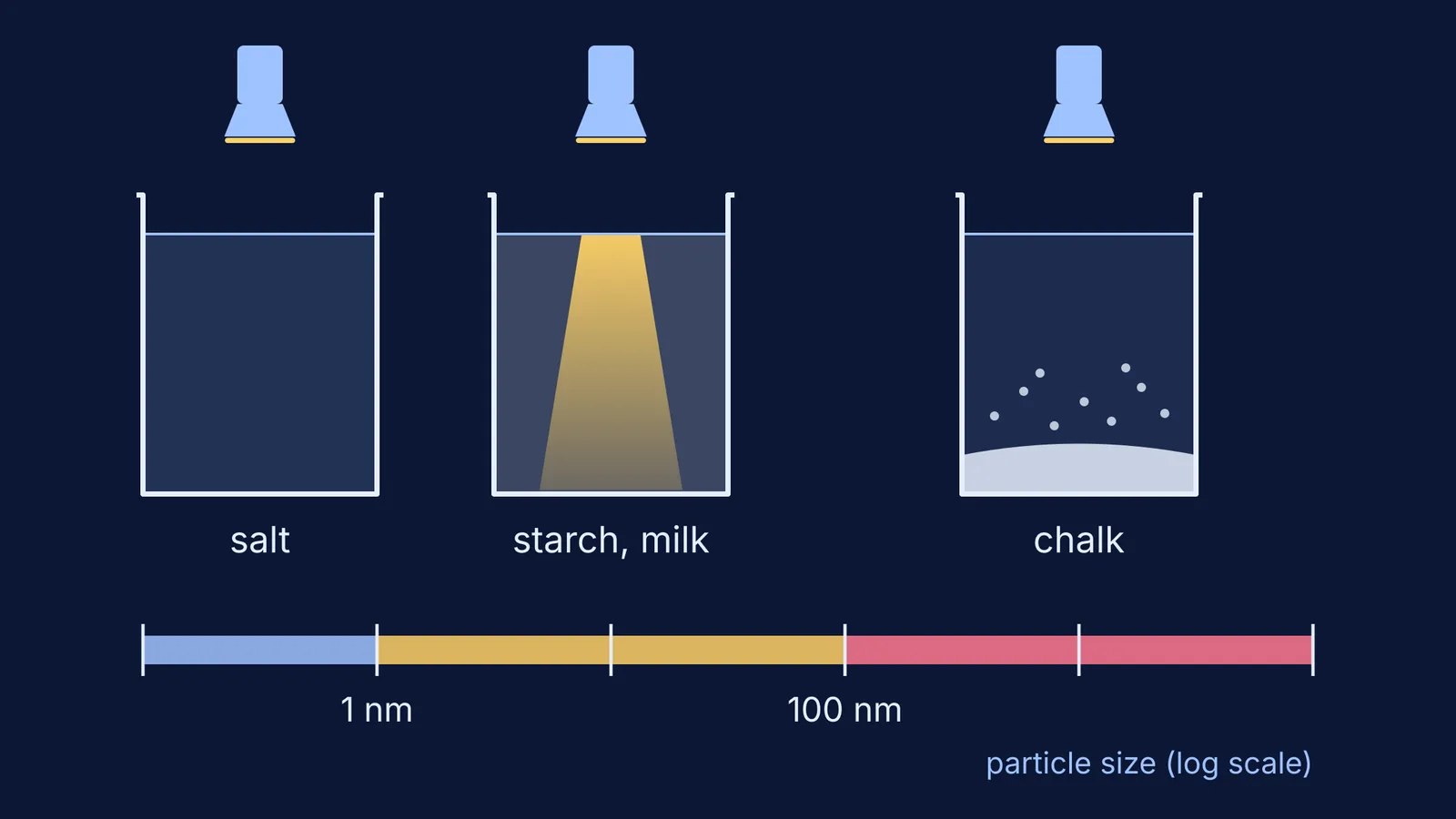
The difference is particle size. In the NIOS Senior Secondary Chemistry lesson on colloids, a true solution has particles smaller than 1 nm, a colloidal solution has particles between 1 and 100 nm, and a suspension has particles larger than 100 nm. Everything else follows from that.
True solution (salt or sugar in water): particles are invisible even under a microscope, pass through filter paper and do not settle on keeping.
Colloid (starch in water, milk): particles pass through filter paper and do not settle on their own, but they are big enough to scatter light.
Suspension (chalk or soil in water): particles are visible to the naked eye, stay behind on filter paper and settle under gravity.
In exams, use the boundaries given in your own textbook. For the many kinds of colloid beyond starch and milk, see our guide to types of colloids: aerosol, emulsion, foam and gel.
How does the Tyndall beam test work?
Darken the room and shine a torch into each beaker. In a colloid, the path of the beam shows up as a glowing band. The Tyndall effect is the lighting-up of a strong beam's path through a colloidal solution, caused by colloidal particles scattering the light, as the NIOS lesson on colloids describes.
OpenStax Chemistry 2e explains that colloidal particles are large enough to scatter light, and gives searchlight beams in fog as an everyday example. In a true solution the particles are far too small, so the beam passes through unseen. The effect is named after John Tyndall, whose other work we covered in John Tyndall and how gases absorb heat.
Stirred chalk is too cloudy for the beam test to say much; the next two tests decide it.
What happens when you filter each mixture or leave it to stand?
Filtration picks out the suspension. The NIOS comparison table records that particles of a true solution and of a colloid both pass through ordinary filter paper, while suspension particles do not. Chalk leaves a white residue; salt and starch do not.
Settling is the stability test. The same table says suspension particles settle on their own under gravity, colloid particles do not settle on their own (they can be made to settle by centrifugation), and solution particles do not settle on keeping.
How do you do the Class 9 practical with salt, starch, milk and chalk?
The CBSE Secondary Science curriculum for 2025-26 lists this as the first Class 9 practical: prepare a true solution of common salt, sugar and alum; a suspension of soil, chalk powder and fine sand in water; and a colloidal solution of starch in water and egg albumin or milk in water, then distinguish them by transparency, filtration and stability. The same document gives practical work 5 marks of internal assessment, with a written record.
A plan that fits one lab period:
Half-fill four beakers, A to D, with water.
A: stir in a spoon of salt. B: mix starch into a little cold water, then stir it into hot water (NIOS prepares starch sols in hot water); let your teacher handle the hot water. C: add a few drops of milk. D: stir in a spoon of chalk powder.
Transparency: hold each against the light; note clear, translucent or opaque.
Beam test: shine a torch through each in a dark corner.
Filtration: filter some of each; note any residue.
Stability: leave the rest untouched and check for a bottom layer at the end of the period.
What your record should show:
A, salt: clear; no beam path; no residue; nothing settles. True solution.
B, starch: translucent; beam path visible; no residue; nothing settles. Colloid.
C, milk: cloudy white; beam path visible; no residue; nothing settles. Colloid.
D, chalk: cloudy, then clearer from the top; residue on the filter paper; a white layer at the bottom. Suspension.
What mistakes cost marks in this practical?
Using neat milk. It can be too opaque to see a beam inside it; a few drops in a beaker of water work better.
Skipping the hot water for starch. NIOS prepares starch sols by dissolving starch in hot water, so follow the method above.
Calling a colloid a solution because it passed the filter. The beam test is what separates those two.
Writing "chalk dissolves". It is suspended, which is why it settles.
If an idea still feels shaky, the Fermi Concept Library gives every concept in chemistry its own lesson. For "classify these mixtures" questions, the Fermi Problem Library has worked problems with a step-by-step solver that explains the reasoning rather than printing an answer.
For a wider look at what counts as a solution, read our guide to nine types of solutions with solid, liquid and gas examples.


