

On this page
Class 10 trigonometry gives you a table of values that many students learn as columns of surds. It is easier to remember once you see why it has to look that way.
What happens to sin and cos from 0° to 90°?
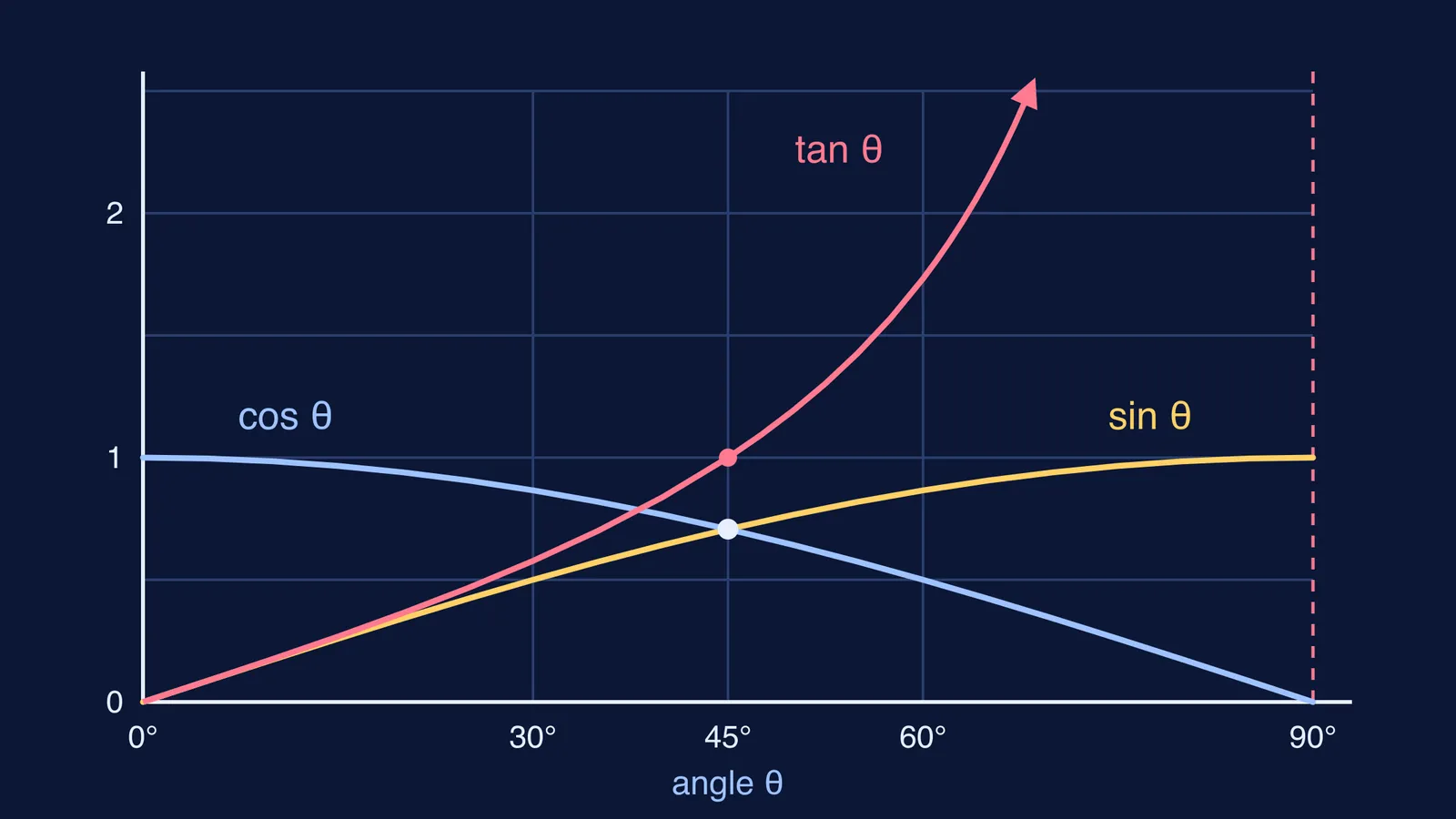
The NCERT Class 10 Mathematics chapter Introduction to Trigonometry lists the standard values in its Table 8.1. It then remarks that as angle A increases from 0° to 90°, sin A increases from 0 to 1 and cos A decreases from 1 to 0. The values:
0°: sin = 0, cos = 1, tan = 0
30°: sin = 1/2, cos = √3/2, tan = 1/√3
45°: sin = 1/√2, cos = 1/√2, tan = 1
60°: sin = √3/2, cos = 1/2, tan = √3
90°: sin = 1, cos = 0, tan not defined
Read the cos values from 90° back to 0° and you get the sin values.
Why does sin increase and cos decrease?
Fix the hypotenuse at length 1 and swing it up from the horizontal. That traces out the unit circle. OpenStax Precalculus defines cos t as the x-coordinate and sin t as the y-coordinate of a point on a circle of radius 1.
Now you can see the change. As the arm rises, its tip climbs higher (sin grows) and moves closer to the vertical axis (cos shrinks). At 0° the arm lies flat, with height 0 and base 1. At 90° it stands straight up, with height 1 and base 0.
Two more facts hold the pattern in place:
The same OpenStax page gives the identity cos²t + sin²t = 1, so when one of them rises, the other must fall.
In a right triangle the other acute angle is 90° − A, and its opposite side is the side adjacent to A. So cos A = sin(90° − A), which is why the cos row is the sin row reversed.
The change is not steady, though. Sin climbs by 0.5 in the first 30° but only by about 0.134 (from √3/2, about 0.866, up to 1) in the last 30°. The curve flattens as it nears the top. To watch this happen, see our post on how the unit circle unrolls into the sine graph.
Why does tan grow without bound near 90°?
Tan is the ratio of the two: tan A = sin A / cos A, as the NCERT chapter shows. Near 90°, the top of that fraction is almost 1 and the bottom is almost 0. A calculator shows how fast this happens:
tan 45° = 1
tan 60° ≈ 1.73
tan 80° ≈ 5.67
tan 89° ≈ 57.29
tan 89.9° ≈ 572.96
Going from 89° to 89.9° makes tan about ten times bigger, and there is no ceiling. At exactly 90°, cos is 0. OpenStax defines tan t = y/x only when x ≠ 0, so tan 90° has no value at all. We explain this in more detail in why tan 90° is undefined.
How can you use this in an exam?
The pattern lets you compare values without a table. Here is a worked example: which is bigger, sin 50° or cos 50°?
Rewrite cos 50° as sin 40°, using cos A = sin(90° − A).
Sin increases from 0° to 90°, and 50° is more than 40°, so sin 50° is more than sin 40°.
So sin 50° is bigger, which matches the 45° rule below.
A five-point check to run before a test:
Between 45° and 90°, sin is bigger than cos and tan is more than 1. Between 0° and 45°, cos is bigger than sin and tan is less than 1. At 45°, they are equal and tan is 1.
A bigger acute angle always has a bigger sin, a bigger tan and a smaller cos.
Sin and cos of an acute angle can never be more than 1, because the hypotenuse is the longest side. The NCERT chapter points this out too.
Tan can be any positive number. NCERT Exercise 8.1 asks whether the value of tan A is always less than 1. Since tan 60° = √3, the answer is false.
tan 90°, sec 90°, cot 0° and cosec 0° are not defined. Each one has a zero in the denominator.
For a harder version of point 1, try comparing sin 1 and cos 1 in radians.
If a row still feels like a list of surds, try the Fermi Concept Library. It covers every concept in mathematics, each with its own lesson and its place in the map. For practice, the Fermi Problem Library has worked problems with a step-by-step solver that explains the reasoning rather than printing an answer.


