

On this page
Which is larger, sin 1 or cos 1? It is a classic trigonometry question, and it often appears as a multiple-choice item in exam practice. You can work out the answer with a calculator, but you don't need one. Once you know roughly where the angle 1 sits on the unit circle, the comparison takes about one line.
What is 1 radian in degrees?
One radian is the angle at the centre of a circle made by an arc as long as the radius (Wikipedia: Radian).
One radian equals 180°/π, which is about 57.3° (Wikipedia: Radian).
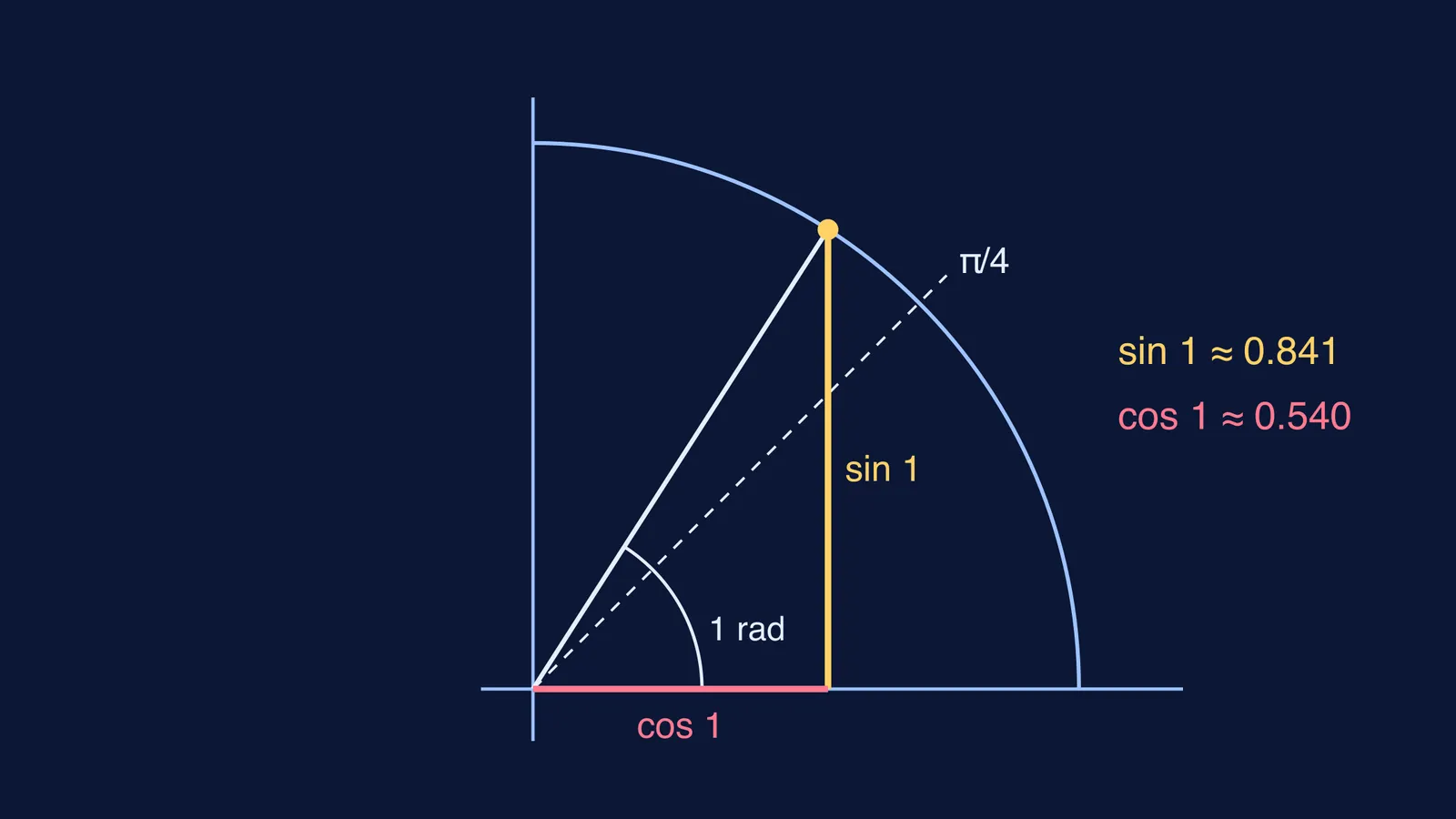
When no degree sign is written, as in "sin 1", the angle is in radians. Here are the landmarks that matter. π/4 is about 0.785 and π/2 is about 1.571. So 1 is bigger than π/4 but smaller than π/2, which puts it in the first quadrant, past the 45° line. If radians still feel slippery, read our walk-through on converting degrees to radians, arc length and sector area.
Why is sin 1 bigger than cos 1?
On the unit circle, a point at angle θ has coordinates (cos θ, sin θ): cosine is the x-coordinate and sine is the y-coordinate (Wikipedia: Sine and cosine).
At 45° the point sits on the line y = x, so sine and cosine are equal. Turn further anticlockwise and the point rises above that line, so its height (sine) is greater than its horizontal distance (cosine). An angle of 1 radian is about 57°, so it lies above the line, and sin 1 > cos 1. The diagram at the top shows this: the yellow vertical segment is taller than the pink horizontal one.
You can also argue it from how the functions behave. Between 0 and π/2, sine increases and cosine decreases (Wikipedia: Sine and cosine). The cofunction identity cos θ = sin(π/2 − θ) from the same source gives cos 1 = sin(π/2 − 1), which is about sin 0.571. Since sine increases on this stretch and 0.571 < 1, sin 0.571 < sin 1. That means cos 1 < sin 1.
The decimals agree. sin 1 = 0.8414709848… (OEIS A049469) and cos 1 = 0.5403023058… (OEIS A049470).
That trap has its own post: which is greater, sin 1 or sin 1 degree.
How do you compare trig values without a calculator?
Use the same idea for any pair: find the angle first, then compare.
Read the units. No degree sign means radians.
Place the angle between landmarks: π/6 ≈ 0.52, π/4 ≈ 0.785, π/3 ≈ 1.05, π/2 ≈ 1.571, π ≈ 3.14.
Name the quadrant and write down the sign of each function there.
If one value is positive and the other negative, you are done.
If both are in the first quadrant, compare the angle with π/4. Above it, sine wins. Below it, cosine wins.
Otherwise, rewrite both in terms of a reference angle in the first quadrant, then compare.
Here are four worked comparisons.
sin 2 or cos 2? 2 lies between π/2 and π, the second quadrant. Sine is positive there and cosine is negative, so sin 2 > cos 2.
sin 1 or sin 3? sin 3 = sin(π − 3), which is about sin 0.14, a small angle near the start of the curve. Since 0.14 < 1 and sine increases up to π/2, sin 1 > sin 3.
cos 1 or cos 2? cos 1 is positive (first quadrant) and cos 2 is negative (second quadrant), so cos 1 > cos 2.
Is tan 1 more than 1? tan 1 = sin 1 / cos 1, and the numerator is bigger than the denominator, so tan 1 > 1.
Where do students usually slip?
Reading "sin 1" as sin 1°, which reverses the answer.
Assuming cosine is always bigger "because sine starts at 0". That holds only below 45°.
Comparing sizes in the second, third or fourth quadrant without checking signs first.
Remembering π/4 as 0.75. It is about 0.785, and in close cases that gap matters.
If the unit circle itself still feels shaky, the Fermi Concept Library covers every concept in mathematics, each with its own lesson. When you get a comparison wrong, try worked problems in the Fermi Problem Library. Its step-by-step solver explains the reasoning rather than printing an answer, so you can see which step went wrong.
For another result you can see on the unit circle, try what happens when you press cos again and again.


