On this page
Pick any number. Put your calculator in radian mode, type the number in and press cos. Then press cos again on the answer, and again. Before you read on, make a guess: will the numbers grow, jump around forever, or stop somewhere?
Whatever you start with, the display settles on 0.739085 and stops changing. Wolfram MathWorld defines this value as the unique real root of cos x = x and calls it the Dottie number.
What happens when you press cos repeatedly on a calculator?
Start at x = 1 radian. The first ten presses give:
0.540302
0.857553
0.654290
0.793480
0.701369
0.763960
0.722102
0.750418
0.731404
0.744237
Notice two things. The answers take turns being above and below 0.739, and the gap gets smaller every time. Keep pressing and the first six decimals freeze at 0.739085. The longer expansion, 0.7390851332..., is listed in OEIS sequence A003957.
MathWorld traces the name to a 2007 note by Samuel R. Kaplan in Mathematics Magazine: Dottie was a professor of French who noticed that whatever number she typed in, pressing cos repeatedly in radian mode always ended at the same value.
Why does cos x converge to 0.739?
A fixed point of a function is an input the function leaves unchanged, so that f(x) = x. Feeding each answer back in, x(n+1) = cos x(n), is called fixed-point iteration (Wikipedia: fixed-point iteration). If the sequence settles at all, it must settle where cos x = x, because there one more press changes nothing.
Settling is not automatic. The same article gives the test: a fixed point pulls nearby numbers in when the slope of the function there is less than 1 in size, |f'(x)| < 1.
Check it for cos. The slope of cos x is -sin x, and sin(0.739085) is about 0.674. So near the fixed point, each press multiplies your error by roughly -0.674:
The size of the error shrinks to about two-thirds, so you close in.
The minus sign puts you on the other side each time, which is why the answers alternate high, low, high, low.
Check this against the list. After press 9 you are 0.0077 below 0.739085; after press 10 you are 0.0052 above. And 0.0052 divided by 0.0077 is about 0.67.
Why does every starting number work? After one press, any real number lands between -1 and 1. After a second press it lands between cos 1 (about 0.54) and 1. On that interval the slope is never bigger than sin 1, about 0.84, so cos is a contraction there, and the Banach fixed-point theorem (in the same Wikipedia article) says the iteration converges to the one fixed point from any start.
How do you draw a cobweb plot for cos x?
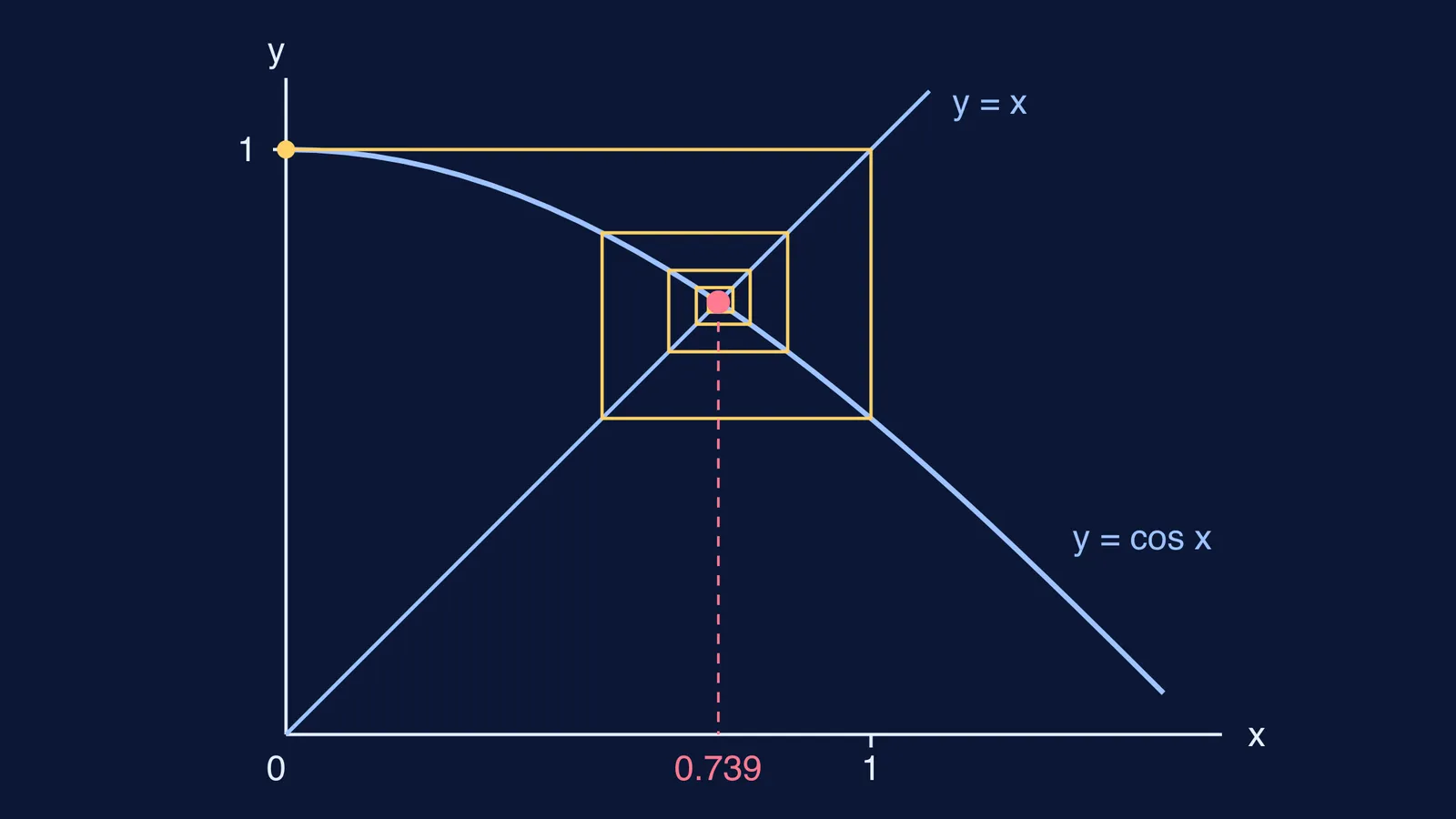
A cobweb plot is a picture of an iteration, drawn on top of the graph of y = f(x) and the line y = x (Wikipedia: cobweb plot). For cos x:
Draw y = cos x and y = x on the same axes, with x from 0 to 1.5.
Mark your starting value on the curve. From x = 0 that is the point (0, 1).
Move horizontally to the line y = x.
Move vertically back to the curve. That height is the next press of cos.
Repeat steps 3 and 4.
For cos x the path is a square spiral that winds in on the point where the curve meets the line. The cobweb article explains the rule: an inward spiral or a staircase with shrinking steps means a stable fixed point; an outward spiral or growing steps means an unstable one. The spiral comes from the negative slope: every step overshoots to the other side.
Why does degree mode give a different number?
In degree mode the calculator works out the cosine of x degrees, a different function. A few degrees is a tiny angle, so its cosine is very close to 1, and the sequence settles just below 1, at about 0.99985. MathWorld is specific that the Dottie number appears in radian mode.
Try it: a ten-minute exploration
In radian mode, start at 0. Write a prediction, then press cos ten times and note each value.
Start at 100. After two presses you are already between 0.54 and 1.
On graph paper, draw the cobweb for your first five values and check that it spirals in.
Press the square-root key repeatedly from any positive number. It settles on 1, and because the slope there is positive (one half), the cobweb is a staircase, not a spiral.
For ideas that are easier to see than to read, the Fermi Simulation Lab has interactive simulations. If slopes and derivatives still feel shaky, the Fermi Concept Library gives each concept in mathematics its own lesson.
Next time you have a calculator in your hand, start from your roll number and count how many presses it takes to reach 0.739085.