

On this page
Punch "tan 90" into any scientific calculator, and it will return an error. It is one of the first times mathematics students encounter a function that simply refuses to output a number.
This mathematical wall is not a calculator glitch. It stems directly from how we define the trigonometric functions and what happens when we try to divide a number by zero.
What does tangent mean in trigonometry?
In a right-angled triangle, the tangent of an angle is the ratio of the opposite side to the adjacent side. However, a more universal definition allows us to map trigonometric functions to any angle.
The tangent of an angle is defined as the ratio of its sine to its cosine 1. We write this relationship as: tan θ = sin θ / cos θ
This formula is the engine behind the calculation. If you know the sine and cosine of an angle, you can always find its tangent.
Why is tan 90 degrees undefined?
The breakdown at 90 degrees happens entirely in the denominator of that ratio.
The sine of 90 degrees is 1, and the cosine of 90 degrees is exactly 0 1.
If we substitute these exact values into our formula, we get: tan 90° = 1 / 0
In mathematics, dividing any non-zero number by zero is an undefined operation. There is no number that you can multiply by zero to get 1. Because the arithmetic cannot be resolved, tan 90° simply does not exist.
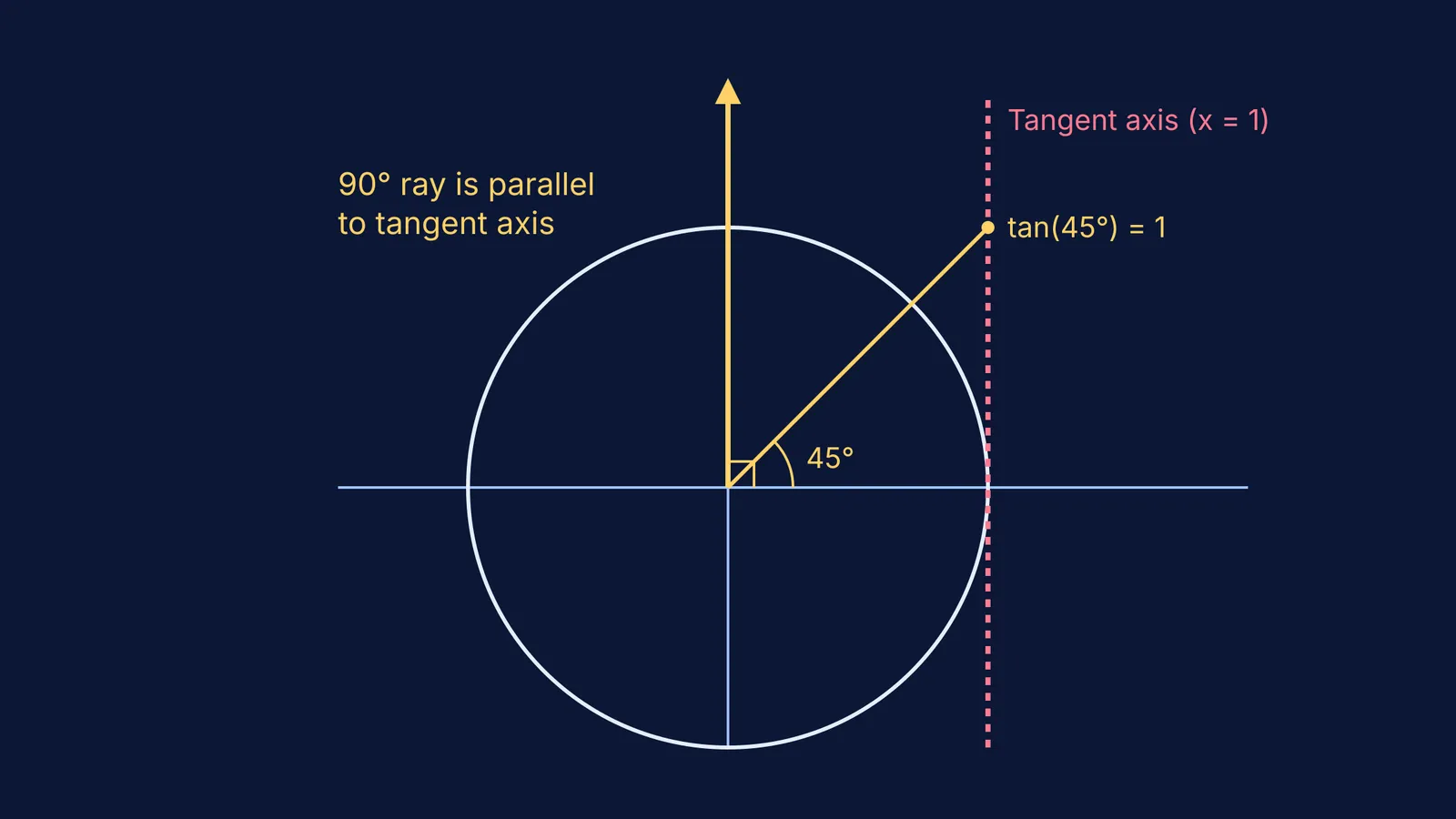
We can also see this geometrically on a unit circle. In the unit circle model, the tangent of an angle is the length of the y-coordinate where the angle's extended ray intersects a vertical line drawn at x = 1. When the angle is small, the ray hits the vertical line quickly. As the angle grows steeper, the intersection point moves higher, driving the tangent value up. When the angle reaches exactly 90 degrees, the ray points straight up. It runs parallel to the vertical tangent line and never crosses it 1. Because there is no intersection, there is no geometric tangent value.
Is tan 90 degrees infinity or undefined?
When you plot the graph of y = tan x on a coordinate plane, the curve shoots upwards as it nears 90° (or π/2 radians). For example, tan 89.9° is roughly 573, and it grows infinitely larger the closer you push toward 90.
However, we cannot technically say tan 90° is "infinity". If you approach 90° from the other direction, such as 90.1°, the tangent value plunges downwards to negative infinity. Because the function tears off in opposite directions and never converges on a single point, mathematicians classify the exact value at 90° as undefined, marking it with a vertical asymptote. This means the graph splits and never actually touches the 90° line.
If trig graphs feel hard to picture, Fermi's AI tutor teaches rather than answers: it holds a line of reasoning across a session, notices where a student is stuck, and decides whether to explain, ask, or show. You can also trace how sine, cosine and tangent connect in the Fermi Concept Library, where every concept in mathematics has its own lesson and its place in the map.
What about sec 90° and cot 0°?
Tangent is not the only trigonometric function with asymptotes. Any function that places a zero in the denominator will be undefined at that angle.
The secant function is defined as 1 / cos θ 1. Because the cosine of 90° is zero, sec 90° requires calculating 1 / 0, making it undefined for the exact same reason.
Similarly, the cotangent function is the ratio of cosine to sine. At 0°, the sine is zero. Therefore, cot 0° results in 1 / 0, which is also undefined.
How do you find undefined points of trig functions?
When you encounter complex mathematical functions, you can find their undefined points without memorising entirely new graphs. Here is a framework to test any trigonometric expression:
Rewrite the function entirely in terms of sine and cosine.
Identify the denominator of the resulting fraction.
Find the angles that make the denominator equal to zero.
Problem: Find where the cosecant function, csc θ, is undefined.
Step 1: Rewrite the function. csc θ = 1 / sin θ
Step 2: Identify the denominator. The denominator is sin θ.
Step 3: Set the denominator to zero. We need to find angles where sin θ = 0. The sine function is zero at 0°, 180°, 360°, and so on. Therefore, csc 0° and csc 180° are undefined.
Once you understand the basic asymptotes, you can tackle more complex visualisations, like [sin⁻¹(sin x) beyond [−π/2, π/2]: drawing the sawtooth graph](https://news.fermi.ai/academic-success/sin-inverse-sin-x-beyond-range). And while 90° yields no tangent, other angles give precise, predictable algebraic numbers. For example, you can calculate the exact values of sin 18° and cos 36°, derived step by step without relying on a calculator.


