

On this page
Most students can draw y = sin x. Things go wrong once numbers appear around it: y = 3 sin(2x − π/2) + 1 looks like four separate problems. It is really one wave that has been stretched, squeezed, slid and lifted, and each number does exactly one of those jobs.
What do a, b, c and d do in y = a sin(bx + c) + d?
The definitions below follow OpenStax Precalculus, section 6.1, a free textbook. It writes the form as A sin(Bx − C) + D, so its C has the opposite sign to the c used here.
a, the amplitude: the amplitude is |a|, the vertical height of the wave above its midline. If a is negative, the wave is also flipped upside down.
b, the period: the period of y = a sin(bx + c) + d is 2π/|b|. A b bigger than 1 squeezes the wave sideways; a b between 0 and 1 stretches it.
c, the phase shift: the graph moves sideways by −c/b. With b positive, a plus sign inside the bracket moves it left and a minus sign moves it right.
d, the vertical shift: the midline is y = d, the line the wave goes up and down around.
If your textbook writes y = a sin bx + c, with no bracket, that c sits outside the sine and plays the role of d: it lifts the graph by c.
How do you sketch the graph from five key points?
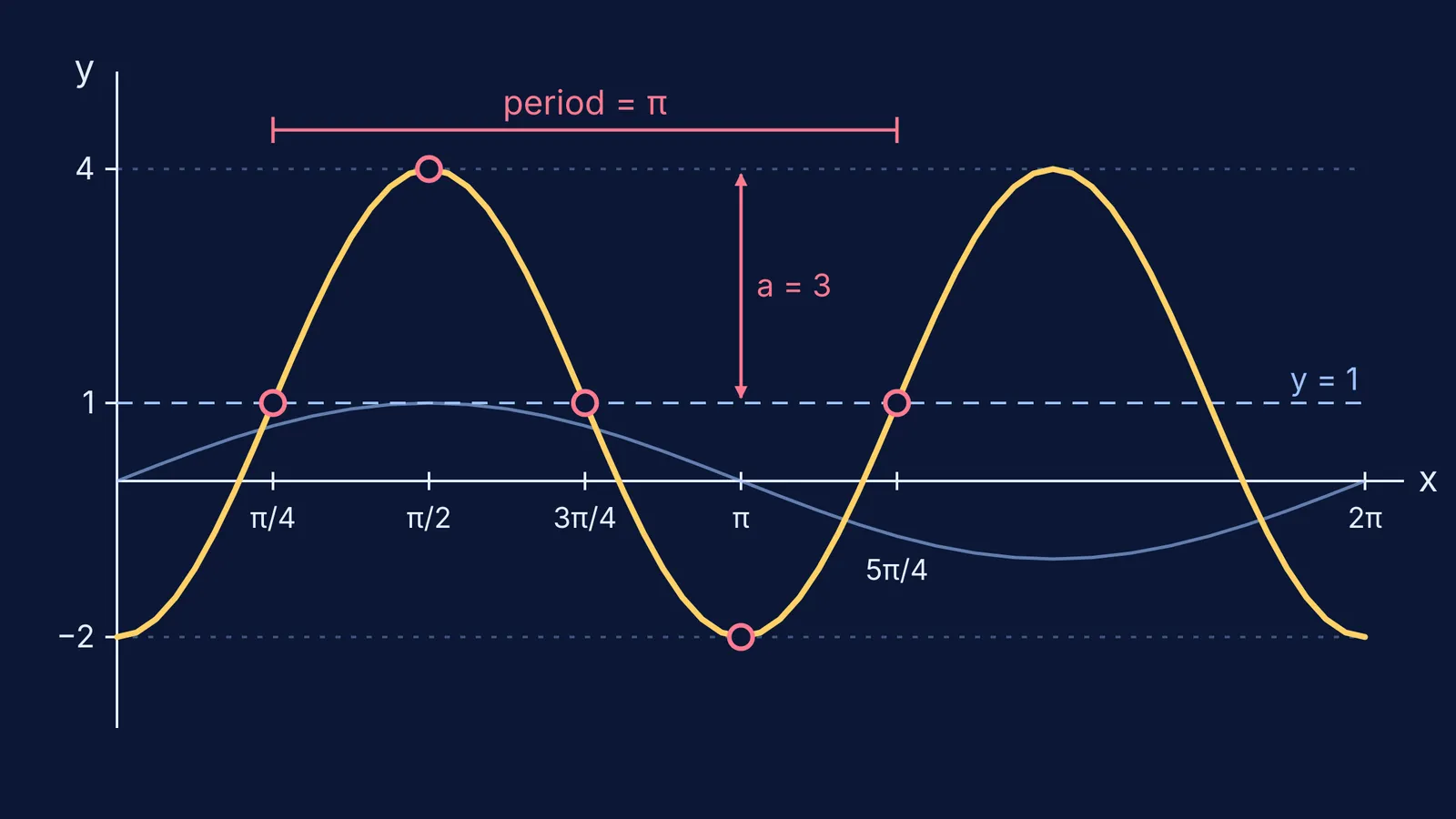
One period of sin x has five key points: midline, top, midline, bottom, midline. Every transformed sine wave has the same five, only moved. Try it on y = 3 sin(2x − π/2) + 1.
Read the numbers. Amplitude 3, midline y = 1, so the wave runs from 1 − 3 = −2 up to 1 + 3 = 4.
Find the period: 2π/2 = π.
Find the start. Set the inside of the bracket to zero: 2x − π/2 = 0 gives x = π/4. This is where one cycle begins.
Find the end: start plus period, π/4 + π = 5π/4.
Cut the period into four equal steps of π/4, giving x = π/4, π/2, 3π/4, π and 5π/4.
Assign heights in the order midline, maximum, midline, minimum, midline. If a is negative, swap to midline, minimum, midline, maximum, midline.
For our example the five key points are (π/4, 1), (π/2, 4), (3π/4, 1), (π, −2) and (5π/4, 1). Draw the dashed midline and guide lines at y = 4 and y = −2, plot the points, and join them with a smooth curve, rounded at the top and bottom, never pointed. Repeat the shape left and right as needed. To check, substitute x = π/2: sin(π − π/2) = 1, so y = 4.
If sliding and stretching still feel like magic, our post on why f(x + 2) shifts the graph left shows the same rules on simpler graphs, and watching the unit circle unroll into the sine graph shows where the shape of the sine wave comes from.
How do you find the equation from a graph?
Work through the same four numbers in reverse. Suppose a sine graph has a highest value of 5, a lowest value of −1, peaks at x = 2 and x = 6, and crosses its midline going upwards at x = 1.
Midline: d = (max + min)/2 = (5 + (−1))/2 = 2.
Amplitude: a = (max − min)/2 = (5 − (−1))/2 = 3. OpenStax gives the same rule: amplitude is half the distance between the maximum and minimum.
Period: peak to peak is 6 − 2 = 4, so b = 2π/4 = π/2.
Shift: a plain sine wave starts on its midline going up. Ours does that at x = 1, so the graph has moved 1 to the right.
Put together: y = 3 sin((π/2)(x − 1)) + 2. Test it at x = 2: the bracket becomes π/2, sin is 1, and y = 5, the peak. Other equations can be equally correct, such as a cosine read from a peak.
What mistakes should you avoid when sketching sine graphs?
Taking c, not c/b, as the shift.
Writing the period as 2π × b instead of 2π/b.
Using the peak height as the amplitude when the midline is not zero (a peak at 5 with midline 2 means amplitude 3).
Forgetting that a negative a starts the wave going down.
Mixing degrees and radians on the x-axis. Our explainer on why calculus uses radians covers why radians are the natural unit.
If one of these keeps happening, the Fermi Problem Library has worked problems with a step-by-step solver that explains the reasoning rather than printing an answer, so you can see which step went wrong. To revise the idea itself, try the Fermi Concept Library.
For tonight, sketch y = 2 sin(x + π/3) − 1 using the six steps above, then check two of your points by substituting them.


