

On this page
A question like "evaluate (cos 45° + sin 60°) ÷ (sec 30° + cosec 45°)" looks like a memory test. Marks are often lost after the values are written down: a square lands on the wrong thing, a minus sign escapes a bracket, or a surd is left in the denominator.
CBSE's Class X Mathematics syllabus for 2026-27 lists "Values of the trigonometric ratios of 30°, 45° and 60°" and expects students to be "solving related expressions". The same document gives the Trigonometry unit 12 of the 80 theory marks, and limits angles of elevation and depression to 30°, 45° and 60°, so these values come back across the whole unit.
What are the exact values at 30°, 45° and 60°?
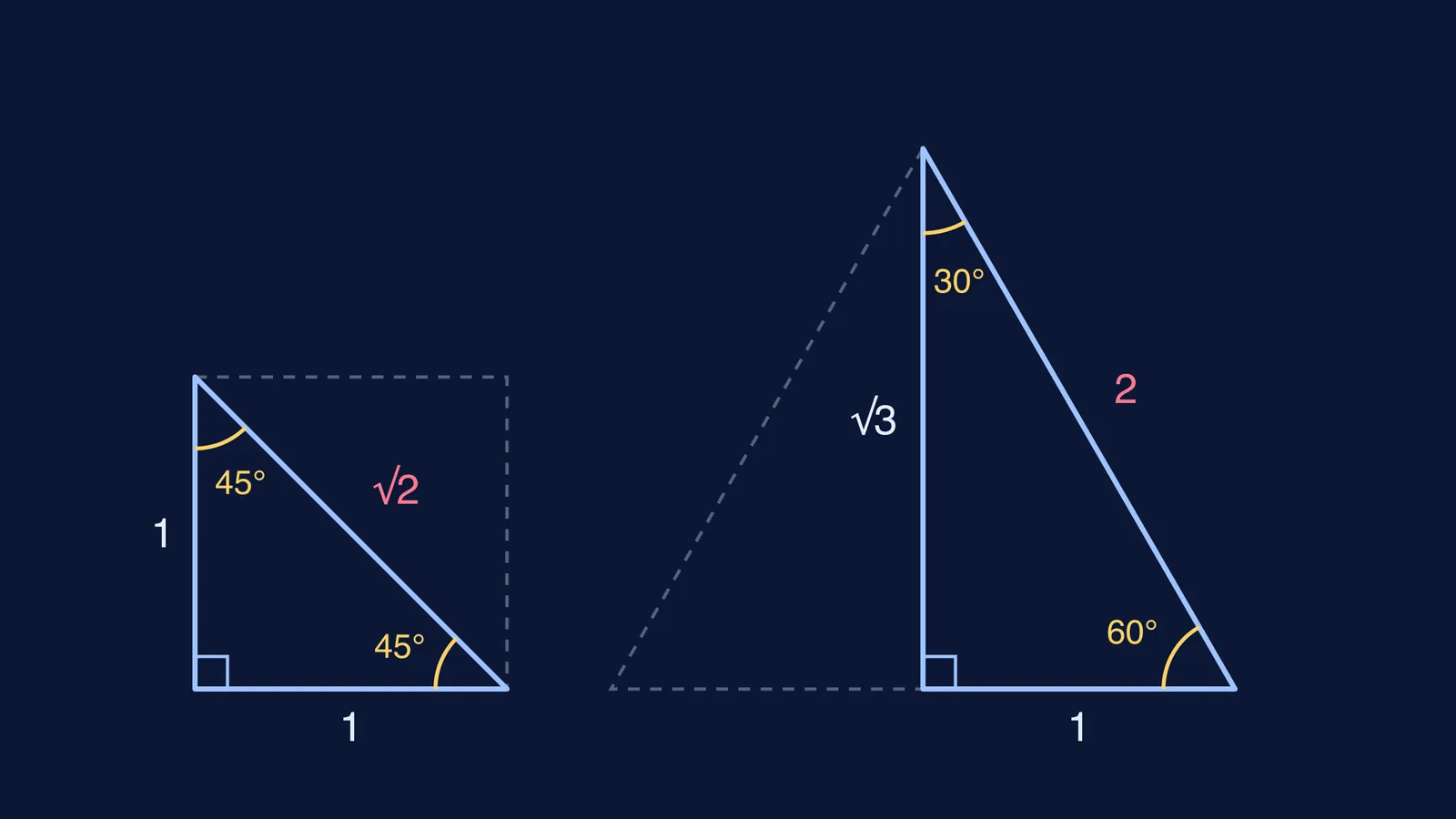
You can rebuild every value from two triangles. Cut a square of side 1 along its diagonal and you get a 45°-45°-90° triangle with sides 1, 1 and √2. Cut an equilateral triangle of side 2 in half and you get a 30°-60°-90° triangle with sides 1, √3 and 2. Then use opposite over hypotenuse for sine and adjacent over hypotenuse for cosine:
sin 30° = 1/2, cos 30° = √3/2, tan 30° = 1/√3 = √3/3
sin 45° = cos 45° = 1/√2 = √2/2, tan 45° = 1
sin 60° = √3/2, cos 60° = 1/2, tan 60° = √3
cosec 30° = 2, sec 30° = 2/√3, cot 30° = √3
cosec 45° = sec 45° = √2, cot 45° = 1
cosec 60° = 2/√3, sec 60° = 2, cot 60° = 1/√3
If the table itself is the problem, our guide on how to remember the trig table for 0°, 30°, 45°, 60° and 90° covers recall.
How do you evaluate a trig expression with 30°, 45° and 60°?
Write the values you need on one line at the top.
Replace every ratio with its value inside a bracket, so sin²60° becomes (√3/2)².
Change sec, cosec and cot into exact values straight away.
Simplify the numerator and the denominator separately until each is a single fraction.
Divide, cancel any common surd factor, then rationalise the denominator.
Worked example. Evaluate (cos 45° + sin 60°) ÷ (sec 30° + cosec 45°).
Numerator: (√2/2) + (√3/2) = (√2 + √3)/2. Writing 1/√2 as √2/2 at the start keeps both terms over the same denominator.
Denominator: (2/√3) + (√2). Rationalise the first term: 2/√3 = 2√3/3. So the denominator is (2√3 + 3√2)/3.
Now divide: (√2 + √3)/2 × 3/(2√3 + 3√2).
This step is easy to miss. Since √6 × √2 = √12 = 2√3 and √6 × √3 = √18 = 3√2, the denominator is 2√3 + 3√2 = √6(√2 + √3). The bracket (√2 + √3) cancels and you are left with 3/(2√6).
Rationalise: 3/(2√6) × √6/√6 = 3√6/12 = √6/4.
Which bracket mistakes should you watch for?
Squaring only the top. sin²60° = (√3/2)² = 3/4, not √3/4 or 3/2. The square applies to the whole value.
A minus sign outside a square. −sec²60° = −(2)² = −4. Writing +4 changes the answer completely. In 4 cot²45° − sec²60° + sin²60°, you get 4 − 4 + 3/4 = 3/4.
Squaring a sum term by term. (sin 45° + cos 30°)² is not 1/2 + 3/4. The middle term matters: (1/√2 + √3/2)² = 1/2 + √6/2 + 3/4 = (5 + 2√6)/4.
Treating 2 sin 30° as sin 60°. 2 sin 30° = 2 × 1/2 = 1, but sin 60° = √3/2. A number in front multiplies the value. It does not double the angle.
Our explainer on how to simplify surds using the laws of radicals covers √a × √b = √(ab) and when you can split a root. If a mistake keeps coming back and you cannot see which step causes it, the Fermi Problem Library has worked problems with a step-by-step solver that explains the reasoning rather than printing an answer.
How can you check the answer without a calculator?
Use three approximations: √2 ≈ 1.414, √3 ≈ 1.732 and √6 ≈ 2.449.
For the worked example, the numerator is about 0.707 + 0.866 = 1.573 and the denominator is about 1.155 + 1.414 = 2.569. Their ratio is about 0.612, and √6/4 ≈ 2.449/4 ≈ 0.612. They agree. A lost minus sign or a forgotten middle term would change the size of the answer, so this check catches many of the costly slips.
A second check uses structure. (tan 60° − tan 30°) ÷ (1 + tan 60° tan 30°) = (√3 − 1/√3) ÷ (1 + 1) = (2/√3) ÷ 2 = 1/√3. That is tan 30°, which is what the tan(A − B) formula from Class 11 predicts for 60° − 30°.
For identities, see our post on three methods for proving trig identities in Class 10. If the ratios themselves still feel shaky, the Fermi Concept Library gives every concept in mathematics its own lesson, so you can go back to the ratios themselves.


