

On this page
Tungsten melts at 3,695 K, while mercury is already liquid at 234 K, according to PubChem's periodic table data. Both are d-block metals. For Class 12 boards or JEE, you need to explain that gap in two lines, and it comes down to one idea: how many electrons each atom puts into the metallic bond.
Why do transition metals have high melting points?
A metal holds together because its atoms share a pool of delocalised electrons; the more each atom adds, the stronger the bonding. If that picture is hazy, see why metals bend while ionic crystals shatter. Sodium adds one electron per atom and melts at 370.95 K (PubChem).
Transition metals add more. The NCERT Class 12 chapter on the d- and f-block elements attributes their high melting points to "the involvement of greater number of electrons from (n-1)d in addition to the ns electrons in the interatomic metallic bonding". The same chapter states the rule plainly: "greater the number of valence electrons, stronger is the resultant bonding."
A good measure of that bond strength is the enthalpy of atomisation, the energy needed to turn the solid metal into separate gaseous atoms. In NCERT's Table 4.2, it is 515 kJ/mol for vanadium but only 126 kJ/mol for zinc (NCERT, Chapter 4).
Why do melting points peak in the middle of the series?
Along any row the d orbitals fill one electron at a time. By Hund's rule, the first five d electrons go in singly, so the number of unpaired d electrons rises to five at d5; after that, each new electron pairs up and the count falls to zero at d10. (For a refresher, see how to count unpaired electrons using Hund's rule.)
The NCERT chapter says melting points in each row "rise to a maximum at d5 except for anomalous values of Mn and Tc and fall regularly as the atomic number increases". It adds that the maxima near the middle of each series show that "one unpaired electron per d orbital is particularly favourable for strong interatomic interaction".
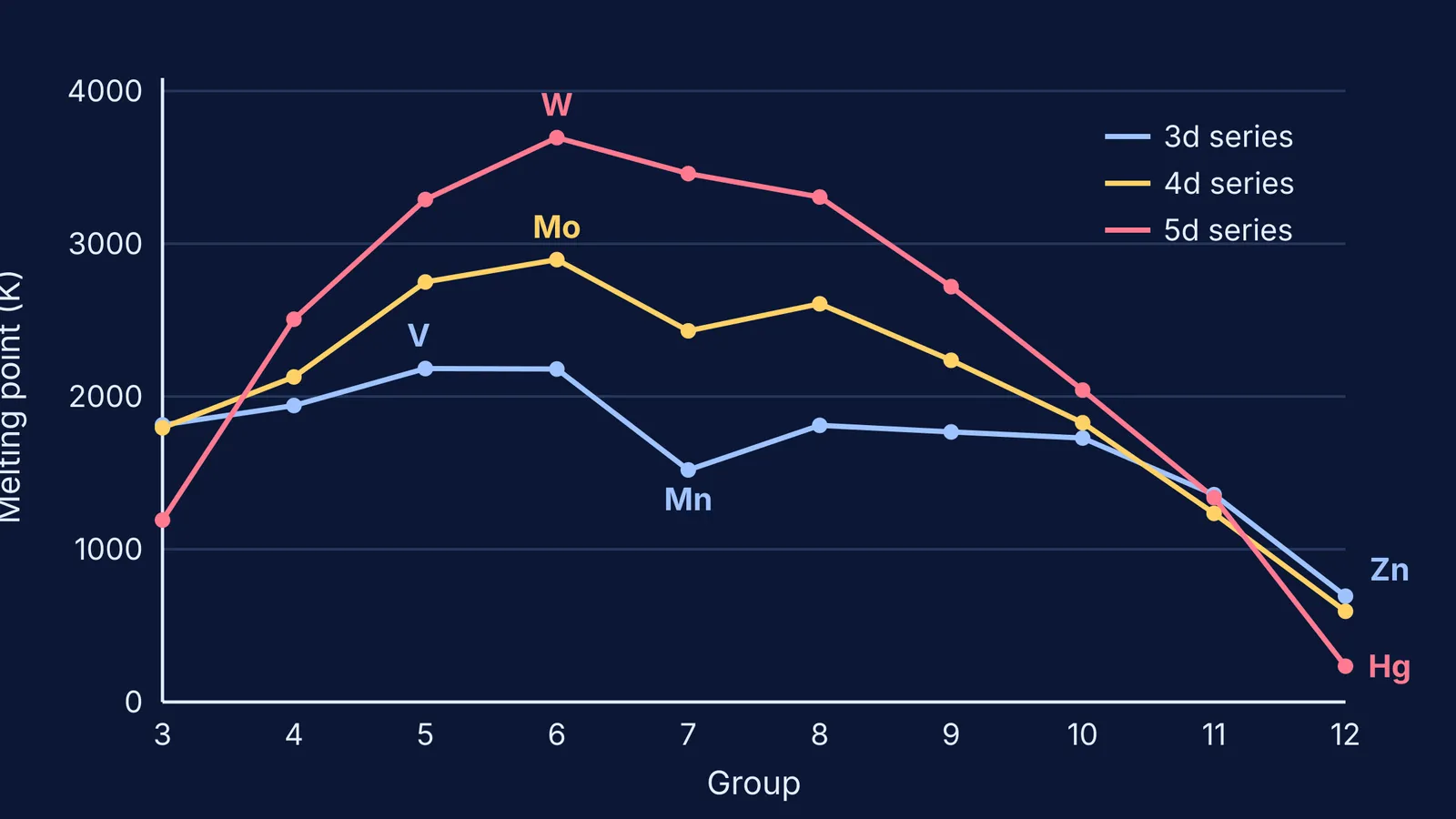
The chart at the top plots PubChem's melting points for all three rows. Molybdenum (2,896 K) and tungsten (3,695 K) peak in group 6; in the 3d row, vanadium (2,183 K) just edges chromium (2,180 K). Manganese drops to 1,519 K, the dip NCERT calls anomalous. The 4d and 5d rows also sit above the 3d row, which matches NCERT's note that the second and third series have greater enthalpies of atomisation than the first.
Why do zinc and mercury have such low melting points?
Zinc, cadmium and mercury end their rows with the configuration (n-1)d10 ns2. NCERT points out that their d orbitals are completely filled in the ground state and in their common oxidation states, so these three are not regarded as transition elements at all (NCERT, Chapter 4). With no unpaired d electrons to offer, the d shell stops adding to the metallic bond, and NCERT names Zn, Cd and Hg as the exceptions to the hard, high-melting pattern.
The numbers show it. Zinc melts at 692.68 K, cadmium at 594.22 K and mercury at 234.32 K (PubChem).
Mercury goes lowest of all, and part of the reason is relativity. In a 2013 Angewandte Chemie paper, Florent Calvo, Peter Schwerdtfeger and colleagues used simulations built on relativistic calculations and found that relativistic effects lower the melting point of bulk mercury by 105 K (abstract on PubMed). Without them, mercury would melt near 339 K, solid at room temperature.
How do you answer the "give reason" question?
Use three steps every time:
Write the configuration and count the unpaired (n-1)d electrons.
Link the count to the bond: more unpaired d electrons, more electrons in metallic bonding, stronger bonding, higher enthalpy of atomisation and melting point.
Check the exceptions: Mn and Tc are anomalous; Zn, Cd and Hg (d10) bond through their ns electrons only.
Worked example: arrange V, Mn and Zn in decreasing order of melting point.
V is 3d3 4s2: three unpaired d electrons, strong bonding.
Mn is 3d5 4s2: five unpaired d electrons, but step 3 flags it as anomalous, so it falls below V.
Zn is 3d10 4s2: no unpaired d electrons, weakest bonding.
Answer: V > Mn > Zn, which PubChem's values (2,183 K, 1,519 K and 692.68 K) bear out. Counting alone would have put Mn first.
A model answer: "In transition metals, (n-1)d electrons take part in metallic bonding along with ns electrons, so the bonding is strong and melting points are high. Zinc (3d10 4s2) has no unpaired d electrons, so its metallic bonding is weak and its melting point is low."
If the d-block still feels like a list of exceptions, the Fermi Concept Library gives every chemistry concept its own lesson and its place in the map, so you can see how metallic bonding and Hund's rule connect. For practice, the Fermi Problem Library has worked problems with a step-by-step solver that explains the reasoning rather than printing an answer.
Next, read why the ionisation enthalpy trend in the 3d series is irregular.


