

On this page
You can measure the period of a simple pendulum with just a stopwatch, a clamp stand and a metre scale. The trick isn't a better stopwatch. It's counting many swings and dividing, so the delay in your thumb matters far less.
How do you measure the time period of a pendulum with a stopwatch?
The time period T is the time for one complete oscillation: from one extreme to the other and back again. NCERT's Class 11 physics laboratory manual (Experiment 6) sets out the standard school-lab method. In plain steps:
With the bob hanging at rest, mark its resting (mean) position with a chalk line on the edge of the table, just behind the thread.
Pull the bob aside by no more than 15 degrees and let it go gently, so it swings in one plane without spinning or tracing an ellipse.
Let it swing a few times. Start the stopwatch as the thread crosses the mark moving left to right, and say "zero".
Count "one, two, three..." each time it crosses the mark in that same direction.
Stop at 20 (or 25). The manual says to choose the count so the total time is 50 s or more.
Repeat a few times, take the mean time t, and divide: T = t/n.
For small swings, the same manual gives the period as T = 2π√(L/g). Here L is the effective length, from the point of suspension to the centre of the bob, and g is the acceleration due to gravity.
Why time 20 oscillations instead of one?
Every hand-timed reading picks up a human error at the start and at the stop. NIST's guide to stopwatch and timer calibrations (Special Publication 960-12) says the uncertainty from an operator starting and stopping a watch is "typically tens or even hundreds of milliseconds". In a small NIST test where four people timed a stopwatch against an audio time signal, the worst-case standard deviation of their reaction time was 230 ms. So 0.2 s is a reasonable working figure for a hand-timed reading, even when the display shows hundredths of a second.
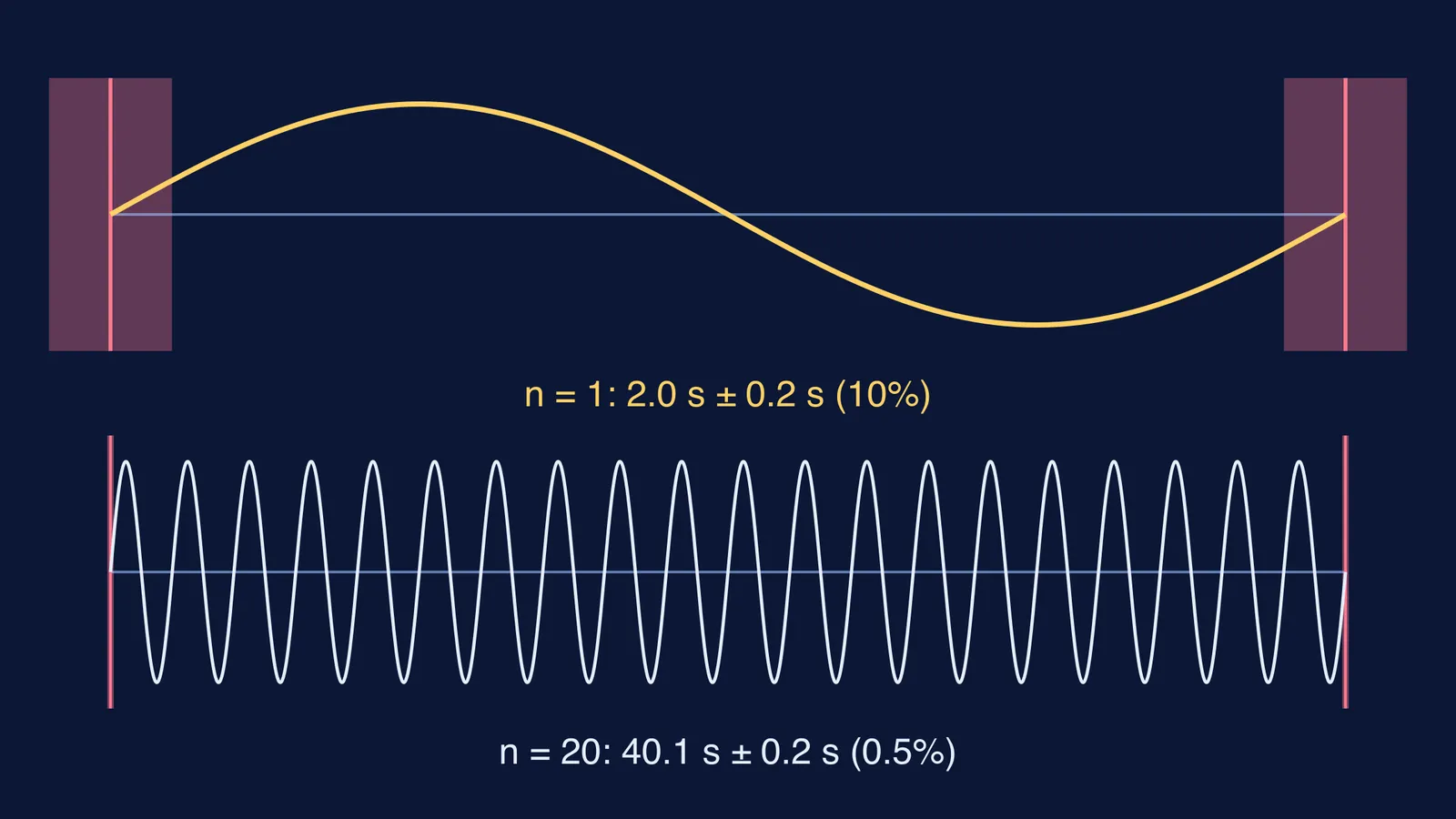
That error happens only at the start and the stop, so it's about the same for one swing or twenty. Here's what it does to a 1.00 m pendulum, where T = 2π√(1.00/9.8) ≈ 2.01 s:
One swing: 2.0 s ± 0.2 s, an error of about 10%.
Twenty swings: 40.1 s ± 0.2 s, an error of about 0.5%. Divide by 20 and T = 2.007 ± 0.010 s.
The same 0.2 s is now shared among 20 swings, so the error in T is twenty times smaller.
This matters even more when you go on to find g. Because g = 4π²L/T², the percentage error in g is the error in L plus twice the error in T. A 10% error in T becomes about 20% in g, while a 0.5% error becomes about 1%. Our guide to measuring g with the L–T² graph takes these readings the rest of the way.
What changes the time period of a pendulum?
According to the simple pendulum formula, the period depends on length and gravity. Mass doesn't appear in it at all.
Length: T grows with the square root of L. Make the string four times longer and the period doubles.
Gravity: a smaller g means a longer period, so the same pendulum would swing more slowly on the Moon.
Amplitude: the formula only holds for small swings. HyperPhysics notes that the simple formula is off by less than one percent for amplitudes under 22 degrees. Wider swings take longer, and NCERT's 15-degree limit keeps you inside that range.
Air: the NCERT manual notes that air drag and buoyancy slightly increase the period, an effect a small, heavy iron or brass bob greatly reduces.
Mass: the bob's mass is not in T = 2π√(L/g). See a fair test of whether a heavier bob swings faster.
The Fermi Simulation Lab has interactive simulations for the ideas that are easier to see than to read.
What should you check before writing your reading?
This bench checklist follows the NCERT Class 11 lab manual:
Effective length L = thread length + hook length + bob radius, in metres.
Time 20 to 25 swings, with a total of 50 s or more.
Repeat the timing a few times, then use the mean.
Write the least count of the stopwatch next to your readings.
For your practical file, see how to write precautions and sources of error.
When you reach numericals that combine the errors in L and T, the Fermi Problem Library has worked problems with a step-by-step solver that explains the reasoning rather than printing an answer.


