

On this page
You need one definition, one law and one habit. Below are worked numbers for a straight ray, a slanted ray and a stack of water and glass.
What is the formula for the time light takes through a glass slab?
The refractive index of a material is defined as n = c/v, where v is the speed of light in that material (OpenStax College Physics 2e). The speed of light in vacuum, c, is exactly 299,792,458 m/s, a defined constant of the SI (NIST CODATA).
Time is distance divided by speed. At normal incidence the light travels straight through a thickness d at speed c/n, so:
t = d ÷ (c/n) = nd/c
The same OpenStax table gives n = 1.52 for crown glass. Many textbook problems round glass to 1.5; use whatever value your question states.
Worked example. A crown glass slab is 2 cm thick.
Convert: d = 0.02 m.
t = 1.52 × 0.02 ÷ (2.998 × 10⁸) ≈ 1.01 × 10⁻¹⁰ s.
The same 2 cm of vacuum takes 0.02 ÷ (2.998 × 10⁸) ≈ 6.67 × 10⁻¹¹ s.
The delay caused by the glass is (n − 1)d/c ≈ 3.47 × 10⁻¹¹ s.
The product nd is the optical path length, which explains time delays like this one.
How long does light take through a slab at an angle?
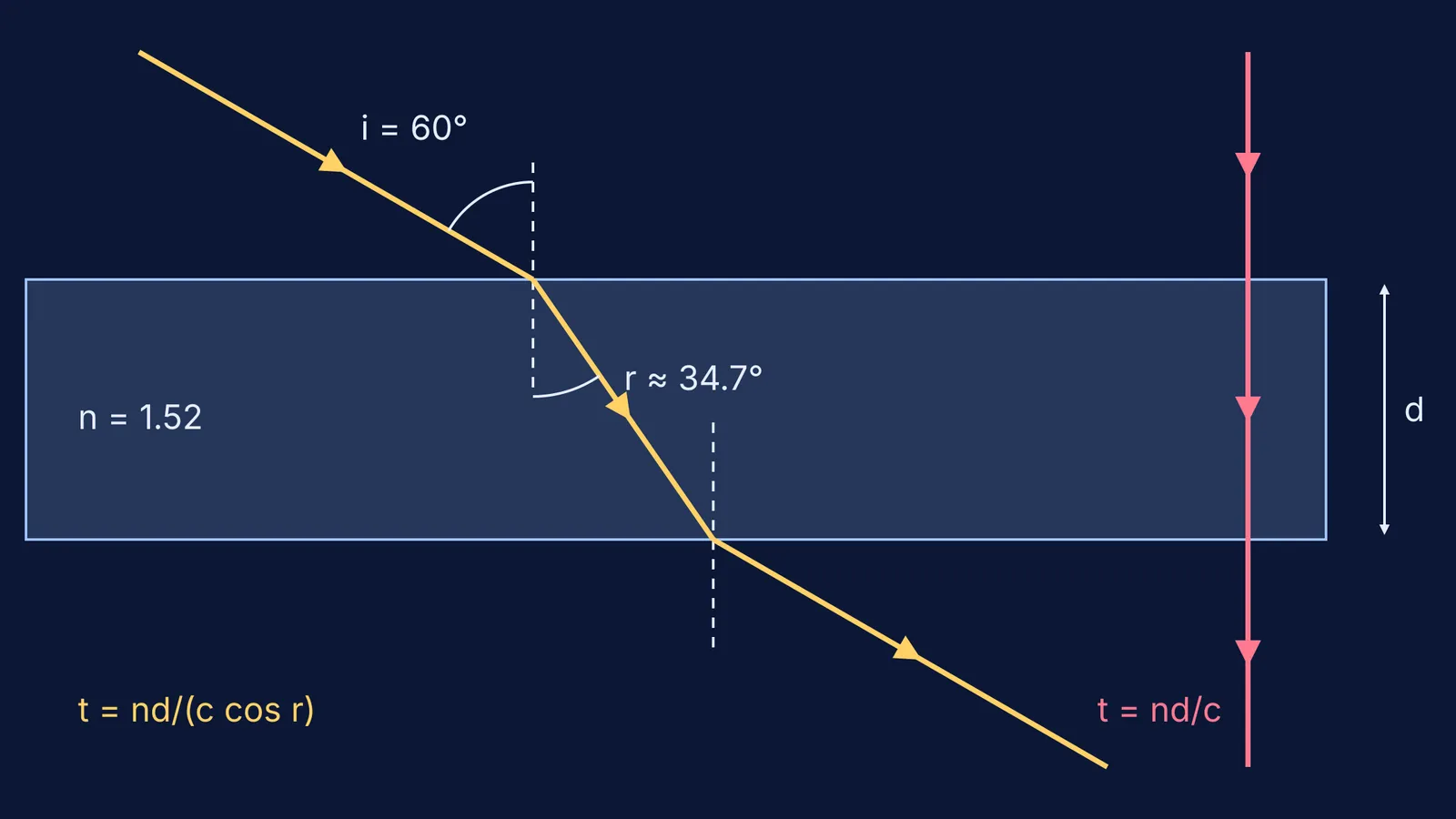
When the ray hits the slab at an angle of incidence i, it bends towards the normal. Snell's law, n₁ sin θ₁ = n₂ sin θ₂ (OpenStax), gives the angle of refraction r from air: sin r = sin i / n.
The ray now crosses the thickness d on a slant, so its path inside is d/cos r, not d. The time becomes:
t = nd / (c cos r)
Worked example. Same 2 cm crown glass slab, light arriving at i = 60°.
sin r = 0.866 ÷ 1.52 ≈ 0.570, so r ≈ 34.7°.
cos r ≈ 0.822, so the path inside is 2 ÷ 0.822 ≈ 2.43 cm.
t = 1.52 × 0.0243 ÷ (2.998 × 10⁸) ≈ 1.23 × 10⁻¹⁰ s.
That is about 22% longer than the straight-through time. The ray leaves parallel to its original direction, only shifted sideways. That is also why a slab, unlike a prism, does not fan white light out into colours (why a prism disperses light but a glass slab does not).
Does light take longer through water or glass?
For the same thickness, light takes longer in glass, because glass has the higher refractive index. OpenStax lists fresh water at n = 1.333 against 1.52 for crown glass (OpenStax table). But thickness matters just as much, because time depends on the product nd.
Stack at normal incidence: 3 cm of water resting on 2 cm of crown glass.
Water: 1.333 × 0.03 ÷ (2.998 × 10⁸) ≈ 1.33 × 10⁻¹⁰ s
Glass: ≈ 1.01 × 10⁻¹⁰ s (from above)
Total: ≈ 2.35 × 10⁻¹⁰ s
The water takes longer here, despite its lower n, because it is thicker. The two layers take equal time when n_w d_w = n_g d_g, which means the water must be 1.52 ÷ 1.333 ≈ 1.14 times as thick as the glass. So 2 cm of glass matches about 2.28 cm of water.
Same stack at 60°. Across parallel layers, n sin θ stays the same in every layer, so you can find each layer's angle straight from sin θ = sin i / n for that layer.
Water: sin θ = 0.866 ÷ 1.333 ≈ 0.650, so θ ≈ 40.5° and cos θ ≈ 0.760. Path ≈ 3.95 cm, time ≈ 1.75 × 10⁻¹⁰ s.
Glass: θ ≈ 34.7°, the same as before, time ≈ 1.23 × 10⁻¹⁰ s.
Total: ≈ 2.99 × 10⁻¹⁰ s.
The water's time grew by about 32%, the glass's by about 22%: light bends less in water, so its path stays more slanted.
What mistakes cost marks on these problems?
Check before you write the answer:
Convert centimetres and millimetres to metres before dividing by c.
Inside the slab, the speed is c/n, not c.
For a slanted ray, use cos r (the angle inside), never cos i.
In a stack, compare nd for each layer, not d or n on its own.
The sideways shift of the ray does not change the time spent inside; only the slanted path length d/cos r does.
If the bending is hard to picture, the Fermi Simulation Lab has interactive simulations for ideas that are easier to see than to read. For more practice, the Fermi Problem Library has worked problems with a step-by-step solver that explains the reasoning rather than just printing an answer.


