

On this page
A thermochemical equation is a balanced chemical equation written together with the value of its ΔrH, as the NCERT Class 11 Chemistry chapter on thermodynamics defines it. The four rules below guard against four small slips: a missing state, a dropped sign, an unscaled ΔH, and a formation equation that makes two moles instead of one.
What makes an equation thermochemical?
NCERT's own example is the combustion of liquid ethanol: C₂H₅OH(l) + 3O₂(g) → 2CO₂(g) + 3H₂O(l); ΔrH⦵ = −1367 kJ mol⁻¹ (NCERT, section 5.4 (d)). That line adds three things to an ordinary equation: a state on every species, a sign on ΔH, and a number tied to exactly these coefficients.
The coefficients count moles, never molecules, and ΔrH⦵ refers to the number of moles shown in the equation, according to NCERT's conventions. So kJ mol⁻¹ here means per mole of reaction as written, not per mole of any one substance.
Why do states of matter change ΔH?
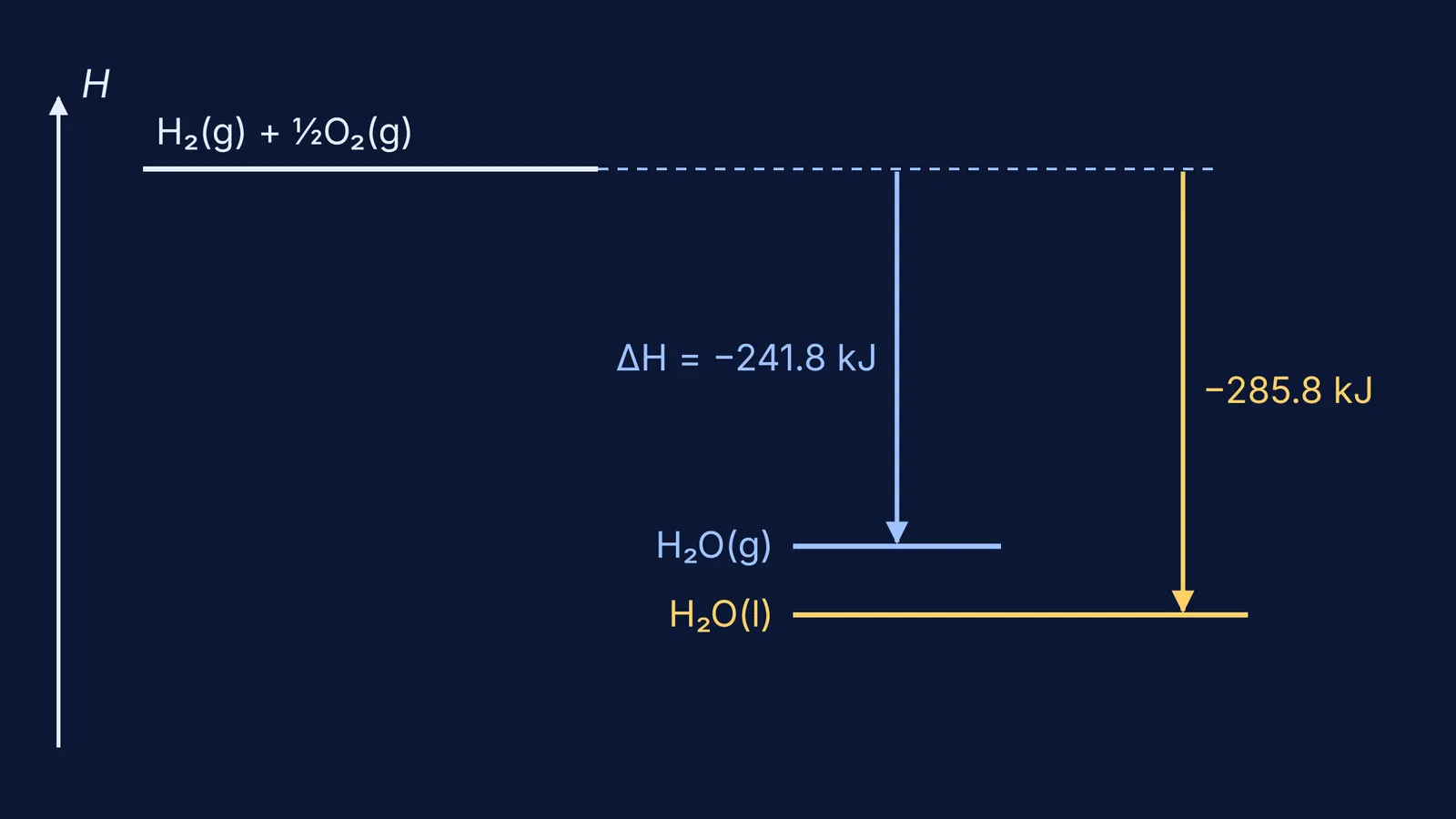
The enthalpy change of a reaction depends on the physical states of the reactants and products, so the states must be shown, as OpenStax Chemistry 2e puts it. NCERT's Table 5.2 lists the standard enthalpy of formation of H₂O(l) as −285.83 kJ mol⁻¹ and of H₂O(g) as −241.82 kJ mol⁻¹ (NCERT). The 44.01 kJ gap is water's enthalpy of vaporisation at 298 K, which the same chapter gives as 44.01 kJ mol⁻¹. Write liquid when the question means vapour and every mole of water carries that error; see why combustion enthalpy differs for liquid and vapour water.
Sometimes the state includes the allotrope: NCERT lists C(graphite) at 0 and C(diamond) at +1.89 kJ mol⁻¹, so formation equations write C(graphite, s).
What does the sign of ΔH tell you?
A negative ΔH means the reaction is exothermic and a positive ΔH means it is endothermic (OpenStax). Always write the sign, including the plus.
A common slip is mixing up ΔH with heat released. For ethanol combustion ΔrH⦵ is −1367 kJ mol⁻¹ (NCERT), so the heat released is 1367 kJ per mole of reaction. The minus sign belongs to ΔH, not to the word released.
How do you scale or reverse a thermochemical equation?
Both rules are stated in OpenStax and worked through in NCERT's conventions:
Scale the coefficients by a factor and scale ΔH by the same factor, because enthalpy is extensive. Fe₂O₃(s) + 3H₂(g) → 2Fe(s) + 3H₂O(l) has ΔrH⦵ = −33.3 kJ mol⁻¹; with every coefficient halved it is −16.6 kJ mol⁻¹.
Reverse the equation and the sign of ΔH reverses. N₂(g) + 3H₂(g) → 2NH₃(g) has ΔrH⦵ = −91.8 kJ mol⁻¹, so the reverse has +91.8 kJ mol⁻¹.
Worked example: what is ΔH for decomposing one mole of ammonia?
Find ΔH for NH₃(g) → ½N₂(g) + 3/2H₂(g), using the NCERT values.
Start: N₂(g) + 3H₂(g) → 2NH₃(g), ΔH = −91.8 kJ mol⁻¹.
Reverse it: 2NH₃(g) → N₂(g) + 3H₂(g), ΔH = +91.8 kJ mol⁻¹.
Divide by 2: NH₃(g) → ½N₂(g) + 3/2H₂(g), ΔH = +45.9 kJ mol⁻¹.
Now check it. NCERT's Table 5.2 gives the enthalpy of formation of NH₃(g) as −46.11 kJ mol⁻¹. Our answer reverses the formation of one mole of ammonia, so it should be close to +46, and it is; the small gap reflects slightly different source data. This is the same reverse-and-scale move you make in every Hess's law problem.
Why does enthalpy of formation use fractional coefficients?
A standard enthalpy of formation is the enthalpy change for a reaction in which exactly 1 mole of a pure substance is formed from free elements in their most stable states under standard conditions (OpenStax). The product's coefficient must therefore be 1, and the reactants take whatever coefficients balance it, often halves.
NCERT's hydrogen bromide example: H₂(g) + Br₂(l) → 2HBr(g) forms two moles, so its ΔrH⦵ equals 2ΔfH⦵. Halving every coefficient gives ½H₂(g) + ½Br₂(l) → HBr(g), ΔfH⦵ = −36.4 kJ mol⁻¹ (NCERT). Water follows the same pattern: H₂(g) + ½O₂(g) → H₂O(l), ΔfH⦵ = −285.8 kJ mol⁻¹.
The reactants must be in their reference states, which NCERT gives at 25 °C and 1 bar as H₂ gas, O₂ gas, graphite and rhombic sulfur; elements in those states have a formation enthalpy of zero, as our post on why the formation enthalpy of elements is zero explains.
Before you move on, run this 30-second check:
Every species has a state, plus the allotrope where one exists.
ΔH has a sign and units of kJ mol⁻¹.
Coefficients multiplied or divided? Do the same to ΔH.
Equation reversed? Flip the sign.
A formation equation makes exactly 1 mole of product, fractions allowed.
The answer agrees with a second value, as in the ammonia check.
If you know the rules but still lose a sign or a factor in multi-step questions, the Fermi Problem Library has worked problems with a step-by-step solver that explains the reasoning rather than printing an answer, so you can see which line went wrong. If reference states still feel shaky, the Fermi Concept Library gives each concept its own lesson.


