On this page
Draw square planar [MX2L2] and you get cis and trans. Draw tetrahedral [MX2L2] and you keep getting the same structure. That is not a drawing mistake. It is the geometry.
Why do tetrahedral complexes not show geometrical isomerism?
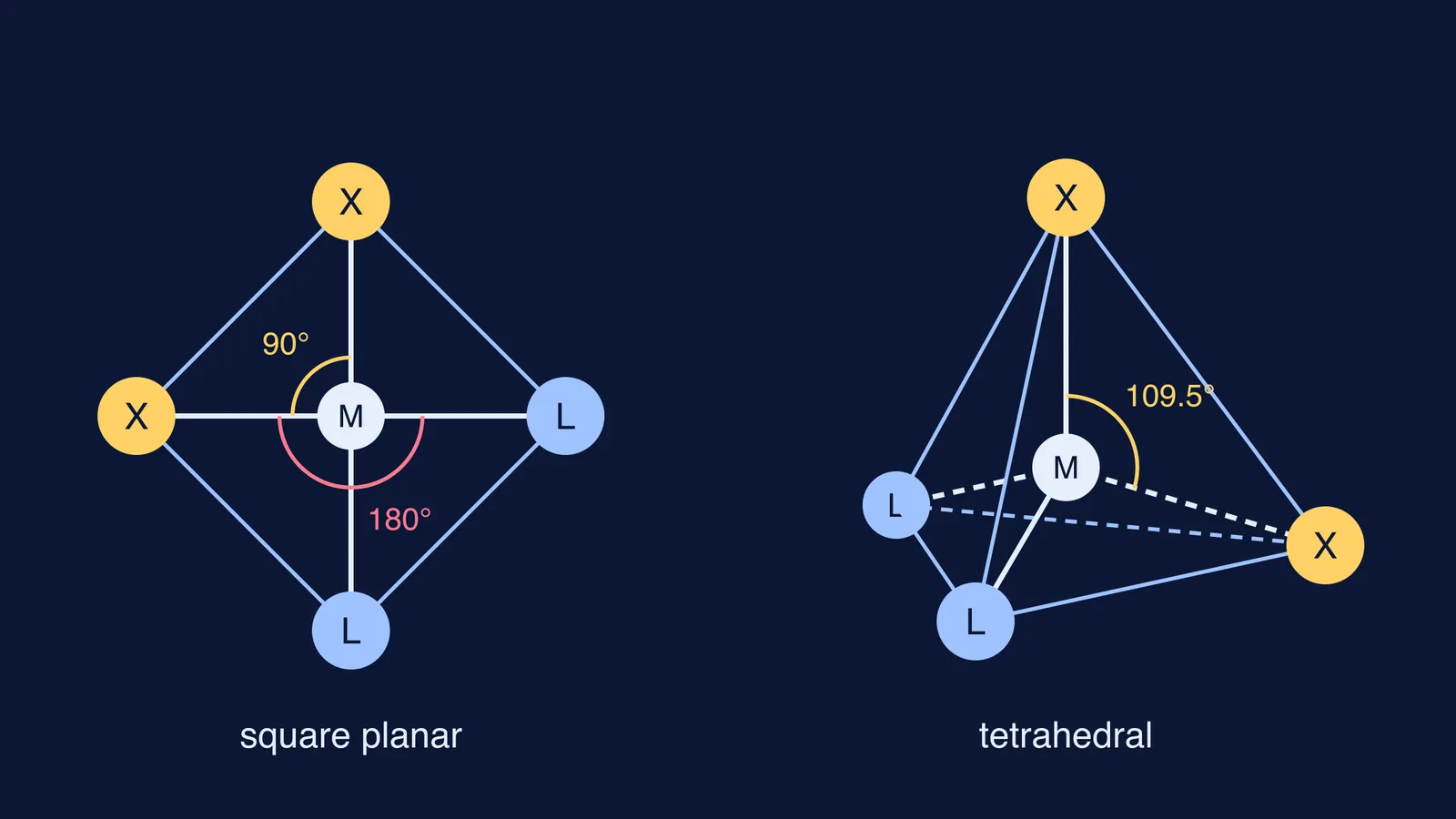
Geometrical (cis-trans) isomerism needs two kinds of position: next to each other (cis) and opposite each other (trans). A tetrahedron only has the first kind. As the ChemPRIME chapter on the geometry of complexes/22:_Metals/22.09:_Geometry_of_Complexes) puts it, any given corner of a tetrahedron is adjacent to the other three, so all the corners are cis to each other and none are trans.
The angles tell the same story. Tetrahedral complexes prefer ligand-metal-ligand angles of 109.5°, according to the LibreTexts inorganic chemistry chapter on isomerism/09:_Coordination_Chemistry_I_-_Structure_and_Isomers/9.04:_Isomerism) by Stephen Contakes of Westmont College. Because every pair of positions is separated by the same angle, swapping two ligands only gives you the same molecule turned around.
The NCERT textbook gives the exam version in Example 5.4: tetrahedral complexes do not show geometrical isomerism "because the relative positions of the unidentate ligands attached to the central metal atom are the same with respect to each other" (NCERT Class 12 Chemistry Part I, Unit 5: Coordination Compounds).
What makes square planar complexes different?
In a square planar complex the four ligands sit at the corners of a square around the metal. The LibreTexts chapter/09:_Coordination_Chemistry_I_-_Structure_and_Isomers/9.04:_Isomerism) notes that square planar complexes prefer 90° angles between neighbours, which puts the positions across the square 180° apart. Two different relationships are enough to make isomers.
NCERT's example is [Pt(NH3)2Cl2]. In a square planar complex of formula [MX2L2], the two X ligands can sit adjacent to each other (cis) or opposite each other (trans), according to section 5.4.1 of the NCERT coordination compounds unit. The same section notes that a square planar MABXL complex has three isomers, two cis and one trans, and that octahedral [MX2L4] complexes also show cis and trans forms.
The difference matters outside the exam hall too. The ChemPRIME chapter/22:_Metals/22.09:_Geometry_of_Complexes) notes that the cis isomer of [Pt(NH3)2Cl2] is used as an anti-tumour drug, while the trans form shows no similar biological activity.
How can you check any four-coordinate complex quickly?
Here is a counting check that turns the idea into arithmetic. Four ligand positions make six pairs (4 × 3 ÷ 2).
Count the pairs of positions: 6.
Count how many pairs are joined by an edge of the shape. A tetrahedron has 6 edges, so all 6 pairs are neighbours. A square has 4 edges, so 4 pairs are neighbours and 2 pairs sit across a diagonal.
If every pair is a neighbour pair, cis and trans cannot exist. If some pairs are across from each other, they can.
Worked example for a complex of type [MX2L2]:
Square planar: put the first X anywhere. The second X has three places left: two neighbours (cis) and one across (trans). Two different answers, so two geometrical isomers.
Tetrahedral: put the first X anywhere. The second X has three places left, and all three are neighbours at the same angle from the first. Rotate the model and any one of them becomes any other. One answer, so no geometrical isomers.
The check only works once you know the shape. As a starting guide, the ChemPRIME chapter/22:_Metals/22.09:_Geometry_of_Complexes) says most four-coordinate complexes of Zn(II), Cd(II) and Hg(II) are tetrahedral, while Pd(II), Pt(II) and Cu(II) prefer square planar. The LibreTexts isomerism chapter/09:_Coordination_Chemistry_I_-_Structure_and_Isomers/9.04:_Isomerism) gives a pair worth remembering: [NiCl4]2- is tetrahedral while [PtCl4]2- is square planar.
If you cannot picture it, build it: four toothpicks in a ball of clay pointing to the corners of a tetrahedron, two blue and two red beads on the ends. Try to make a second arrangement. You will not find one.
Can tetrahedral complexes show optical isomerism?
In principle, yes. A tetrahedral metal centre with four different ligands, Mabcd, is chiral in the same way as a carbon atom with four different groups, according to the LibreTexts isomerism chapter/09:_Coordination_Chemistry_I_-_Structure_and_Isomers/9.04:_Isomerism). The same chapter says complexes of that type are relatively rare, and that a square planar Mabcd complex is identical to its mirror image, so it is not chiral.
What should you write in the exam?
A two-line answer built on the wording of NCERT Example 5.4, with the tetrahedral angle from the LibreTexts isomerism chapter/09:_Coordination_Chemistry_I_-_Structure_and_Isomers/9.04:_Isomerism):
If the question carries more marks, add a quick sketch of cis and trans [Pt(NH3)2Cl2] to show the contrast with square planar.
If the geometry still feels shaky, the Fermi Concept Library covers every concept in chemistry, each with its own lesson and its place in the map. When you are ready to practise, the Fermi Problem Library has worked problems with a step-by-step solver that explains the reasoning rather than printing an answer.
Next isomer question, ask first: does this shape have any positions opposite each other?