On this page
In your Class 12 chemistry book, the line that tetrahedral complexes are high spin looks like one more fact to memorise. It is really one ratio and one comparison, and once you see both you can work out the answer in an exam.
Why are tetrahedral complexes high spin?
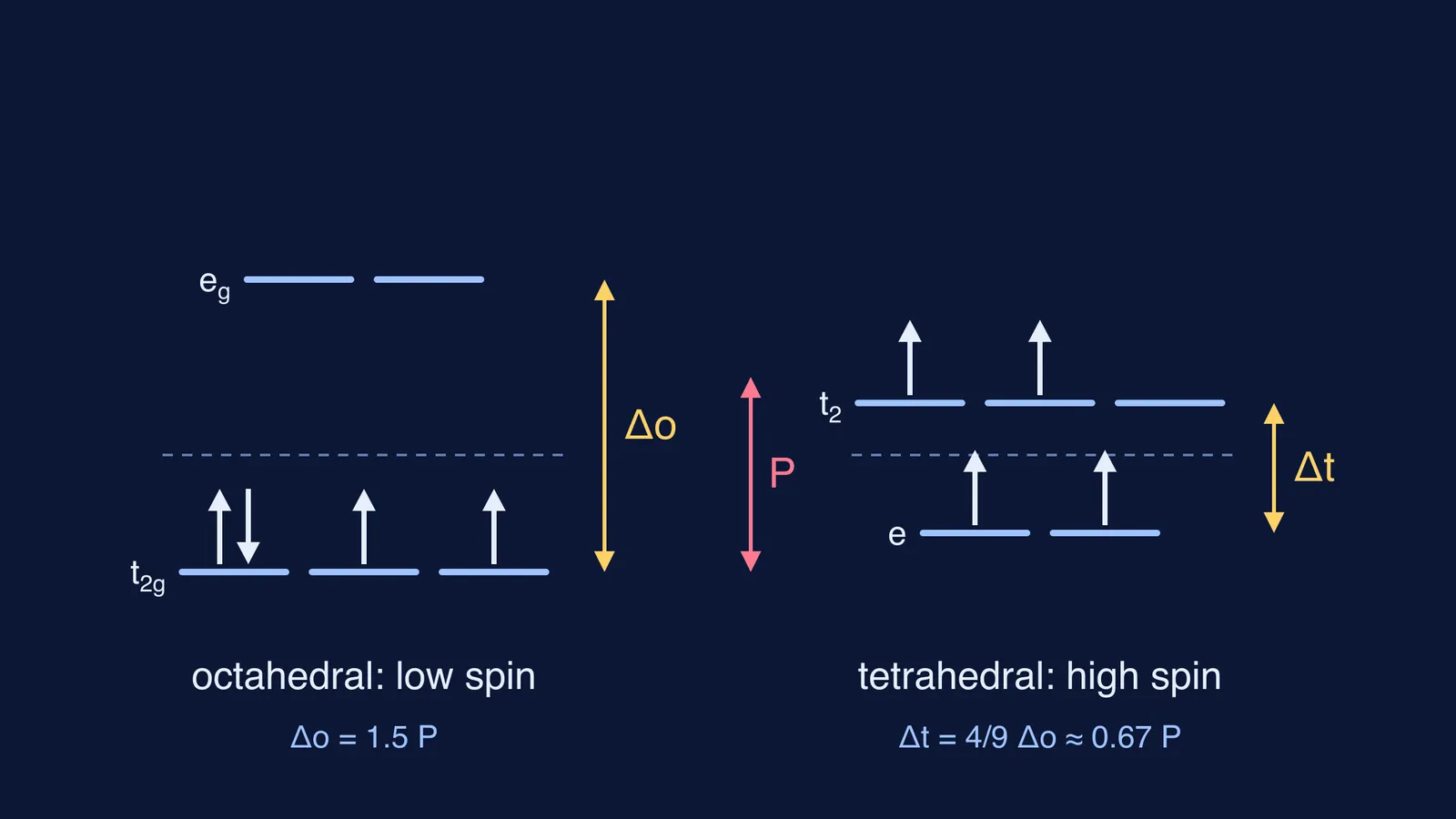
Once ligands split the d orbitals, each extra electron has a choice: pair up in a lower orbital, costing the pairing energy P, or sit alone in a higher orbital, costing the splitting energy. The NCERT Class 12 chemistry chapter on coordination compounds defines P as "the energy required for electron pairing in a single orbital" and sets out the rule for octahedral complexes: if Δo < P you get high spin, and if Δo > P you get low spin.
Tetrahedral complexes face the same choice, but the gap is much smaller. The same NCERT chapter states that, for the same metal, the same ligands and the same metal-ligand distances, Δt = (4/9)Δo. It concludes that "the orbital splitting energies are not sufficiently large for forcing pairing and, therefore, low spin configurations are rarely observed."
So electrons take the cheaper option: they spread out across all five orbitals before any of them pair.
One detail trips students up: the order of the levels flips. In a tetrahedral field the two e orbitals are lower and the three t2 orbitals are higher, the reverse of the octahedral t2g and eg (LibreTexts, Tetrahedral Complexes/05:_Coordination_Chemistry_and_Crystal_Field_Theory/5.09:_Tetrahedral_Complexes)).
Why is Δt only four ninths of Δo?
Two reasons, both about geometry.
Fewer ligands. A tetrahedral complex has four ligands around the metal, not six (LibreTexts, Chem 260/04:_Coordination_Chemistry_and_Crystal_Field_Theory/4.12:_Tetrahedral_Complexes)).
No orbital points straight at a ligand. In a tetrahedral complex the ligand electrons are not aimed directly at the d orbitals, so the splitting is smaller (Wikipedia, Crystal field theory). The dz² and dx²−y² orbitals, which point along the axes, have the least contact with the ligand lone pairs and form the lower e set (LibreTexts, Tetrahedral Complexes/05:_Coordination_Chemistry_and_Crystal_Field_Theory/5.09:_Tetrahedral_Complexes)).
If crystal field splitting itself feels shaky, the Fermi Concept Library has every concept in chemistry, each with its own lesson and its place in the map.
How big would Δt need to be to force pairing?
Here is a worked example that uses only the 4/9 ratio from NCERT. Call the pairing energy P.
Suppose a strong-field ligand gives an octahedral complex Δo = 1.5P. Since Δo > P, an octahedral d4 ion is low spin: t2g⁴ eg⁰, two unpaired electrons.
Now keep the metal and ligands but make the complex tetrahedral. Δt = (4/9) × 1.5P ≈ 0.67P, which is less than P. The first two electrons fill the two e orbitals singly. The third would rather jump up to t2 (cost 0.67P) than pair (cost P), and so would the fourth. Result: e² t2², four unpaired electrons.
Now flip the question. For a tetrahedral complex to go low spin you need Δt > P, which means Δo > (9/4)P, more than 2.25 times the pairing energy. That is why the textbook calls low spin tetrahedral complexes rare.
How do you count unpaired electrons in a tetrahedral complex?
Use this four-step check in a board exam or a JEE practice problem:
Find the metal's oxidation state and its d electron count.
Fill the two lower e orbitals singly, then the three upper t2 orbitals singly.
Only after all five hold one electron each, start pairing, from e upwards.
Count the unpaired electrons n and, if asked, find the spin-only moment μ = √(n(n+2)) BM.
NCERT's own Example 5.7 runs this logic backwards. [MnBr₄]²⁻ has a spin-only magnetic moment of 5.9 BM, which fits five unpaired electrons on Mn²⁺ (d5), so the textbook concludes it is tetrahedral rather than square planar (NCERT, Example 5.7). Check it yourself: √(5 × 7) = √35 ≈ 5.92.
To practise, the Fermi Problem Library has worked problems with a step-by-step solver that explains the reasoning rather than printing an answer.
Are tetrahedral complexes ever low spin?
Almost never. NCERT says low spin is "rarely observed" (NCERT), while LibreTexts says that for 3d elements tetrahedral complexes are "always high spin" (LibreTexts/05:_Coordination_Chemistry_and_Crystal_Field_Theory/5.09:_Tetrahedral_Complexes)).
A known exception is a cobalt compound with four bulky norbornyl groups. In 1986 Erin Byrne, Darrin Richeson and Klaus Theopold reported it in a paper titled "Tetrakis(1-norbornyl)cobalt, a low spin tetrahedral complex of a first row transition metal" (Journal of the Chemical Society, Chemical Communications). Wikipedia describes it as the first low-spin complex with tetrahedral geometry to be isolated (Wikipediacobalt(IV))).
For your exam, the answer is high spin: Δt is about four ninths of Δo, usually too small to beat the pairing energy, with rare exceptions.