On this page
Chemistry textbooks tell you that methane has bond angles of 109.5°. Few show where the number comes from. It is not measured first and memorised later: it falls out of one idea and three lines of maths. Once you have seen the cube picture, you can rebuild the number in an exam even if you have forgotten it.
What does VSEPR say about four bonds?
The starting idea is valence shell electron pair repulsion. In the words of a widely used general chemistry text on LibreTexts/09%3A_Molecular_Geometry_and_Bonding_Theories/9.02%3A_The_VSEPR_Model), electron pairs "repel each other and will therefore adopt the geometry that places electron pairs as far apart from each other as possible."
So the chemistry question becomes a geometry question: how do you place four identical arrows from one point so that every pair is as far apart as the others? On a flat page the answer looks like a plus sign, with 90° between neighbours. In three dimensions you can do better, and the cube shows how.
Why is the tetrahedral bond angle 109.5 degrees?
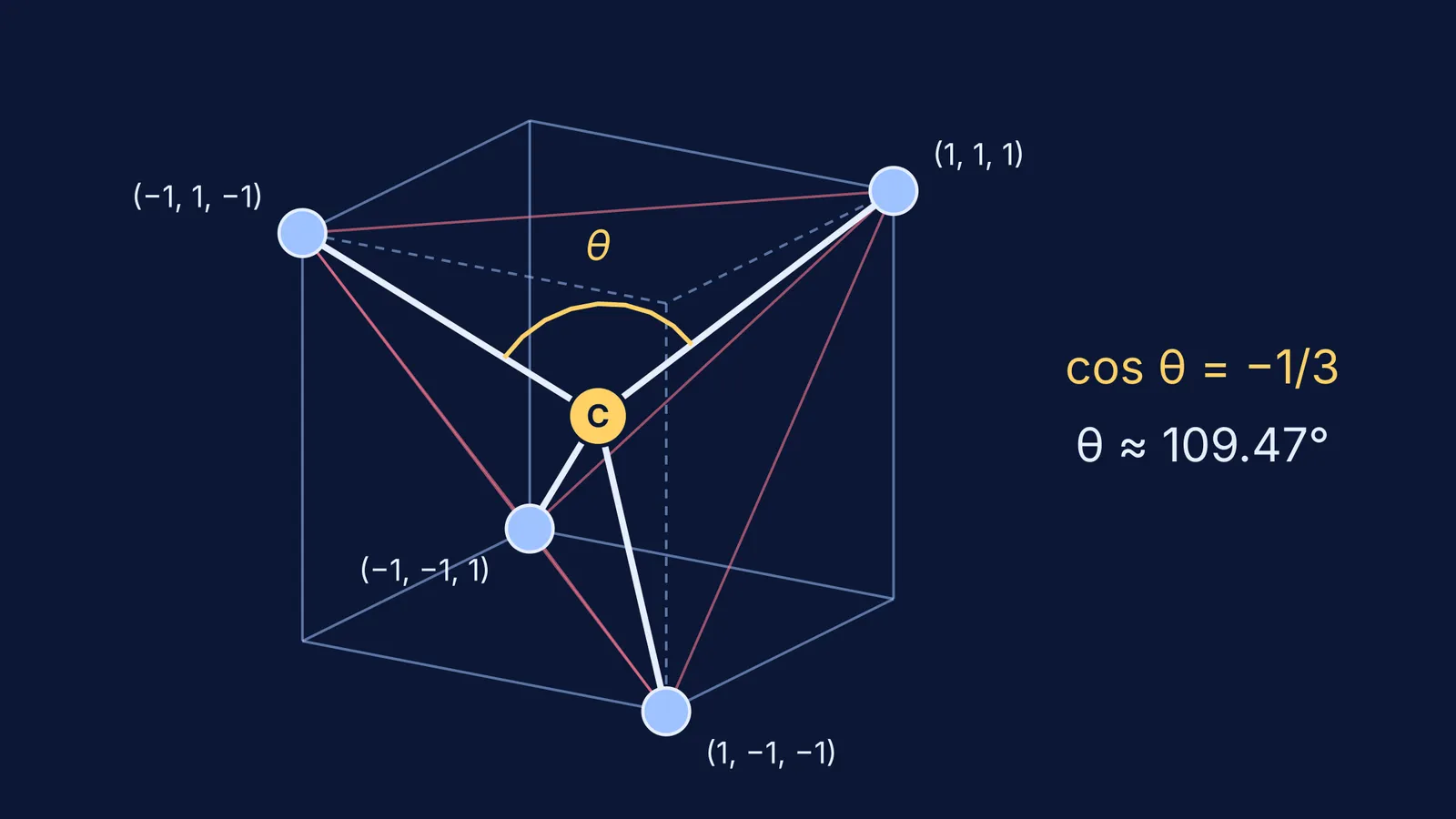
Put the carbon atom at the centre of a cube, which we call the origin. The Wikipedia article on tetrahedral geometry uses exactly this construction: the molecule is inscribed in a cube with the central atom at the cube's centre. Now follow these steps.
Give the cube corners coordinates (±1, ±1, ±1). The centre is (0, 0, 0).
Choose four corners that never share an edge: (1, 1, 1), (1, −1, −1), (−1, 1, −1) and (−1, −1, 1). Each is the same distance from the centre, and each pair is a face diagonal apart, so they are equally spaced.
Draw a bond from the centre to each corner. Take two bond vectors, a = (1, 1, 1) and b = (1, −1, −1).
Dot product: a · b = (1)(1) + (1)(−1) + (1)(−1) = −1.
Lengths: |a| = |b| = √3, so |a||b| = 3.
cos θ = (a · b) / (|a||b|) = −1/3.
The exact value of the angle is arccos(−1/3) = 109.4712...°, the figure given in the same reference. Rounded, that is the 109.5° in your textbook. Try any other pair of the four corners: the dot product is always −1, so all six angles are equal.
A second check, without the cube: if four equal bonds are perfectly balanced, their unit vectors add to zero. Square that sum: each vector contributes 1, and each of the six pairs contributes 2 cos θ. So 4 + 12 cos θ = 0, which again gives cos θ = −1/3. Two different routes, one answer: that is a good sign you have not made an arithmetic slip.
Does real methane actually have this angle?
Yes. The NIST Computational Chemistry Comparison and Benchmark Database lists methane's experimental structure in point group Td, the full symmetry of a regular tetrahedron, with an H–C–H angle of 109.471° and a C–H bond length of 1.087 Å. That angle is fixed by the symmetry rather than measured separately to three decimals: experiment shows the four C–H bonds are equivalent, and the cube supplies the number.
Why are ammonia and water less than 109.5 degrees?
The cube gives the ideal angle only when all four electron pairs are identical. In ammonia, one of the four is a lone pair, and the H–N–H angle shrinks to about 107°, according to the tetrahedral geometry reference. In water, with two lone pairs, the H–O–H angle is 104.5°, as shown in the LibreTexts VSEPR chapter/09%3A_Molecular_Geometry_and_Bonding_Theories/9.02%3A_The_VSEPR_Model). The same chapter explains why: a lone pair is not shared by two nuclei, so it occupies more space near the central atom, and its stronger repulsion squeezes the bonding pairs closer together.
This pattern often comes up in hybridisation questions: start from 109.5°, then ask how many lone pairs are squeezing it.
How do you rebuild 109.5 degrees in an exam?
Use this short routine when you blank on the number or need to justify it.
Draw a cube and mark the centre.
Put the four bonds on alternate corners, so no two share an edge.
Write two vectors, such as (1, 1, 1) and (1, −1, −1).
Dot product −1, lengths √3 each, so cos θ = −1/3.
Remember that arccos(−1/3) is just under 110°, which rounds to 109.5°.
For lone pairs, say the angle shrinks: about 107° for NH₃ and 104.5° for H₂O, the values given by Wikipedia and LibreTexts/09%3A_Molecular_Geometry_and_Bonding_Theories/9.02%3A_The_VSEPR_Model).
If the vector step is where you get stuck, the Fermi Concept Library gives every concept in chemistry and mathematics its own lesson, so you can revise dot products and VSEPR. For more practice, the Fermi Problem Library has worked problems with a step-by-step solver that explains the reasoning rather than printing an answer.
Next time you see 109.5°, picture the cube: four corners, one centre, and cos θ = −1/3.