

On this page
You add a few drops of bromine water to a test tube, shake it, and the colour disappears. Most students write "double bond present" and move on. That is only half right: both reagents react with C=C and C≡C bonds, but also with other compounds, and viva questions check whether you know which.
What does a positive test for unsaturation look like?
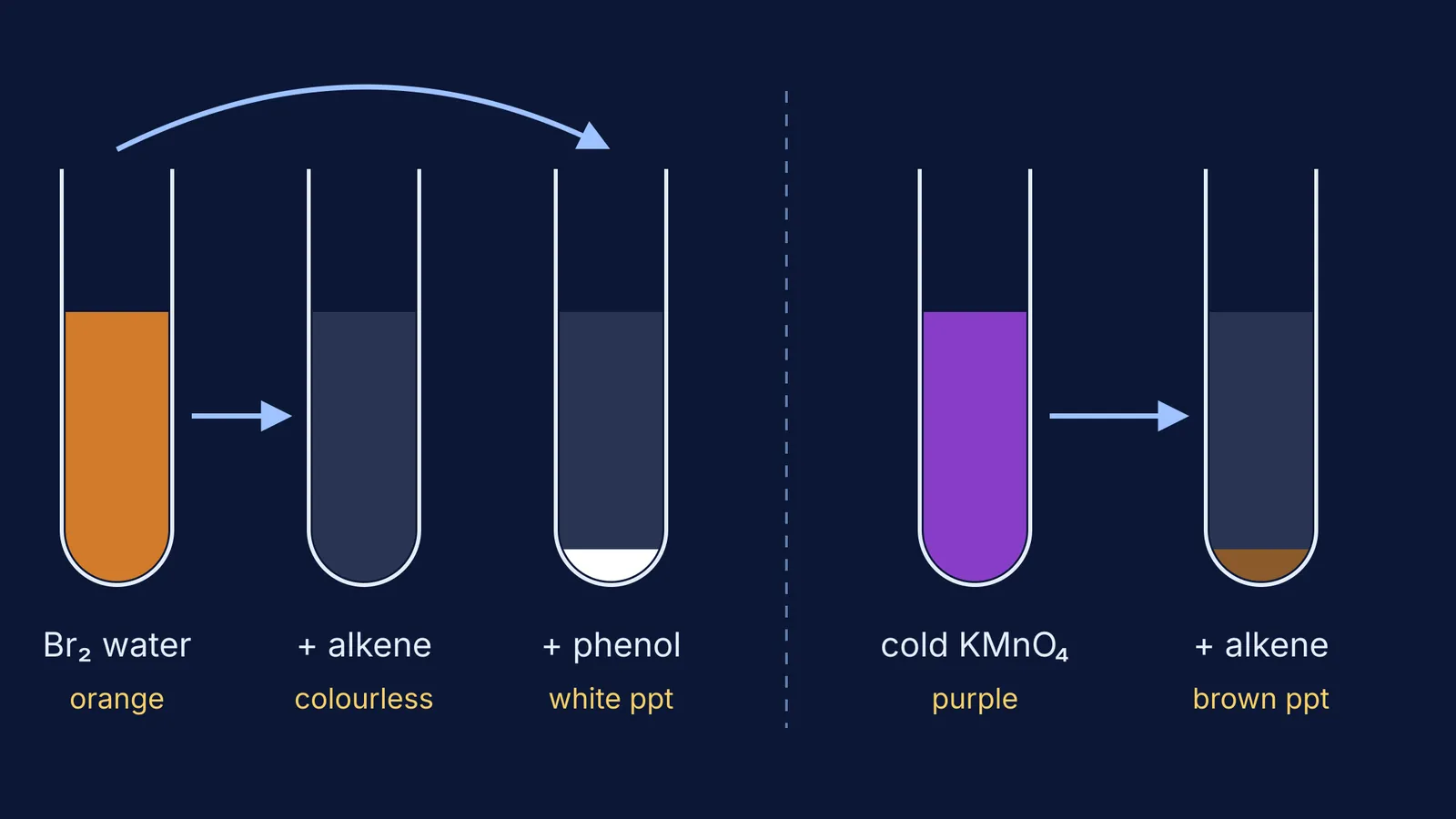
The NCERT Class 11 Hydrocarbons chapter says that the reddish-orange colour of a solution of bromine in carbon tetrachloride is discharged when bromine adds at an unsaturation site, and that this reaction is used as a test for unsaturation. Ethene and bromine give 1,2-dibromoethane, an addition product.
The same chapter describes Baeyer's reagent as a cold, dilute, aqueous solution of potassium permanganate, which turns alkenes into vicinal glycols (ethene becomes ethane-1,2-diol). NCERT states that the decolourisation of KMnO₄ is used as a test for unsaturation.
A university chemical tests handout from Utah Tech adds the detail you will actually see: the purple permanganate is used up and manganese dioxide forms as a brown precipitate. The same handout notes that bromine reacts at once with alkenes but may take a short while with alkynes.
In the school lab you usually use bromine water. Chemguide explains that alkenes decolourise bromine water too, but in water most of the product from ethene is actually 2-bromoethanol, with some 1,2-dibromoethane. School answers usually show the dibromide; either way, the colour goes.
Why does phenol decolourise bromine water?
Phenol has no C=C bond outside its ring, yet it passes the bromine test. The NCERT Class 12 chapter on alcohols, phenols and ethers explains that the –OH group activates the benzene ring so strongly that bromine reacts even without a Lewis acid catalyst. With bromine water, phenol forms 2,4,6-tribromophenol as a white precipitate.
This is substitution on the ring, not addition across a double bond. The Utah Tech handout puts it plainly: activated aromatic rings give a false positive in the bromine test.
So the clue is the precipitate. Colour gone and the solution stays clear points to unsaturation. Colour gone and a white solid appears points to phenol, which you can confirm with the neutral ferric chloride test for phenol.
Benzene itself does not pass. NCERT's Hydrocarbons chapter says the absence of pure double bonds in benzene accounts for its reluctance to undergo addition reactions under normal conditions.
Can aldehydes and alcohols give a false positive?
Yes, because both reagents are also oxidising agents. The NCERT Class 12 Biomolecules chapter uses bromine water as a mild oxidising agent that turns glucose into gluconic acid, and treats this as evidence of an aldehyde group. Bromine is used up there without any C=C bond.
Permanganate is less fussy still. The Utah Tech handout warns that the Baeyer test may also be positive for aryl amines, aldehydes and alcohols, because they can be oxidised too. If you suspect an aldehyde, run a test made for it, such as Tollens' reagent or Schiff's reagent for aldehydes.
How should you word the observation in your practical file?
Keep what you saw separate from what you concluded:
Name the colour before and after: "reddish-orange to colourless", not just "decolourised".
Say whether a precipitate formed, and its colour.
Write the inference as "indicates" or "may contain", not "is an alkene", unless other tests support it.
Use "unsaturation (C=C or C≡C)" rather than "double bond", since alkynes pass too.
Record negative results in the same way: "the purple colour persisted; unsaturation absent".
Scripts you can copy:
Bromine water, positive: "On shaking with bromine water, the reddish-orange colour was discharged and no precipitate formed. The compound may contain unsaturation (C=C or C≡C)."
Bromine water, phenol: "The colour of bromine water was discharged and a white precipitate formed. Phenol is indicated (2,4,6-tribromophenol); to be confirmed with neutral FeCl₃."
Baeyer's test, positive: "On adding cold, dilute KMnO₄ (Baeyer's reagent), the purple colour disappeared and a brown precipitate formed. Unsaturation is indicated."
Worked example: which of three unknowns has a double bond?
Suppose compound A decolourises both reagents and gives no precipitate with bromine water. Unsaturation is the likely inference. Compound B decolourises bromine water with a white precipitate and gives a violet colour with neutral FeCl₃: that points to phenol, not an alkene. Compound C decolourises Baeyer's reagent and gives a silver mirror with Tollens' reagent: it contains an aldehyde group, so the permanganate result alone proves nothing about a C=C bond.
If you mix up which reagent adds and which oxidises, the Fermi Concept Library gives every chemistry concept its own lesson and its place in the map. For "distinguish between" questions, the Fermi Problem Library has worked problems with a step-by-step solver that explains the reasoning rather than printing an answer.
Next, see what happens when the permanganate is hot instead of cold in cold dilute versus hot KMnO₄ with alkenes.


