

On this page
Tert-butyl bromide and isobutyl bromide have the same formula, C4H9Br, and the same carbon skeleton. Only the bromine's position differs. Tert-butyl bromide is 2-bromo-2-methylpropane, with bromine on the central carbon (PubChem CID 10485). Isobutyl bromide is 1-bromo-2-methylpropane, with bromine on an end CH2 (PubChem CID 6555).
No single reagent slides a bromine from one carbon to the next. So you take it off, which gives an alkene, and put it back on the other way round. This pattern turns up often in conversion questions.
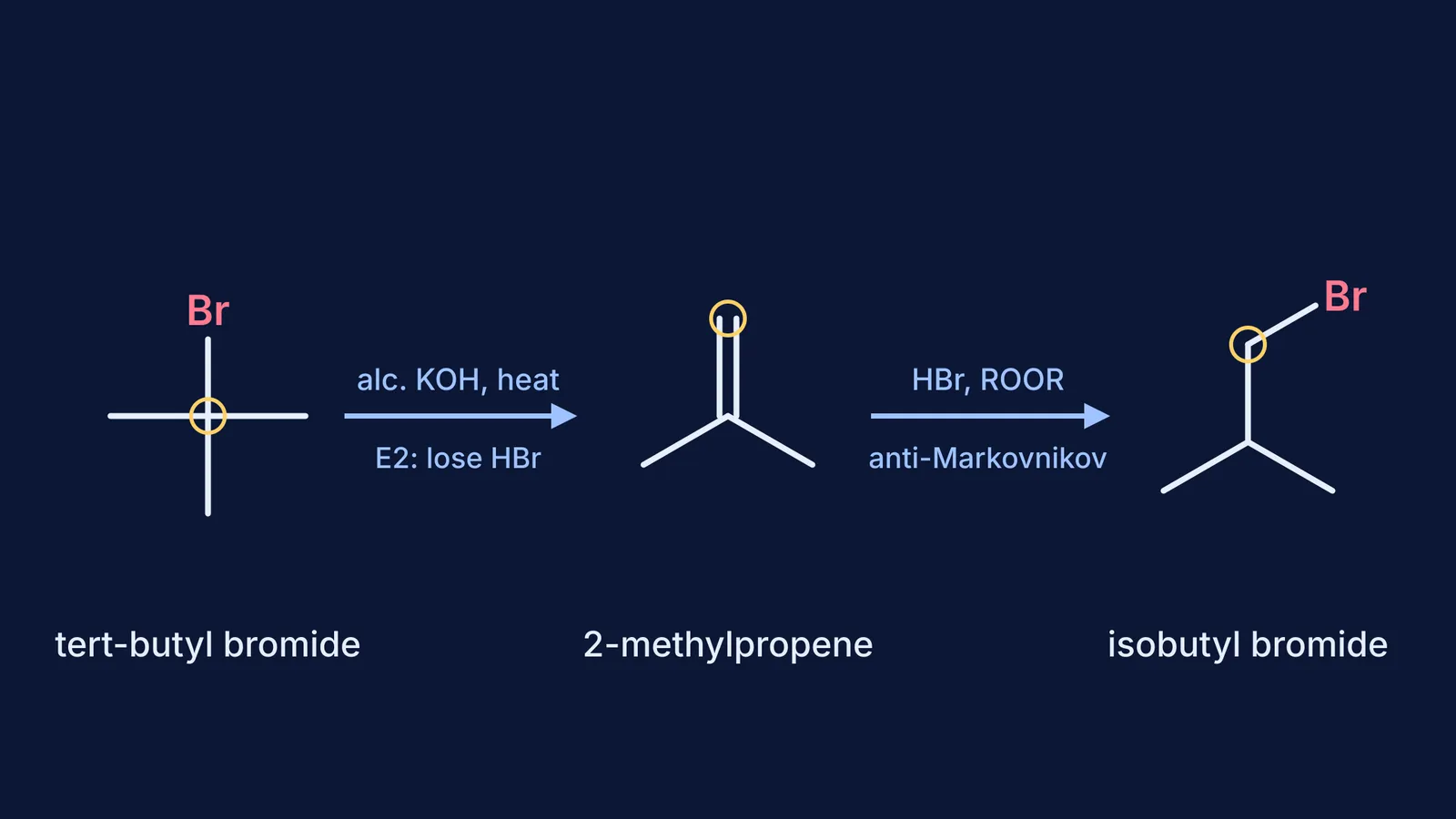
What is the two-step route from tert-butyl bromide to isobutyl bromide?
Heat (CH3)3C–Br with alcoholic KOH. HBr is eliminated and you get (CH3)2C=CH2, 2-methylpropene.
Add HBr in the presence of an organic peroxide (ROOR). Bromine adds to the CH2 end, giving (CH3)2CH–CH2Br, isobutyl bromide.
The alkene is the bridge. Step 1 removes the bromine, and step 2 decides where it goes back.
Why does step 1 give only 2-methylpropene?
A tertiary carbon is too crowded for a base to attack it from the back, so a strong base pulls off a hydrogen from a neighbouring carbon instead. The C–Br bond breaks at the same moment, and a double bond forms. This one-step, base-driven loss of HBr is the E2 elimination. LibreTexts shows the same substrate, (CH3)3C–Br, giving (CH3)2C=CH2 (with cyanide as the base) in its page on E2 elimination reactions/Alkyl_Halides/Reactivity_of_Alkyl_Halides/Alkyl_Halide_Reactions/Substitution_and_Elimination_Reactions_of_Alkyl_Halides/E2_Elimination_Reactions).
Here's what makes step 1 easy: all three neighbouring carbons are identical CH3 groups. Wherever the base takes a hydrogen, the product is the same alkene, so you don't have to choose between alkenes. When there is a choice, the Saytzeff (Zaitsev) rule for the major alkene comes into play.
Why does HBr with peroxide put bromine on the end carbon?
Start with what happens without peroxide, because that's the trap. In ordinary HBr addition, H+ adds first. LibreTexts uses 2-methylpropene as its own example: the proton goes to the CH2 end, which makes a tertiary carbocation, and bromide then attacks it to give 2-bromo-2-methylpropane, the Markovnikov product (LibreTexts, addition of hydrogen halide to alkenes/10:_Alkenes_and_Alkynes/10.02:_Reactions_of_Alkenes-_Addition_of_Hydrogen_Halide_to_Alkenes)). That's your starting material again.
A peroxide changes the mechanism to a radical chain. The LibreTexts page on radical additions/Alkenes/Reactivity_of_Alkenes/Free_Radical_Reactions_of_Alkenes/Radical_Additions%3A_Anti-Markovnikov_Product_Formation) works through it with 2-methylprop-1-ene:
Initiation: the peroxide splits into oxygen radicals, which take H from HBr and release a bromine radical, Br•.
Propagation: Br• adds to the CH2 end, which leaves the unpaired electron on the tertiary carbon. A carbon radical is more stable on a more substituted carbon because of induction and hyperconjugation.
That tertiary radical takes H from another HBr. This gives (CH3)2CH–CH2Br and a fresh Br•, so the chain keeps going.
Notice that both mechanisms pass through a tertiary intermediate. What differs is which piece arrives first. In the ionic route, H+ arrives first, so bromine ends up in the middle. In the radical route, Br• arrives first, so bromine ends up on the end carbon.
The anti-Markovnikov addition of proton acids to alkenes works only with HBr, not HCl or HI (LibreTexts, regioselectivity via free radical mechanisms/16:_Electrophilic_Additions_of_Alkenes_as_the_Counterpart_of_Eliminations/16.02:_Regioselectivity_and_Formation_of_Anti-Markovnikov_Products_Via_Free_Radical_Mechanisms)). M. S. Kharasch and Frank R. Mayo reported the peroxide effect, studying HBr addition to allyl bromide, in the Journal of the American Chemical Society in 1933 (doi:10.1021/ja01333a041). Their story is told in our post on the Kharasch peroxide effect.
How should you write this conversion in an exam?
A full-marks answer fits in three lines:
(CH3)3C–Br + KOH (alc.), heat → (CH3)2C=CH2 + KBr + H2O
(CH3)2C=CH2 + HBr, peroxide → (CH3)2CH–CH2Br
Name each compound under its formula, and write “anti-Markovnikov (peroxide effect)” under the second arrow.
Before you hand it in, check four things:
Did you write “alcoholic” KOH and heat for step 1?
Did you write “peroxide” over the HBr arrow? Without it, the answer is wrong.
Did you use HBr, not HCl or HI, for the anti-Markovnikov step?
Does every structure still have four carbons?
Where else does the eliminate-then-re-add trick work?
The same move works for any “shift the halogen” question. Eliminate to an alkene, then pick the addition that puts the halogen where you want it. The peroxide step is also useful on its own: see how but-1-ene becomes 1-iodobutane via peroxide HBr, followed by a halide exchange.
If you keep mixing up which reagent goes over which arrow, try the Fermi Problem Library. It has worked problems with a step-by-step solver that explains the reasoning rather than printing an answer. For a gap in the basics, such as carbocation versus radical stability, the Fermi Concept Library gives each concept its own lesson.


