

On this page
A common JEE-style question: two bodies tied by a light string fall through air with different air resistance. What is the string's tension? Many students write T = 0 from habit, because strings go slack in free fall. That is right only when there is no air. Once drag acts, the string usually tightens, and the tension comes from the gap in drag per kilogram.
Why is the string slack in free fall but taut with drag?
Without air, every body falls with acceleration g whatever its mass, so neither pulls on the other and the tension is zero.
Air changes that. NASA Glenn Research Center's page on a falling object with air resistance gives the acceleration of a falling body as a = (W − D)/m, weight minus drag over mass. NASA's drag equation page says drag depends on the air's density, the square of the velocity, and the size and shape of the body.
So on its own, each body would accelerate at g − F/m, where F is its drag. The body with more drag per kilogram wants to fall more slowly. The string stops the pair separating: it pulls the slow body down and holds the fast one back.
How do you find the tension between two falling bodies?
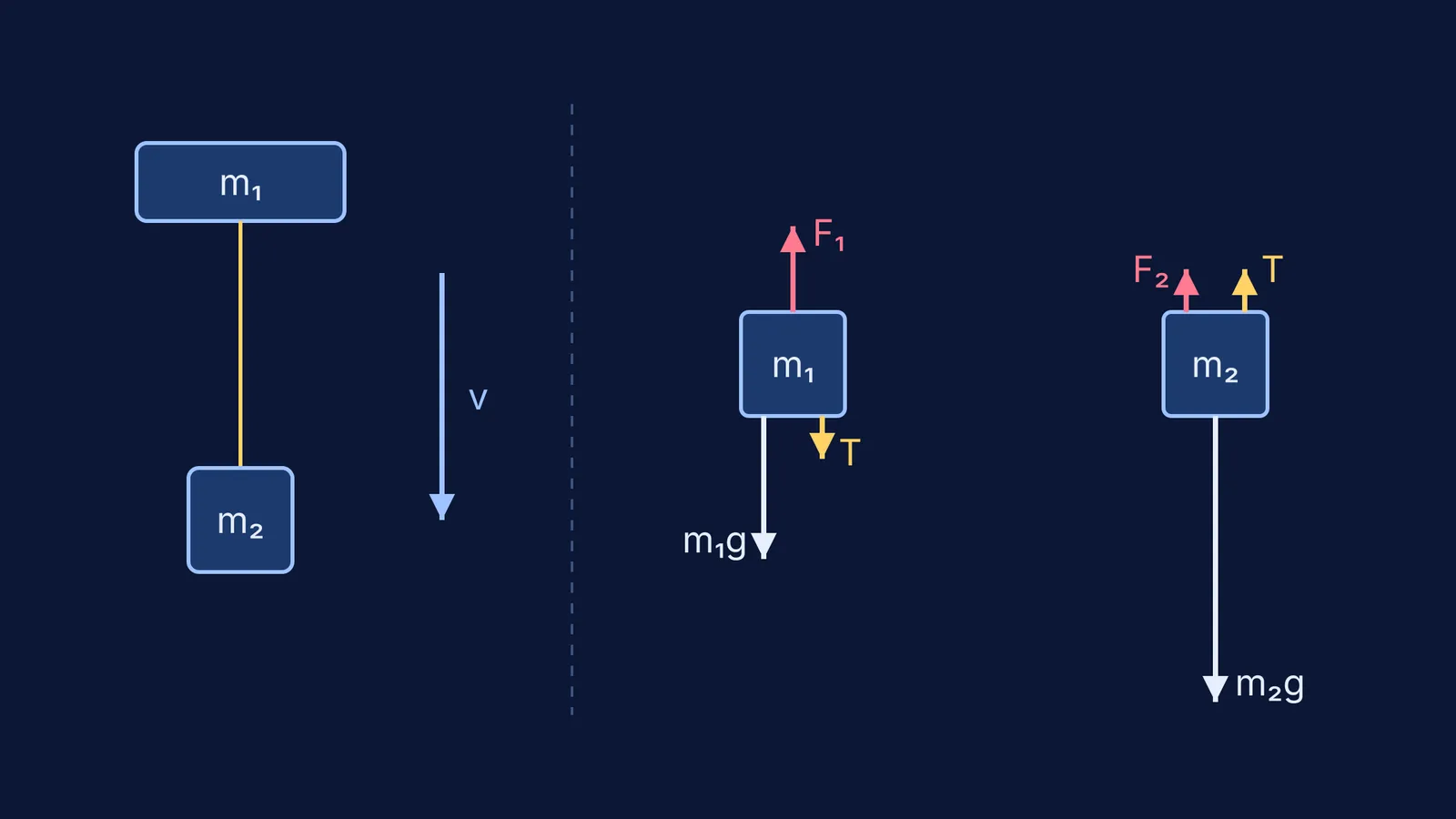
Call the upper body 1 (mass m₁, drag F₁) and the lower body 2 (mass m₂, drag F₂). Take downward as positive.
Draw two free-body diagrams. Body 1: m₁g down, F₁ up, T down. Body 2: m₂g down, F₂ up, T up.
Apply Newton's second law: m₁a = m₁g − F₁ + T and m₂a = m₂g − F₂ − T.
Add them so T cancels: a = g − (F₁ + F₂)/(m₁ + m₂).
Substitute back: T = (m₂F₁ − m₁F₂)/(m₁ + m₂).
Check the sign. Positive T means a taut string. Negative T means the string is slack, because a string can only pull; solve each body separately.
The same result reads T = [m₁m₂/(m₁ + m₂)] × (F₁/m₁ − F₂/m₂). The tension is proportional to the difference in drag per kilogram, so equal drag per kilogram, or no drag at all, gives T = 0.
Worked example
Body 1: 1 kg, drag 6 N. Body 2: 2 kg, drag 3 N. Take g = 10 m/s².
Drag per kilogram is 6 N/kg against 1.5 N/kg, so body 1 is on top and the string is taut.
a = 10 − 9/3 = 7 m/s².
T = (2 × 6 − 1 × 3)/3 = 3 N.
Check: body 1 gives 1 × 7 = 10 − 6 + 3, and body 2 gives 2 × 7 = 20 − 3 − 3.
A common variant uses two balls of the same size and shape but different masses. Moving together, they feel the same drag F by the drag equation (ignoring the wake), so T = F(m₂ − m₁)/(m₁ + m₂). The string is taut only if the heavier ball hangs below.
What happens to the tension at terminal velocity?
NASA's falling-object page notes that drag depends on the square of the velocity, so it grows as the body speeds up, and that the acceleration becomes zero when drag equals weight: the terminal velocity.
Take the equal-size variant with m₁ = 1 kg on top, m₂ = 2 kg below and g = 10 m/s²:
At release the speed is zero, so drag and tension are both zero.
At terminal velocity, total drag equals total weight: 2F = 30 N, so F = 15 N on each ball.
Body 1 is no longer accelerating, so T = F − m₁g = 5 N. The formula agrees: 15 × 1/3 = 5 N.
Shape matters too. OpenStax University Physics gives a 75 kg skydiver a terminal velocity of about 350 km/h headfirst, which can drop to about 200 km/h spread-eagle as the area increases. For what drag does over a whole fall, see work done by air resistance on a falling raindrop.
Which mistakes cost marks in this problem?
Writing T = 0 because "everything falls together".
Drawing tension the same way on both bodies. It pulls the upper body down and the lower body up.
Assuming the heavier body sits on top. Drag per kilogram decides.
Skipping the sign check on T.
The method matches Atwood machine problems on tension and acceleration: one free-body diagram per body, add for a, substitute for T. If you wonder why one light string carries a single T, read when tension can differ along the same string.
If signs trip you up, the Fermi Problem Library has worked problems with a step-by-step solver that explains the reasoning rather than printing an answer. If drag itself feels shaky, the Fermi Concept Library gives each physics concept its own lesson.
Last test: swap the drags in the worked example (3 N on body 1, 6 N on body 2) and T comes out exactly zero. Can you say why?


