On this page
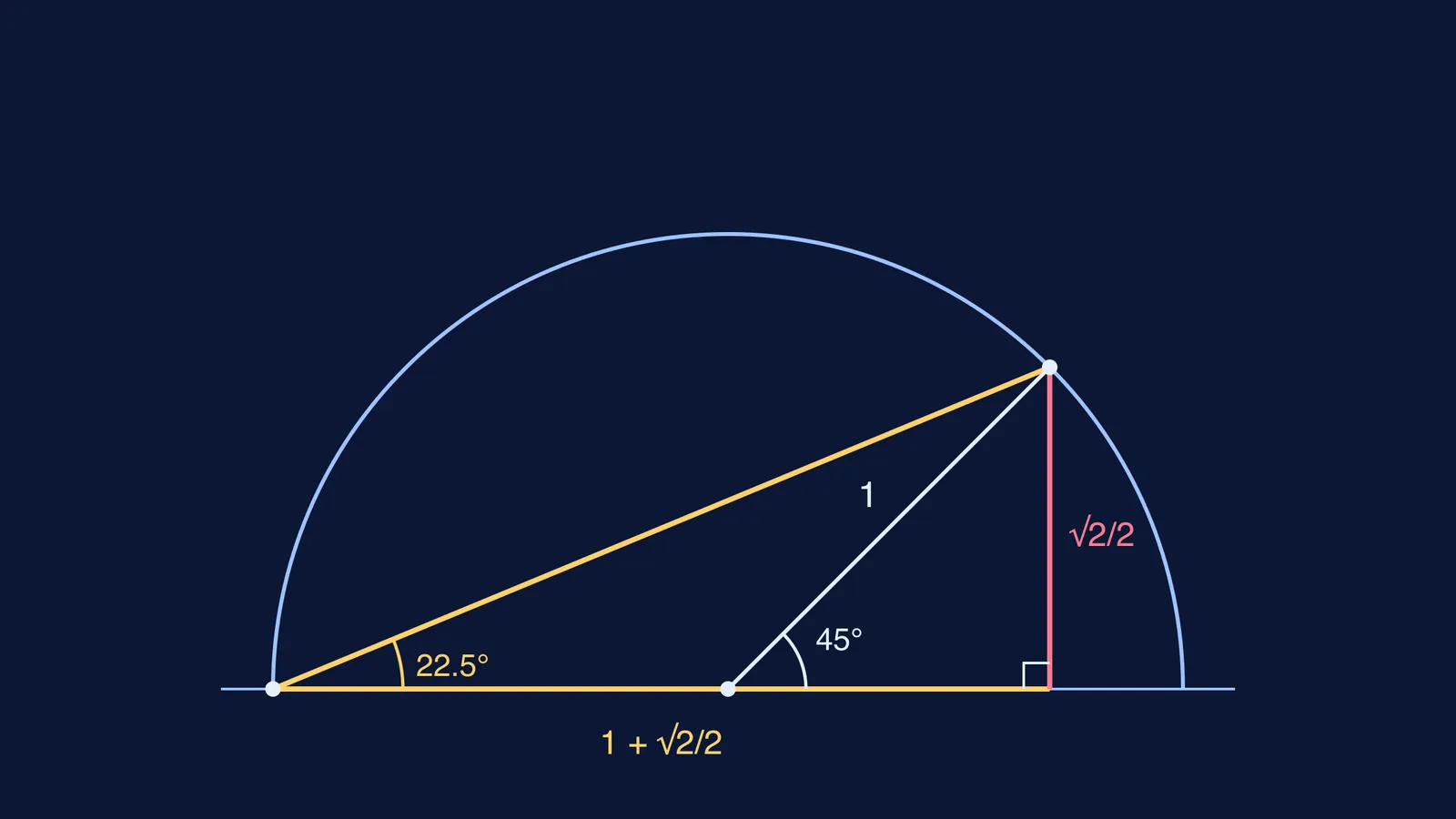
The angle 22.5° is exactly half of 45°, which is why it has an exact surd value. You don't need a calculator for it. You need one identity, a little algebra, and a clear rule for which sign to take. Below are two derivations, the matching sine and cosine, and four quick checks.
What is the exact value of tan 22.5°?
tan 22.5° = √2 − 1, which is about 0.4142 (Wikipedia, Exact trigonometric values).
The same table gives sin 22.5° = √(2 − √2)/2 and cos 22.5° = √(2 + √2)/2. In radians, 22.5° is π/8, so you may see the question written as tan(π/8).
How do you find tan 22.5° with the half-angle formula?
Method 1: the sign-free form
The half-angle identity tan(x/2) = (1 − cos x)/sin x = sin x/(1 + cos x) holds without any ± sign (Wolfram MathWorld, Half-Angle Formulas). Put x = 45°, where sin 45° = cos 45° = √2/2:
tan 22.5° = (1 − √2/2) ÷ (√2/2)
Multiply top and bottom by 2: (2 − √2)/√2
Split the fraction: 2/√2 − √2/√2 = √2 − 1
This is usually the quickest route, because there is no sign to choose.
Method 2: the double-angle quadratic
Let t = tan 22.5°. Since tan 45° = 1 and tan 2θ = 2t/(1 − t²), you get 1 = 2t/(1 − t²), so t² + 2t − 1 = 0. The quadratic formula gives t = −1 + √2 or t = −1 − √2.
The second root is not wrong algebra. It is tan 112.5°, another angle whose double has tangent 1. Because 22.5° is in the first quadrant, its tangent is positive, so t = √2 − 1. A common slip is to write both roots, or to pick one without saying why.
What are sin 22.5° and cos 22.5°, and which sign do you take?
The square-root forms are sin(x/2) = ±√((1 − cos x)/2) and cos(x/2) = ±√((1 + cos x)/2). MathWorld writes the sign as a factor that depends on where the angle sits (Half-Angle Formulas).
With x = 45°, you get the values listed in Wikipedia's table of exact trigonometric values:
sin 22.5° = √((1 − √2/2)/2) = √((2 − √2)/4) = √(2 − √2)/2, about 0.3827
cos 22.5° = √((1 + √2/2)/2) = √((2 + √2)/4) = √(2 + √2)/2, about 0.9239
Both are positive because the half-angle, 22.5°, is in the first quadrant. The rule is: the sign comes from where the half-angle lands, not where the full angle is.
Here is a case where that matters. Find cos 112.5°, which is half of 225°. cos 225° = −√2/2, so the size is √((1 − √2/2)/2) = √(2 − √2)/2. But 112.5° is in the second quadrant, where cosine is negative, so cos 112.5° = −√(2 − √2)/2. If you take the sign from 225° or simply forget it, you get the wrong sign.
You can also get tan 22.5° from these two values. sin/cos = √(2 − √2)/√(2 + √2). Multiply inside the root by (2 − √2)/(2 − √2) to get √((2 − √2)²/2) = (2 − √2)/√2 = √2 − 1. Same answer, three ways.
How can you check the answer in an exam?
Use these four checks on any surd answer for a half-angle. The standard values they rely on, such as tan 30° = 1/√3, are in the same table of exact values:
Size: √2 − 1 ≈ 0.414 lies between tan 0° = 0 and tan 30° = 1/√3 ≈ 0.577, as it should for an angle between them.
Pythagoras: sin² + cos² = (2 − √2)/4 + (2 + √2)/4 = 1.
Double it back: 2(√2 − 1)/(1 − (√2 − 1)²) = 2(√2 − 1)/(2√2 − 2) = 1 = tan 45°.
Complement: tan 67.5° = cot 22.5° = 1/(√2 − 1) = √2 + 1, and (√2 − 1)(√2 + 1) = 1.
If any check fails, the slip is usually in the rationalising step or a dropped factor of 2 inside the root.
If you get the right number but can't say why one sign is right, it helps to see the steps written out. The Fermi Problem Library has worked problems with a step-by-step solver that explains the reasoning rather than printing an answer. If the identities themselves feel shaky, the Fermi Concept Library has a lesson for each concept in mathematics and shows where it sits on the map.
Next time 22.5° shows up, write the sign-free formula, substitute 45°, rationalise, and run one check. That takes about four lines.