

On this page
Synthetic division is polynomial long division with the x's taken out. OpenStax College Algebra 2e defines it as "a shorthand method of dividing polynomials for the special case of dividing by a linear factor whose leading coefficient is 1." So it works when the divisor looks like x − 3, x + 2 or x − 1/2, and not directly for something like x² + 1. The method is also called Ruffini's rule, and because you never write the variables it takes much less space on paper than long division.
How do you set up the synthetic division bracket?
Write the dividend in descending powers of x.
Copy only the coefficients into a row, with a zero for every missing power.
Find k by setting the divisor equal to zero. For x − 3, k = 3.
Write k on the left, behind a small bracket, and leave a blank row under the coefficients with a line below it.
Then repeat one routine: bring the first coefficient down below the line, multiply it by k, write the product under the next coefficient, and add that column. Keep multiplying each new sum by k and adding until you reach the end.
The last number below the line is the remainder. The numbers before it are the coefficients of the quotient, which has a degree one less than the dividend.
Why do you need zeros for missing terms?
Each position in the row stands for one power of x. Skip one and every later number lands in the wrong column. OpenStax puts it plainly: "Notice there is no x-term. We will use a zero as the coefficient for that term." (OpenStax, section 5.4)
For 2x⁴ − 5x² + 3x − 8 there is no x³ term, so the row is 2, 0, −5, 3, −8. Watch for a missing constant too: x³ − 2x becomes 1, 0, −2, 0.
How do you divide by (x + a) with synthetic division?
Rewrite x + a as x − (−a). So k = −a, and for x + 2 you use k = −2, exactly as OpenStax does in its own example.
After that you only add down the columns; changing the sign of k has already done the subtracting that long division does.
Worked example: (2x⁴ − 5x² + 3x − 8) ÷ (x + 2)
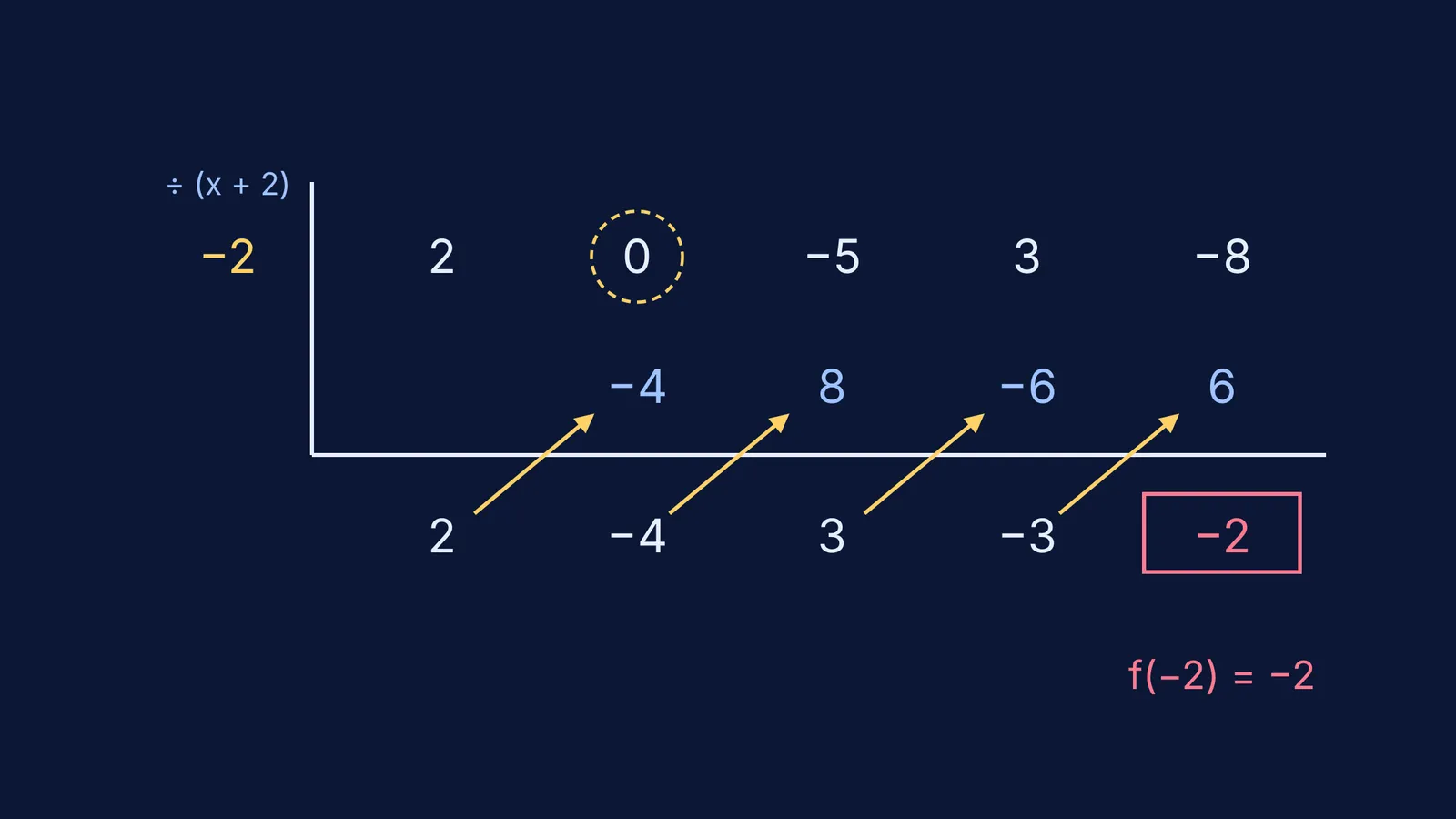
The coefficient row is 2, 0, −5, 3, −8, and k = −2. The image at the top of this post shows the finished bracket.
Bring down 2.
2 × (−2) = −4, and 0 + (−4) = −4.
−4 × (−2) = 8, and −5 + 8 = 3.
3 × (−2) = −6, and 3 + (−6) = −3.
−3 × (−2) = 6, and −8 + 6 = −2.
The bottom row reads 2, −4, 3, −3 with −2 at the end. The quotient is 2x³ − 4x² + 3x − 3 and the remainder is −2.
How do you check the quotient and remainder?
Check the remainder with the remainder theorem. OpenStax section 5.5 states it like this: "If a polynomial f(x) is divided by x−k, then the remainder is the value f(k)." Here f(−2) = 2(16) − 5(4) + 3(−2) − 8 = 32 − 20 − 6 − 8 = −2. That matches the bracket.
Check the quotient by multiplying back. The division algorithm says f(x) = d(x)q(x) + r(x) (OpenStax, section 5.4). Expanding (x + 2)(2x³ − 4x² + 3x − 3) − 2 gives 2x⁴ − 5x² + 3x − 8, the polynomial you started with. The remainder theorem only tests the last number. Multiplying back also tests the quotient.
A remainder of zero tells you something extra. By the factor theorem in the same OpenStax section, k is a zero of f(x) exactly when x − k is a factor. Try x³ − 7x + 6 ÷ (x + 3): the row 1, 0, −7, 6 with k = −3 gives 1, −3, 2 and remainder 0. So x³ − 7x + 6 = (x + 3)(x² − 3x + 2) = (x + 3)(x − 1)(x − 2).
If your remainder and f(k) disagree and you can't find the slip, the Fermi Problem Library has worked problems with a step-by-step solver that explains the reasoning rather than printing an answer.
A checklist before you hand in
Are the powers in descending order?
Is there a zero for every missing power, including the constant?
Does k have the opposite sign to the number in (x + a)?
Is the quotient one degree lower than the dividend?
Does the remainder equal f(k)?
If the theorem behind the last check still feels like a trick, the Fermi Concept Library gives every concept in mathematics its own lesson and shows where it sits in the map.
Next, try finding the remainder when a polynomial is divided by a quadratic or cubic, link factors to pictures with counting zeros of a polynomial from its graph, and see how to write maths steps in board exams.


