

On this page
The capillary rise practical comes down to one height, one radius and a formula. Marks are lost on small things: where the crosswire sits, how you measure the bore, and how clean the glass is.
What does the capillary rise experiment measure?
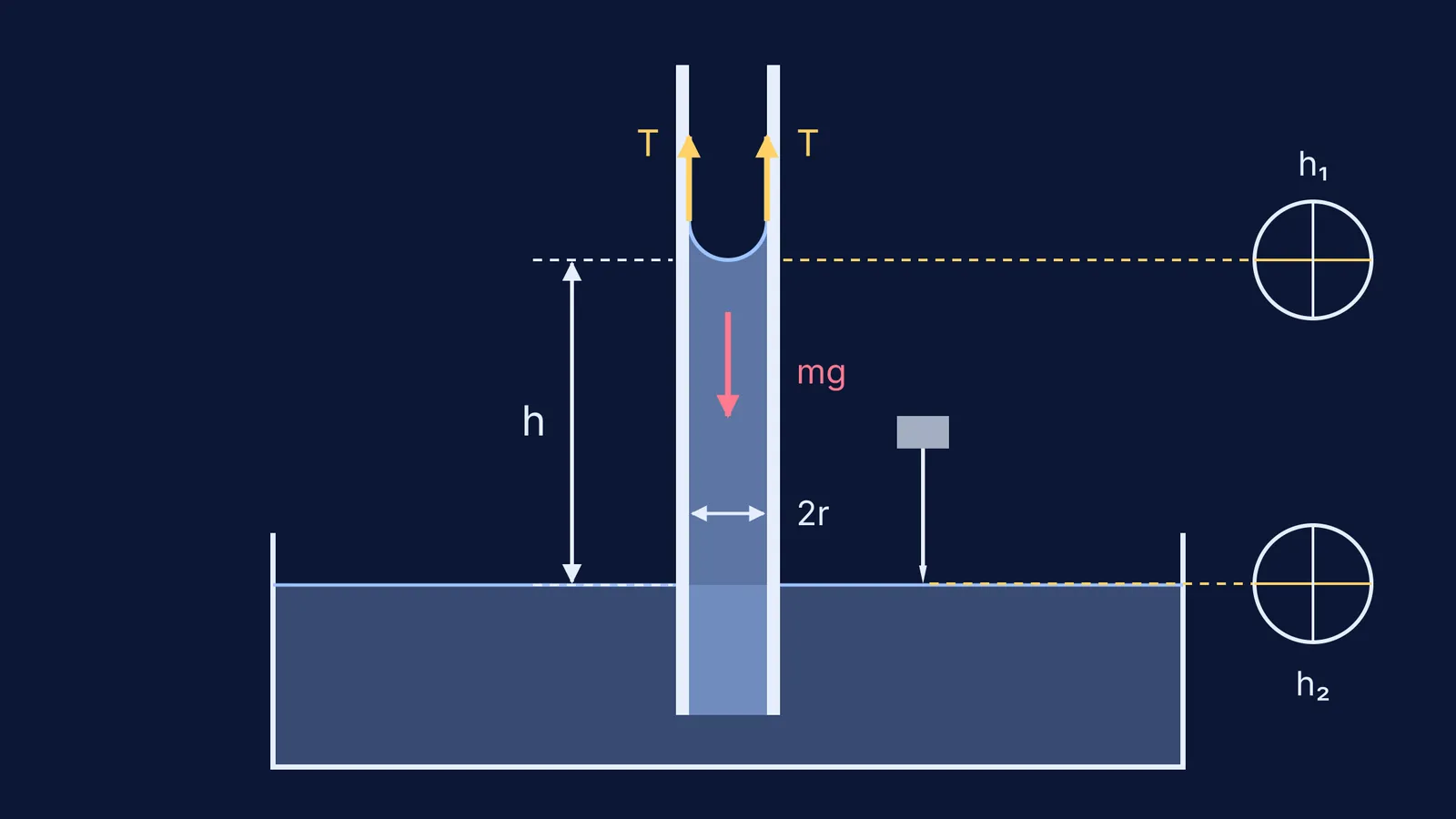
Water climbs a thin glass tube until the upward pull of surface tension around the rim of the meniscus balances the weight of the column below it. The NCERT Class 11 laboratory manual, Experiment 12 writes this balance as 2πrT = πr²hρg, an approximation for water, and rearranges it to T = hρgr/2, where h is the height of the column and r is the inner radius of the tube.
The general form, known as Jurin's law, is h = 2T cos θ / (ρgr), where θ is the contact angle. The contact angle of water on clean glass is close to zero, so cos θ ≈ 1 and the school formula holds. Dirt breaks that assumption.
How do you take the travelling microscope readings?
The NCERT procedure uses a pin to mark the water surface.
Clean the tube and beaker in caustic soda, then dilute nitric acid, then rinse thoroughly with water.
Clamp the tube vertically, checking with a plumb line, and dip its lower end in the water. Note the water temperature.
Lower a pin on a separate clamp until its tip just meets its own reflection in the water.
Focus the microscope on the meniscus. Move it until the horizontal crosswire just touches the lowest point of the meniscus, which looks inverted in the eyepiece. Record h₁.
Mark the meniscus level on the tube, remove the tube and beaker without disturbing the pin, focus on the pin tip and record h₂. Then h = h₁ − h₂.
Each reading is main scale plus vernier divisions times the least count. If verniers slow you down, practise with this vernier caliper reading simulation first.
How do you find the radius of the capillary bore?
Cut the tube at the mark you made, so you measure the bore exactly where the meniscus stood. Clamp it horizontally, focus on the cut end, and read both edges of the bore along one diameter and then along the perpendicular diameter, as the NCERT manual instructs. Average the two diameters, since bores are rarely perfect circles, and halve the result.
Worked example: from readings to T
These are sample readings, not real data. Take a least count of 0.001 cm.
Meniscus h₁ = 10.874 cm, pin tip h₂ = 4.862 cm, so h = 6.012 cm = 0.06012 m
Diameters d₁ = 0.050 cm and d₂ = 0.048 cm, so d = 0.049 cm and r = 0.0245 cm = 2.45 × 10⁻⁴ m
Take ρ = 1000 kg/m³ and g = 9.8 m/s²
T = (0.06012 × 2.45 × 10⁻⁴ × 1000 × 9.8) / 2 ≈ 0.0722 N/m, or 72.2 mN/m.
The IAPWS release on the surface tension of water lists 72.74 mN/m at 20 °C, 71.98 mN/m at 25 °C and 71.19 mN/m at 30 °C; compare with the value at your water's temperature.
Each length is a difference of two readings, so its error is up to two least counts. Using the method in our post on logarithmic differentiation for errors, ΔT/T = Δh/h + Δr/r. That gives 0.002/6.012, about 0.03%, for the height, but 0.002/0.049, about 4%, for the radius. The bore is the weak link.
Why does my surface tension value come out too low?
Most common faults make h, and so T, smaller.
Grease on the glass. A fingerprint or oily film raises the contact angle above zero. The rise shrinks by a factor of cos θ, and a formula that assumes cos θ = 1 reads that as low surface tension.
Soap or other impurities in the water. The NCERT manual lists impurities and temperature among the sources of error. Detergent residue in the beaker lowers T itself.
A dry tube. NCERT warns that water which has risen in a dry tube may not fall back when the level is lowered, which gives a wrong h, so raise and lower the beaker to wet the bore before reading.
A tilted tube or poor focus. Both throw off h.
Warm water. Surface tension falls as temperature rises, as our post on why surface tension decreases with temperature explains. Record the temperature before and after, and compare with the value for that temperature.
If the idea of contact angle is still fuzzy before your viva, the Fermi Concept Library gives each physics concept its own lesson. For practice turning readings into answers, the Fermi Problem Library has worked problems with a step-by-step solver that explains the reasoning rather than printing an answer. Then clean the tube and measure the bore twice.


