On this page
"An angle is twice its supplement. Find the angle." Questions like this appear in school geometry from the NCERT Class 7 chapter on lines and angles onwards. The arithmetic is easy. The hard part is turning the words into an equation, and "twice" causes the most trouble. Below is a four-step method that works on every version of this question, with worked examples you can check yourself.
What do complement and supplement mean?
According to OpenStax Prealgebra, section 9.3, two angles are complementary if their measures add up to 90°, and supplementary if their measures add up to 180°. So if one angle is x, its partner is always one of these:
Complement of x: 90° − x
Supplement of x: 180° − x
The same textbook has a handy memory tip: the words complementary and supplementary are in alphabetical order, just as 90 and 180 are in numerical order.
How do you set up the equation for an angle and its supplement?
OpenStax uses a seven-step strategy for geometry word problems: read the problem and draw a figure, identify what you are looking for, name it with a variable, translate into an equation, solve, check, and answer with a complete sentence (OpenStax Prealgebra, section 9.3). For angle-pair questions you can shorten it to four steps:
Call the unknown angle x.
Write its partner in terms of x: 180° − x for a supplement, 90° − x for a complement.
Translate the sentence word by word. "Is" becomes "=". "Twice" or "three times" multiplies whatever comes right after it. "More than" adds, and "less than" subtracts from the thing named after it.
Solve the equation, then put your answer back into the original sentence.
Worked example: which angle is twice its supplement?
Let the angle be x.
Its supplement is 180° − x.
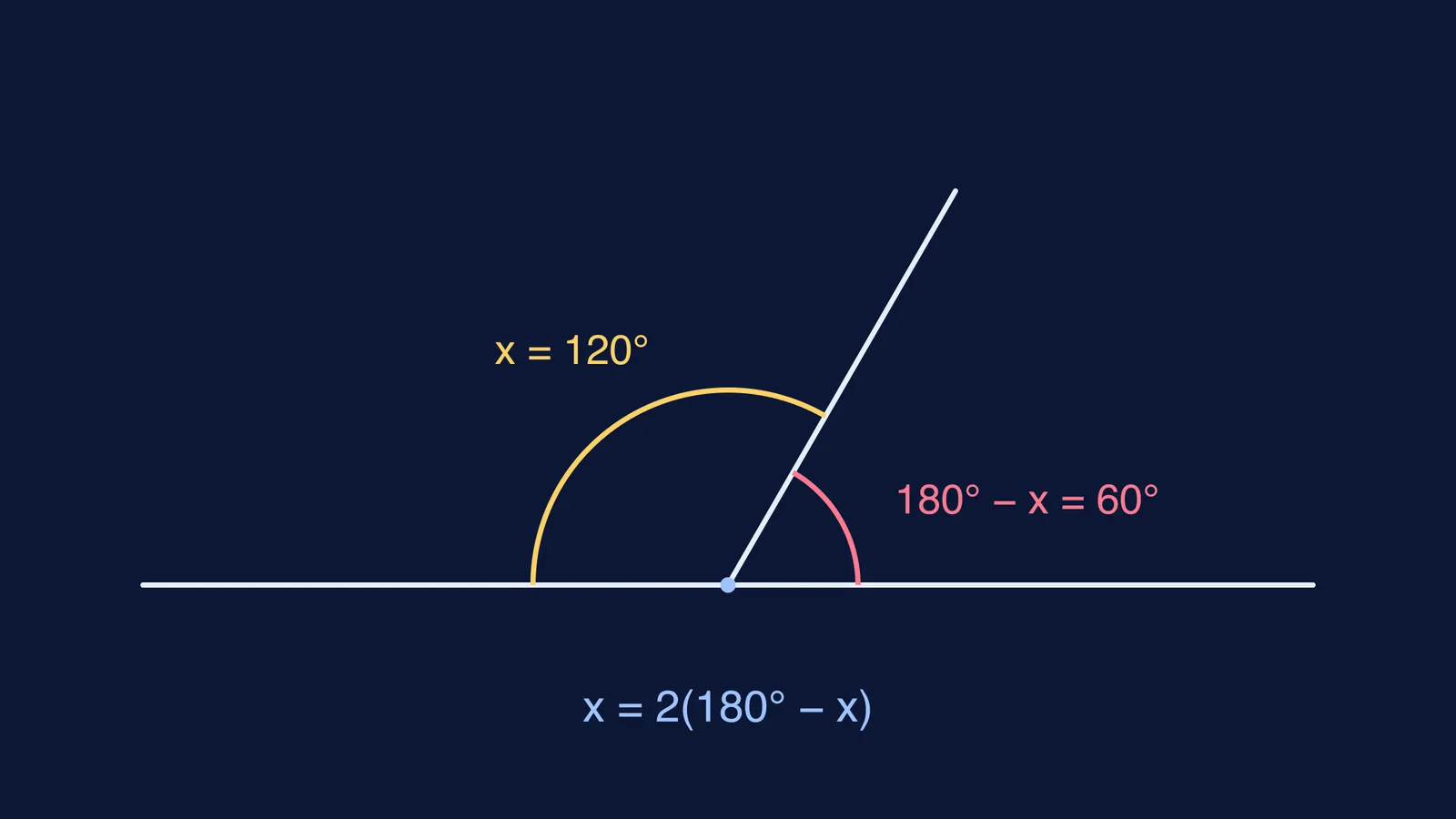
"The angle is twice its supplement" becomes x = 2(180° − x).
Expand: x = 360° − 2x. Add 2x to both sides: 3x = 360°, so x = 120°.
Check: the supplement of 120° is 60°, and 120° is twice 60°. The angle is 120°.
What if the supplement is twice the angle?
Now swap the sentence around: "The supplement of an angle is twice the angle." This time the supplement is on the left of "is", so the equation is 180° − x = 2x. That gives 3x = 180°, so x = 60°. The numbers are the same as before, but the question asks for a different angle.
A quick way to spot which one you have: whichever thing comes before "is" is the larger one when the sentence says "twice". If the angle is twice its supplement, the angle must be more than 90°. If the supplement is twice the angle, the angle must be less than 90°. Decide this before solving and you will catch a backwards equation.
More word forms to practise (with answers)
An angle equal to its complement: x = 90° − x, so x = 45°. This is a question from NCERT Class 7 Lines and Angles, Exercise 5.1 (reproduced with solutions by Vedantu).
An angle equal to its supplement: x = 180° − x, so x = 90°.
An angle is three times its complement: x = 3(90° − x), so 4x = 270° and x = 67.5°.
An angle is 30° less than twice its complement: x = 2(90° − x) − 30°, so 3x = 150° and x = 50°.
The supplement of an angle is four times its complement: 180° − x = 4(90° − x), so 3x = 180° and x = 60°.
Two supplementary angles, the larger 30° more than the smaller: x + (x + 30°) = 180°, which gives 75° and 105° (OpenStax Prealgebra, Example 9.17).
How do you check your answer quickly?
Run these three checks before you move on:
Range: any angle that has a supplement lies between 0° and 180°. An angle that has a complement must be less than 90°. If you get 110° in a complement question, your equation is wrong.
Size: does the bigger-or-smaller relationship match the sentence, as in the "twice" test above?
Read it back: find the partner angle, then say the original sentence with both numbers. "50° is 30° less than twice 40°" is true, so 50° is right.
If setting up equations is where you keep slipping, the Fermi Problem Library has worked problems with a step-by-step solver that explains the reasoning rather than printing an answer, so you can see where the words become the equation. If you're still unsure about the definitions, the Fermi Concept Library gives each concept its own lesson and shows where it fits in the map.
Try the six practice questions again tomorrow without looking at the answers.