On this page
This series is not an AP and not a GP, so neither formula works directly. The fix is one rewrite of each term. In the NCERT Class 11 Mathematics chapter Sequences and Series (reprint 2026-27), Example 10 sums 7 + 77 + 777 + … to n terms, Exercise 8.2 Question 18 asks for 8 + 88 + 888 + …, and Question 11 of the Miscellaneous Exercise asks for 5 + 55 + 555 + … and .6 + .66 + .666 + …. Learn the trick once and you can do all four.
Why isn't 0.7 + 0.77 + 0.777 a GP?
Check the ratios. 0.77 ÷ 0.7 = 1.1, but 0.777 ÷ 0.77 ≈ 1.009. The ratio is not constant, so it is not a GP. The differences are 0.07, then 0.007, so it is not an AP either.
But each term is built from a GP. The term 0.777 is 7 × (0.1 + 0.01 + 0.001), which is seven times a three-term GP.
How do you write each term as (7/9)(1 − 10⁻ᵏ)?
The NCERT chapter gives the sum of the first n terms of a GP with first term a and ratio r ≠ 1 as Sₙ = a(1 − rⁿ)/(1 − r) (NCERT, Section 8.4.2).
The kth term has k sevens after the decimal point:
tₖ = 7 × (0.1 + 0.01 + … + 10⁻ᵏ)
The bracket is a GP with a = 1/10 and r = 1/10, so it equals (1/10)(1 − 10⁻ᵏ)/(9/10) = (1/9)(1 − 10⁻ᵏ)
So tₖ = (7/9)(1 − 10⁻ᵏ)
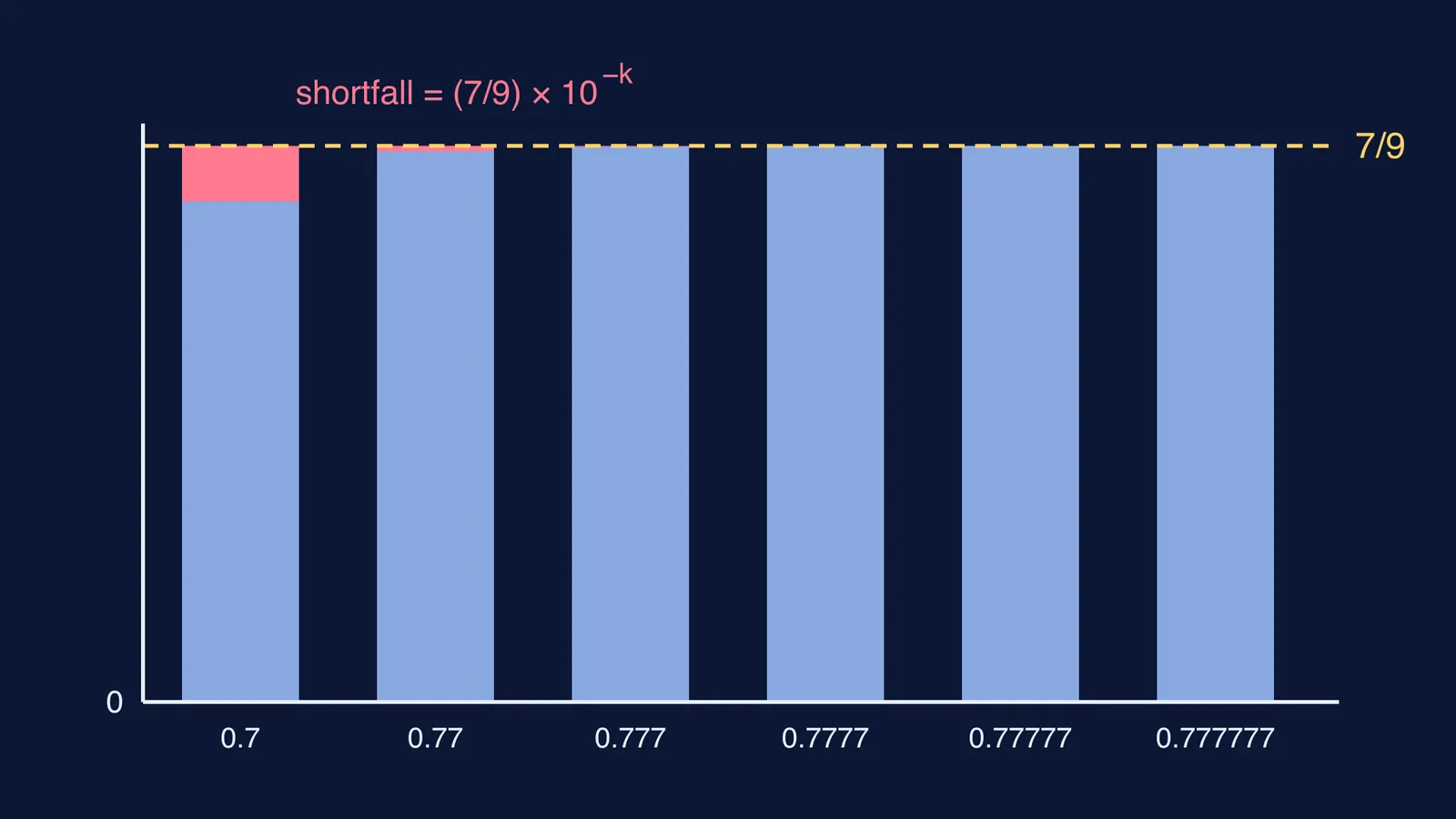
There is a quicker way to see it. The recurring decimal 0.777… equals 7/9. Stopping after k sevens leaves you short by exactly (7/9) × 10⁻ᵏ. For k = 3: 7/9 − 0.000777… = 0.777. The hero diagram shows this shortfall shrinking tenfold with every term.
What is the sum of 0.7 + 0.77 + 0.777 to n terms?
Sₙ = (7/9)[(1 − 1/10) + (1 − 1/10²) + … + (1 − 1/10ⁿ)]
Collect the 1s and the powers separately: Sₙ = (7/9)[n − (1/10 + 1/10² + … + 1/10ⁿ)]
Sum the GP in the second bracket with a = 1/10, r = 1/10: it is (1/9)(1 − 10⁻ⁿ)
So Sₙ = (7/9)n − (7/81)(1 − 10⁻ⁿ)
Over a common denominator: Sₙ = (7/81)(9n − 1 + 10⁻ⁿ)
Now test it. For n = 1, (7/81)(8.1) = 0.7. For n = 2, (7/81)(17.01) = 1.47, which matches 0.7 + 0.77. For n = 3, (7/81)(26.001) = 2.247, which matches 1.47 + 0.777.
For large n, the 10⁻ⁿ part fades away, so Sₙ gets very close to (7/9)n − 7/81. The sum keeps growing without limit, because every term is close to 7/9.
How does the same trick solve 5 + 55 + 555?
For whole numbers the rewrite flips. 555 = 5 × 111 = (5/9) × 999 = (5/9)(10³ − 1). So the kth term is (5/9)(10ᵏ − 1), and the GP now has a = 10 and r = 10.
Sₙ = (5/9)[(10 + 10² + … + 10ⁿ) − n]
The GP gives 10(10ⁿ − 1)/9
So Sₙ = (5/81)(10ⁿ⁺¹ − 9n − 10)
Check n = 3: (5/81)(10000 − 27 − 10) = (5/81)(9963) = 615, and 5 + 55 + 555 = 615. This is the route NCERT's Example 10 takes for 7 + 77 + 777, turning each term into (7/9) times a string of 9s (NCERT, Example 10).
The one-line rule to remember: decimals use (1 − 10⁻ᵏ), whole numbers use (10ᵏ − 1).
Which mistakes cost marks on this question?
Forgetting the n. The 1s (or the −1s) add up to n, not to 1.
Using r = 10 for the decimal series. In 0.7 + 0.77 + …, the powers are 1/10, 1/10², …, so r = 1/10.
Starting the GP at 1 instead of 1/10 (or at 1 instead of 10 for 5 + 55 + …). Write out the first two terms of the GP before using the formula.
Losing the 9 twice. The answer has 81 in the denominator because one 9 comes from rewriting the term and another from the GP formula.
If your answer to a practice question does not match, find the exact line where it went wrong rather than starting again. The Fermi Problem Library has worked problems with a step-by-step solver that explains the reasoning rather than printing an answer, so you can compare your working line by line. If the GP formula itself feels shaky, rebuild it first in the Fermi Concept Library.
Do the four NCERT versions in one sitting, checking each with n = 1 and n = 2.