On this page
Draw the tangent and the normal at a point P on a curve, drop a perpendicular from P to the x-axis, and you get two short segments on that axis. For the parabola y² = 4ax, one of them never changes at all, and the other follows a neat rule. Both can save steps in JEE Main coordinate geometry questions, once you know where they come from.
What are the subtangent and subnormal?
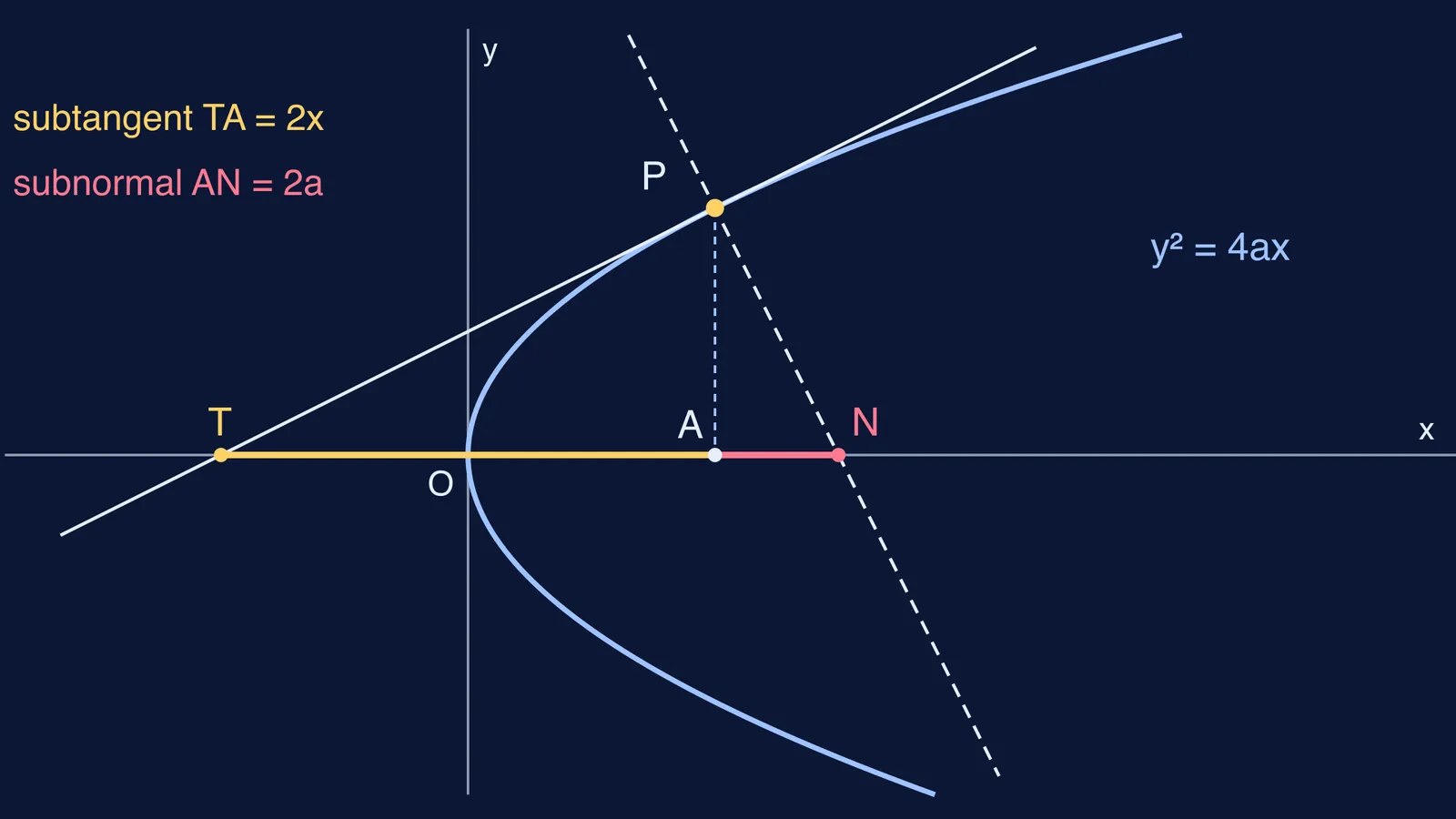
Take a point P(x, y) on a curve and let A be the foot of the perpendicular from P to the x-axis. So A is (x, 0), and PA is the ordinate.
The subtangent is the segment on the x-axis from the point T where the tangent at P meets the axis to the foot A of the ordinate (Wolfram MathWorld, Subtangent).
The subnormal is the segment on the x-axis from the foot A to the point N where the normal at P meets the axis (Wolfram MathWorld, Subnormal).
When dy/dx is finite and not zero, their lengths are:
subtangent TA = y ÷ (dy/dx)
subnormal AN = y · (dy/dx)
MathWorld treats both as directed lengths. Wikipedia's article on the subtangent writes the same results as y cot φ and y tan φ, where φ is the angle the tangent makes with the x-axis. Wikipedia also notes that the terms are somewhat archaic today, though they were in common use until the early 20th century.
Why is the subnormal of y² = 4ax always 2a?
Differentiate y² = 4ax with respect to x:
2y · (dy/dx) = 4a
So dy/dx = 2a ÷ y
Subnormal = y · (dy/dx) = y · (2a ÷ y) = 2a
The y cancels, so the answer has no x or y in it. Whichever point you choose, the normal meets the axis at (x + 2a, 0), exactly 2a to the right of the foot of the ordinate.
And 2a is not a random number: it is the semi-latus rectum, half the chord through the focus perpendicular to the axis. Jeremy Tatum's notes on the parabola, which write it as y² = 4qx (LibreTexts, Celestial Mechanics, 2.3/02:_Conic_Sections/2.03:_The_Parabola)), call this "a curious property": the subnormal is always equal to the length of the semi-latus rectum, whatever the point.
Why is the subtangent of a parabola twice the abscissa?
Use the same slope, dy/dx = 2a ÷ y:
Subtangent = y ÷ (dy/dx) = y · y ÷ 2a = y² ÷ 2a
On the parabola, y² = 4ax, so the subtangent = 4ax ÷ 2a = 2x
So the subtangent is twice the abscissa of P. Since TA = 2x and A sits at (x, 0), the tangent must cut the axis at T(−x, 0). So the vertex O is the midpoint of TA.
Worked example: subtangent and subnormal on y² = 12x
Here 4a = 12, so a = 3. The rules predict a subnormal of 6 everywhere and a subtangent of 2x.
Point P(3, 6). Check: 6² = 36 = 12 × 3. Slope dy/dx = 2a ÷ y = 6 ÷ 6 = 1.
Tangent: y − 6 = 1(x − 3), so y = x + 3. It meets the x-axis at T(−3, 0).
Normal: slope −1, so y − 6 = −(x − 3), giving y = 9 − x. It meets the x-axis at N(9, 0).
Foot of the ordinate: A(3, 0). Subtangent TA = 3 − (−3) = 6 = 2 × 3. Subnormal AN = 9 − 3 = 6 = 2a.
Now move to P(12, 12). Slope = 6 ÷ 12 = 1/2. Tangent meets the axis at x = 12 − 12 ÷ (1/2) = −12, so the subtangent is 24 = 2 × 12. Normal meets the axis at x = 12 + 12 × (1/2) = 18, so the subnormal is 18 − 12 = 6 again.
Try the lower branch, P(3, −6). Slope = 6 ÷ (−6) = −1, and y · (dy/dx) = (−6)(−1) = 6. Same subnormal, and N is still (9, 0).
The subtangent grew from 6 to 24; the subnormal stayed at 6.
Where do students lose marks on this?
Mixing up the two formulas. Subtangent divides by the slope; subnormal multiplies by it.
Using x instead of a. On y² = 12x the subnormal is 6, not 12 and not 3. Find a first.
Applying the result to the wrong parabola. For x² = 4ay the roles of x and y swap, so redo the calculation rather than quoting 2a.
Forgetting that the formulas need a finite, non-zero slope. At the vertex the tangent is the y-axis itself, and the segments are not defined in the usual way.
If the tangent step itself is shaky, our posts on the tangent to the parabola y² = 4ax in slope form and the focus, directrix and latus rectum of y² = 4ax cover the groundwork. For practice, the Fermi Problem Library has worked problems with a step-by-step solver that explains the reasoning rather than printing an answer, so you can see exactly where a subtangent calculation went wrong.
Next time you meet a normal to y² = 4ax, mark the point 2a to the right of the ordinate first.