

On this page
You see dy/dx = (4x + y + 1)² and can't separate it: x and y are locked inside one bracket. The fix is one substitution plus one line of differentiation, and that line is where marks get lost.
Why does the substitution v = ax + by + c work?
The right side depends on x and y only through ax + by + c. Call that v and the right side becomes f(v), a function of one variable.
S. Ghorai's MTH203 lecture notes, hosted on IIT Kanpur's website, state that for y′ = F(ax + by + c) with b ≠ 0, substituting ax + by + c = v reduces the equation to a separable form, and that if b = 0 it is already separable (IIT Kanpur lecture notes, Lecture III).
The left side still says dy/dx, so that has to be rewritten in terms of v too.
What is the derivative step students skip?
Differentiate v = ax + by + c with respect to x. The constant c disappears, and y is a function of x:
dv/dx = a + b·dy/dx
Now replace dy/dx with f(v):
dv/dx = a + b·f(v)
Only v and x are left, so separate: dv/(a + b·f(v)) = dx, then integrate both sides.
The method as a checklist:
Check that x and y appear only through ax + by + c.
Set v = ax + by + c.
Write dv/dx = a + b·dy/dx on its own line.
Substitute f(v) for dy/dx.
Separate and integrate.
Put ax + by + c back for v, then differentiate to check.
Worked example 1: dy/dx = (x + y)²
Put v = x + y. Then dv/dx = 1 + dy/dx = 1 + v².
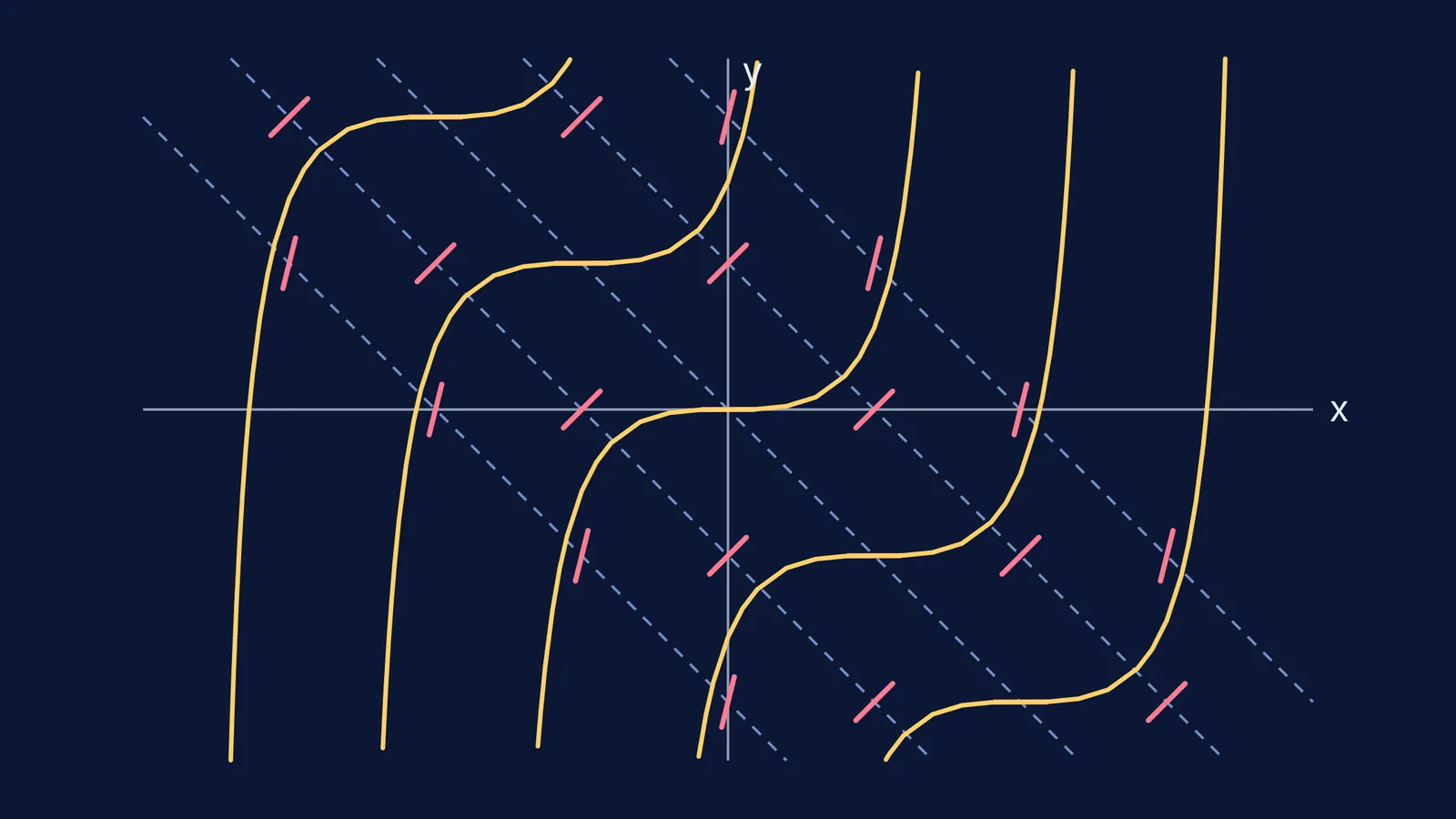
Separate: dv/(1 + v²) = dx. Integrating gives tan⁻¹ v = x + C, so x + y = tan(x + C), or y = tan(x + C) − x. This matches Example 2 in the IIT Kanpur notes linked above.
Skip the derivative step and write dv/dx = v², and you get y = −1/(x + C) − x. Its derivative is 1/(x + C)² − 1, but (x + y)² = 1/(x + C)². They differ by exactly 1, the missing a. Differentiating catches this; see how to verify that a function solves a differential equation.
Worked example 2: dy/dx = (4x + y + 1)² with y(0) = −1
Put v = 4x + y + 1. Then dv/dx = 4 + dy/dx = 4 + v².
Separate and integrate: ∫ dv/(v² + 4) = ∫ dx gives (1/2) tan⁻¹(v/2) = x + C. Rearranged, v = 2 tan(2x + K), where K = 2C.
At x = 0, y = −1, so v = 0, tan K = 0 and K = 0. The answer is y = 2 tan 2x − 4x − 1.
Check: dy/dx = 4 sec² 2x − 4 = 4 tan² 2x, and 4x + y + 1 = 2 tan 2x squares to the same thing. Renaming 2C as K is allowed for the same reason we often write the constant of integration as ln C.
What changes when b is negative?
Take dy/dx = (x − y)² + 1. Put v = x − y, so dv/dx = 1 − dy/dx. The minus sign is the part to watch.
Substituting gives dv/dx = 1 − (v² + 1) = −v². Separate: −dv/v² = dx, which gives 1/v = x + C. So x − y = 1/(x + C), or y = x − 1/(x + C).
Dividing by v² assumed v ≠ 0. Try v = 0, meaning y = x: dy/dx = 1 and (x − x)² + 1 = 1. So y = x is also a solution, which the general formula misses. The IIT Kanpur notes ask the same question of separable equations: what happens when the factor you divide by is zero?
How is this different from (x + y + 1)/(2x + y + 3)?
When the right side is a ratio of two linear expressions whose lines are not parallel, one v won't do; you shift the origin to where the lines meet. When the coefficients are proportional, as in (x + y + 1)/(2x + 2y + 3), the whole right side is a function of x + y, and v = x + y works as above.
If you keep landing on wrong answers, the Fermi Problem Library has worked problems with a step-by-step solver that explains the reasoning rather than printing an answer, so you can find the line where yours went off. If separating variables still feels shaky, the Fermi Concept Library gives every concept in mathematics its own lesson.
Try it now: solve dy/dx = cos(x + y) with v = x + y. Write the derivative line first, then use 1 + cos v = 2 cos²(v/2).


