

On this page
When you first learn to integrate, the constant of integration is a simple + C added to the end of every answer. But in differential equations, that constant starts to behave strangely. Textbooks routinely change C to ln C, swap e^C for k, or swallow negative signs entirely.
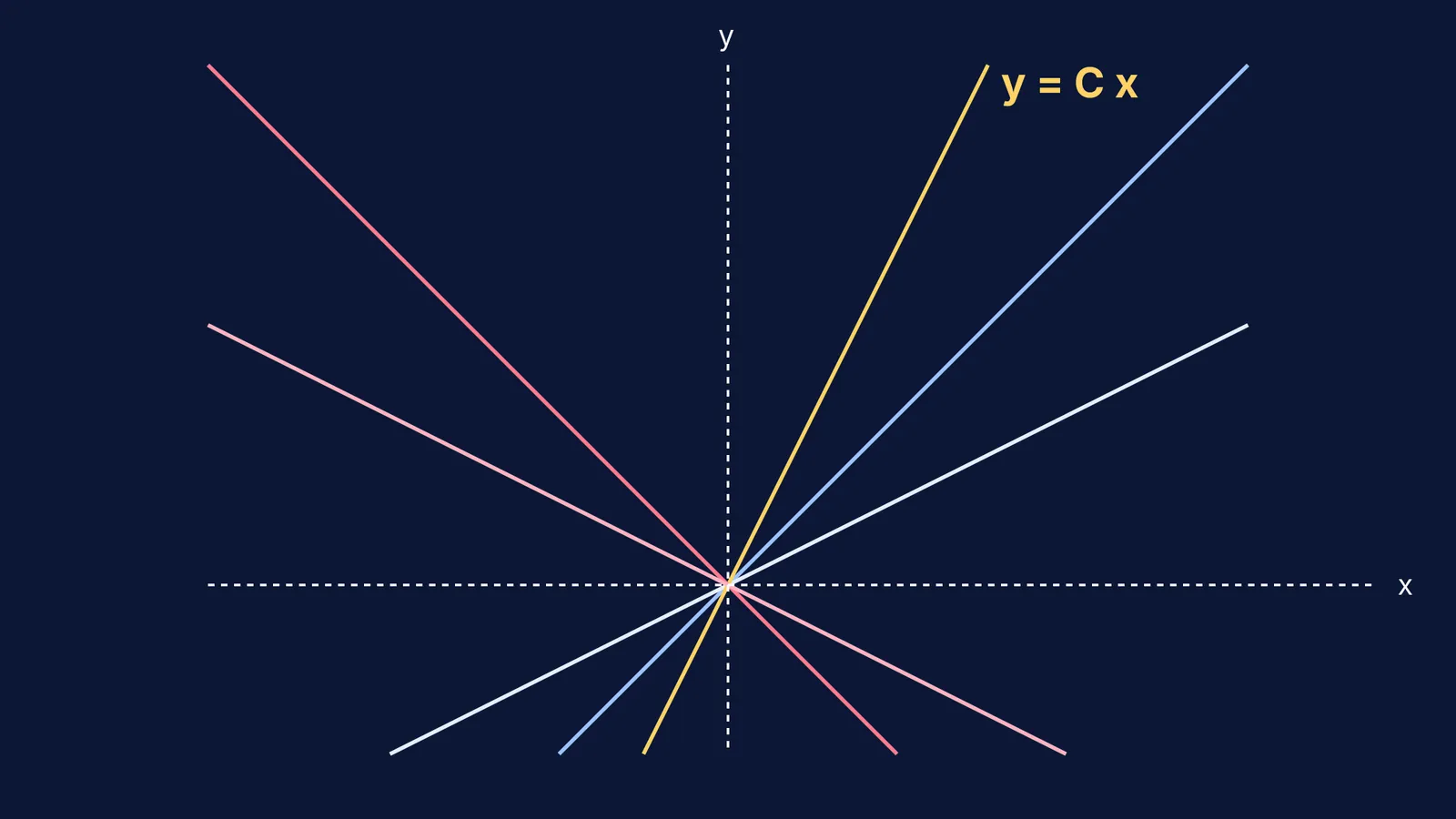
If you have ever checked your answer against a textbook and found y = Cx instead of your messy ln y = ln x + C, you might wonder if you skipped a step. You didn't. The textbook just used an algebraic trick.
What is the constant of integration?
In calculus, the constant of integration is an arbitrary constant added to an antiderivative to represent the set of all antiderivatives of a function. Because the derivative of any constant number is zero, integrating backwards cannot tell you exactly which original function you started with.
In differential equations, this constant is what allows a general solution to fit specific initial conditions. If a problem tells you that a physical system started from rest, or a bacterial culture began with 100 cells, you use that initial state to find the exact value of the constant.
Why is ln C allowed as a constant?
When you integrate ∫ (1/x) dx, you get ln|x| + C. Because C is an arbitrary constant, it can represent any real number.
The natural logarithm function, ln(x), has a range that covers all real numbers from negative infinity to positive infinity. Therefore, writing ln C (where C > 0) is mathematically identical to writing a standard constant C. It still represents any possible real number you might need to satisfy your initial conditions.
According to Paul's Online Math Notes, when you pick up constants of integration on both sides of a separable equation, they can be moved to the same side and absorbed into each other to create a single arbitrary constant.
How does ln C simplify differential equations?
We write the constant as ln C purely for algebraic convenience. When every other term in an equation is a logarithm, adding ln C allows you to combine all terms using the properties of logarithms.
Consider a simple separable equation, dy/dx = y/x. When we separate the variables and integrate, we get:
∫ (1/y) dy = ∫ (1/x) dx ln|y| = ln|x| + C
If we leave the constant as C, the next algebraic step is to clear the natural logarithm by making both sides the exponent of e:
|y| = e^(ln|x| + C) |y| = e^(ln|x|) × e^C y = ±x e^C
Because e^C is just a constant, and the ± sign simply allows that constant to be negative, we can redefine the entire chunk ±e^C as a new constant, k. This leaves us with y = kx.
Now, see what happens if we write the initial constant as ln C instead:
ln|y| = ln|x| + ln C
Using the logarithm addition rule (ln a + ln b = ln(ab)), we combine the right side:
ln|y| = ln(Cx)
Drop the logarithms from both sides, and you immediately have the final answer:
y = Cx
Writing ln C skips the clumsy exponentiation step entirely. It is the preferred method for solving homogeneous differential equations where multiple logarithmic terms are common.
Why do constants get absorbed?
Mathematicians absorb constants to keep the general solution as neat as possible before applying initial conditions. In models of population growth and cooling, the equation dy/dt = ky integrates to ln y = kt + C. The constant is immediately absorbed to form y = C e^(kt).
If you are solving an initial value problem, waiting to calculate the constant until after you have isolated y is a common source of mistakes. Paul's Online Math Notes recommends solving for the constant as soon as it is algebraically convenient, which is often before getting an explicit solution, rather than waiting until the end.
If you add the constant only after rearranging the equation, your solution will no longer satisfy the original differential equation. This is especially true when proving relations with second-order derivatives, where missing a constant early on will derail the entire proof.
If you are working through a tough assignment and cannot figure out how a textbook simplified its answer, Fermi's AI tutor can help. Because the tutor teaches rather than answers, it can show you exactly where a constant was absorbed. You can also explore integration rules in the Concept Library or practice separable equations in the Fermi Problem Library.
By redefining C whenever it is wrapped in an exponent or a logarithm, you ensure your final equation is clean, linear, and ready for initial values.


