

On this page
"Strong" and "concentrated" turn up in the same chapters, so many students treat them as the same thing. They aren't. One word describes the acid itself, and the other describes how much of it is in the water. An exam question can test the difference in a single line.
What does "strong acid" actually mean?
Strength is about what fraction of the acid molecules give up a hydrogen ion in water. The NCERT Class 11 chemistry chapter on equilibrium compares the two textbook cases: hydrochloric acid is completely ionised, while acetic acid is only partially ionised, at less than 5% (NCERT, Chemistry Part I, Unit 6).
OpenStax puts it the same way: if the ionisation reaction is essentially complete, the acid is called strong (OpenStax Chemistry 2e, 14.3).
For a weak acid, strength is measured by its ionisation constant, Ka. Acetic acid (ethanoic acid, the acid in vinegar) has Ka = 1.8 × 10⁻⁵ (OpenStax Chemistry 2e, 14.3). Ka belongs to the acid (at a given temperature), so adding water does not change it.
What does "concentrated acid" mean?
Concentration is the amount of acid per litre of solution, usually given as molarity (mol/L). Concentrated means a lot per litre; dilute means little. Neither word says how much of that acid ionises.
This gives four combinations, and all four exist:
Strong and concentrated: 1 M hydrochloric acid
Strong and dilute: 0.001 M hydrochloric acid
Weak and concentrated: 1 M acetic acid
Weak and dilute: 0.001 M acetic acid
There is one link between the two ideas. The percentage of a weak acid that ionises changes with concentration, usually going down as concentration goes up, even though Ka stays the same (OpenStax Chemistry 2e, 14.3). This is Ostwald's dilution law, which we explain in our piece on Ostwald's dilution law for weak electrolytes.
Can a dilute acid have a lower pH than a concentrated one?
Yes, and working through it once is the quickest way to remember the difference. pH is defined as pH = −log[H₃O⁺], where [H₃O⁺] is the molar concentration of hydronium ions (OpenStax Chemistry 2e, 14.2).
Case 1: 0.01 M HCl (dilute, strong). HCl ionises completely, so [H₃O⁺] = 0.01 M and pH = 2.00.
Case 2: 1 M CH₃COOH (concentrated, weak). Let x be the [H₃O⁺] at equilibrium.
Write Ka = x² / (1 − x) = 1.8 × 10⁻⁵.
Because x is tiny compared with 1, take x² ≈ 1.8 × 10⁻⁵, so x ≈ 4.2 × 10⁻³ M.
pH = −log(4.2 × 10⁻³) = 2.37.
Percent ionised = 0.0042 / 1 × 100 ≈ 0.42%.
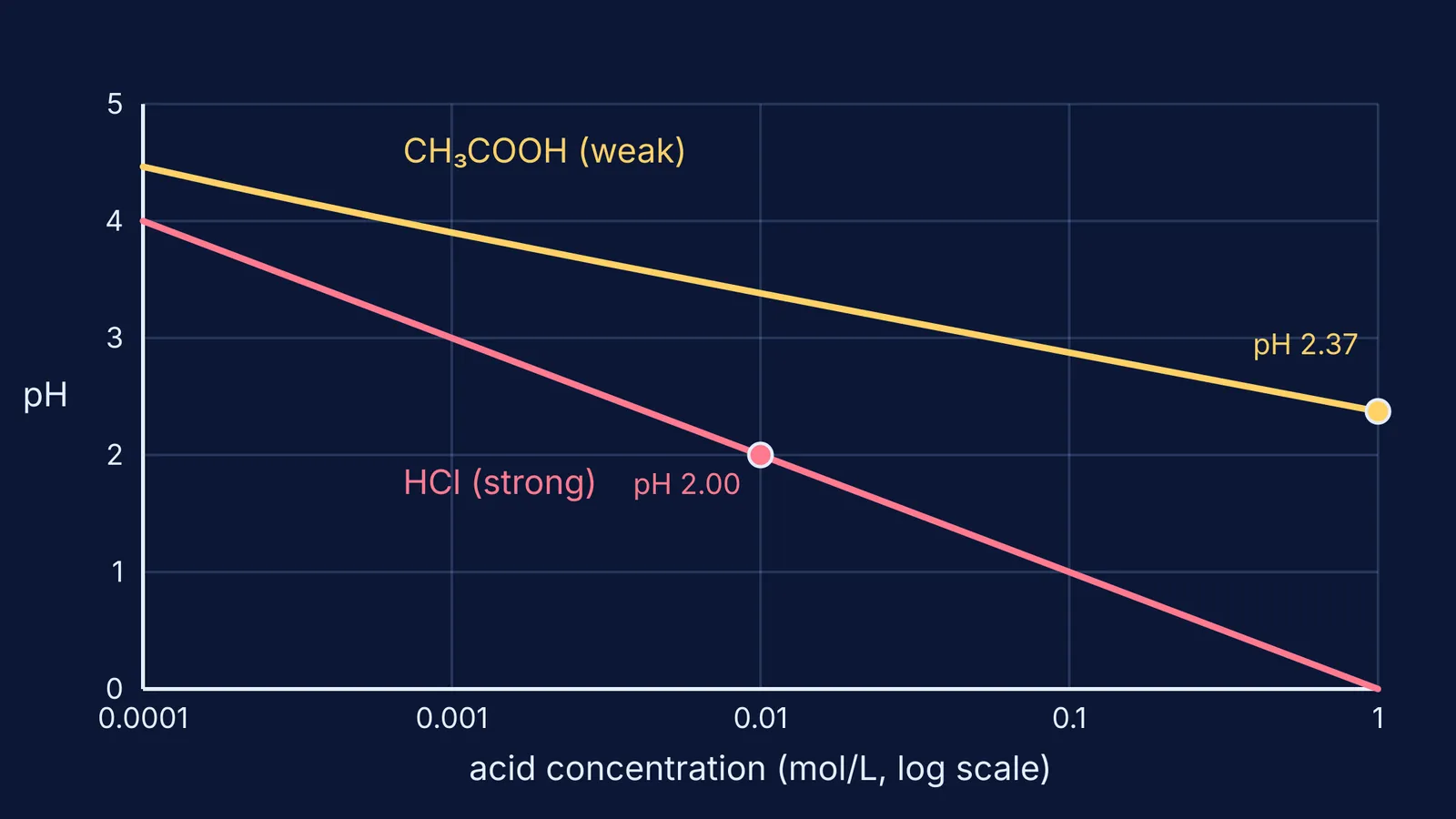
The acetic acid solution holds 100 times more acid per litre, yet it has fewer free hydronium ions (0.0042 M against 0.01 M), so its pH is higher. Running the same Ka = 1.8 × 10⁻⁵ through the full quadratic at four concentrations shows the pattern:
0.001 M: HCl pH 3.00; acetic acid pH 3.90, about 12.5% ionised
0.01 M: HCl pH 2.00; acetic acid pH 3.38, about 4.2% ionised
0.1 M: HCl pH 1.00; acetic acid pH 2.88, about 1.3% ionised
1 M: HCl pH 0.00; acetic acid pH 2.37, about 0.42% ionised
The 0.1 M row matches OpenStax's worked example of 1.3% (OpenStax Chemistry 2e, 14.3). Very concentrated solutions don't behave ideally, so the 1 M HCl value is the textbook answer, not a meter reading.
If you want to go the other way, from a measured pH back to Ka, see how to find Ka from the pH of a weak acid.
How do you tell which word a question needs?
Use this four-step check on any acid question:
Ask whether it is about how much acid is in the solution. If so, the words are concentrated or dilute and the number is molarity.
Ask whether it is about what fraction of the acid ionises. If so, the words are strong or weak and the number is Ka, or percent ionisation.
For pH, a strong monoprotic acid gives [H⁺] = C. A weak acid gives [H⁺] ≈ √(Ka × C), as long as the ionisation stays small; check by working out the percentage.
Describe any solution with both words, for example: "Acetic acid is a weak acid; this 1 M solution is concentrated." This is the sentence to use in a "distinguish between" board answer.
The Fermi Problem Library has worked problems with a step-by-step solver that explains the reasoning rather than printing an answer. That helps when you get the pH right but are not sure why the √(Ka × C) shortcut was allowed. If strength, Ka and percent ionisation still feel tangled, the Fermi Concept Library gives each chemistry concept its own lesson and its place in the map.
Does a weak acid mean a safe acid?
No. "Weak" describes ionisation, not safety. Concentrated acids of either kind need care, and the order of mixing matters. Before your next practical, read why you add acid to water when diluting.


