On this page
Most students stuck on a physics numerical know the formulas. What they lack is an order of work. Here is one, shown on a Class 11 problem.
What do expert physicists do differently?
In a 1981 study, Michelene Chi, Paul Feltovich and Robert Glaser asked experts and novices to sort and talk through physics problems (Cognitive Science, 1981). Experts began by abstracting the physics principle that would solve the problem. Novices built their picture of the problem from its literal features, the objects and words on the page.
A year earlier, Jill Larkin and colleagues, including Herbert Simon, compared experts and novices solving physics problems (Science, 1980). Their conclusion: experts need a large body of knowledge, but that knowledge must be indexed by patterns that, once recognised, guide them in a fraction of a second to the part they need.
In a large introductory college physics course, Patricia Heller, Ronald Keith and Scott Anderson taught an explicit problem-solving strategy, which students practised in mixed-ability groups (American Journal of Physics, 1992). The groups produced better solutions than students working alone, and the approach improved problem solving for students at all ability levels.
The lesson for you: practising a written method is one way to build the habit experts show, which is deciding the principle before touching an equation.
What is the step-by-step method to solve physics problems?
Read: list what is given, what is asked, and any hidden information ("from rest" means initial speed is zero; "smooth" means no friction).
Draw: sketch the situation, mark the start and end states, and label every quantity with a symbol.
Choose the principle: Newton's second law, conservation of energy, conservation of momentum, and so on. Write one line on why it fits.
Write the equations that principle gives, in symbols only.
Solve in symbols for the unknown, then put in the numbers last.
Check units and limits: does the answer have the right unit, and does it behave sensibly when a quantity goes to zero or becomes very large?
How does the method work on a real problem?
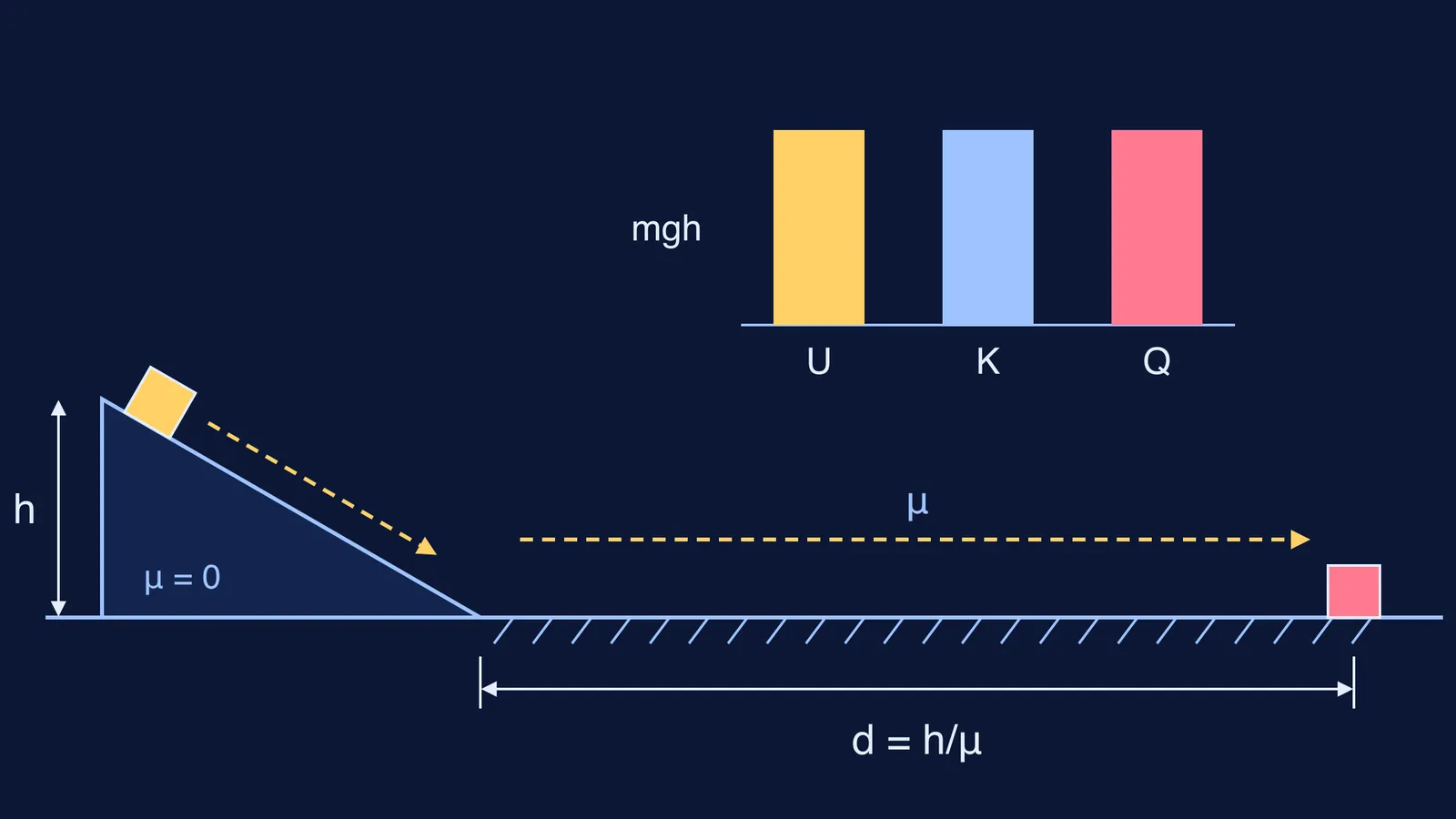
The problem: a 2 kg block is released from rest at the top of a smooth slope 0.8 m high. It slides down and onto a rough horizontal floor with coefficient of kinetic friction 0.25. How far along the floor does it travel before it stops?
Read. Given: m = 2 kg, h = 0.8 m, μ = 0.25. Hidden: it starts from rest and ends at rest; the slope has no friction. Asked: the distance d on the floor.
Draw. Slope on the left, floor to the right, block at the top and the stopping point marked d from the foot of the slope.
Choose the principle. The question asks for a distance, not a time, and the start and end speeds are both zero. That points to work and energy. Newton's laws would also work, but you would need the acceleration on two separate stretches.
Write the equations. From start to stop, the change in kinetic energy is zero, so the work done by gravity equals the work done against friction: mgh = μmg d.
Solve in symbols. Divide both sides by mg: d = h/μ. Only now put in numbers: d = 0.8 / 0.25 = 3.2 m.
Check units and limits. Metres divided by a pure number gives metres. If μ goes to zero, d becomes infinite: on a frictionless floor the block never stops, which is right. If h goes to zero, so does d. The mass cancelled, so a 20 kg block travels just as far. The slope's angle never appears, because a smooth slope takes no energy away.
What should you check before you move on?
Can you say in one sentence which principle you used and why?
Does every symbol in your equations appear on your drawing?
Is the unit of your answer right?
Did you test at least one limit (zero friction, zero height, a very large mass)?
Did a quantity cancel? If so, can you explain why physically?
If you keep landing on the wrong principle at step 3, the Fermi Problem Library has worked problems with a step-by-step solver that explains the reasoning rather than printing an answer. If the trouble is the concept itself, say work done by friction, the Fermi Concept Library gives each concept in physics its own lesson.
How do you practise this until it becomes automatic?
Take five problems from one chapter. For each, do only steps 1 to 3: list the givens, sketch, and write the principle with a one-line reason. Do not solve yet. Then solve one of the five fully, all six steps, and check whether your principle held up. Then mix chapters, so the principle has to come from what is asked, not from what the picture looks like.
Start with the problem above: cover the solution and work it through yourself.