

On this page
Series and parallel rules solve most resistor problems. When nothing combines, the star-delta transformation reshapes three resistors without changing anything the rest of the circuit can measure.
When do you need a star-delta transformation?
Resistors are in series only if the same current passes through both, and in parallel only if they share both end nodes. If one passes neither test, look for:
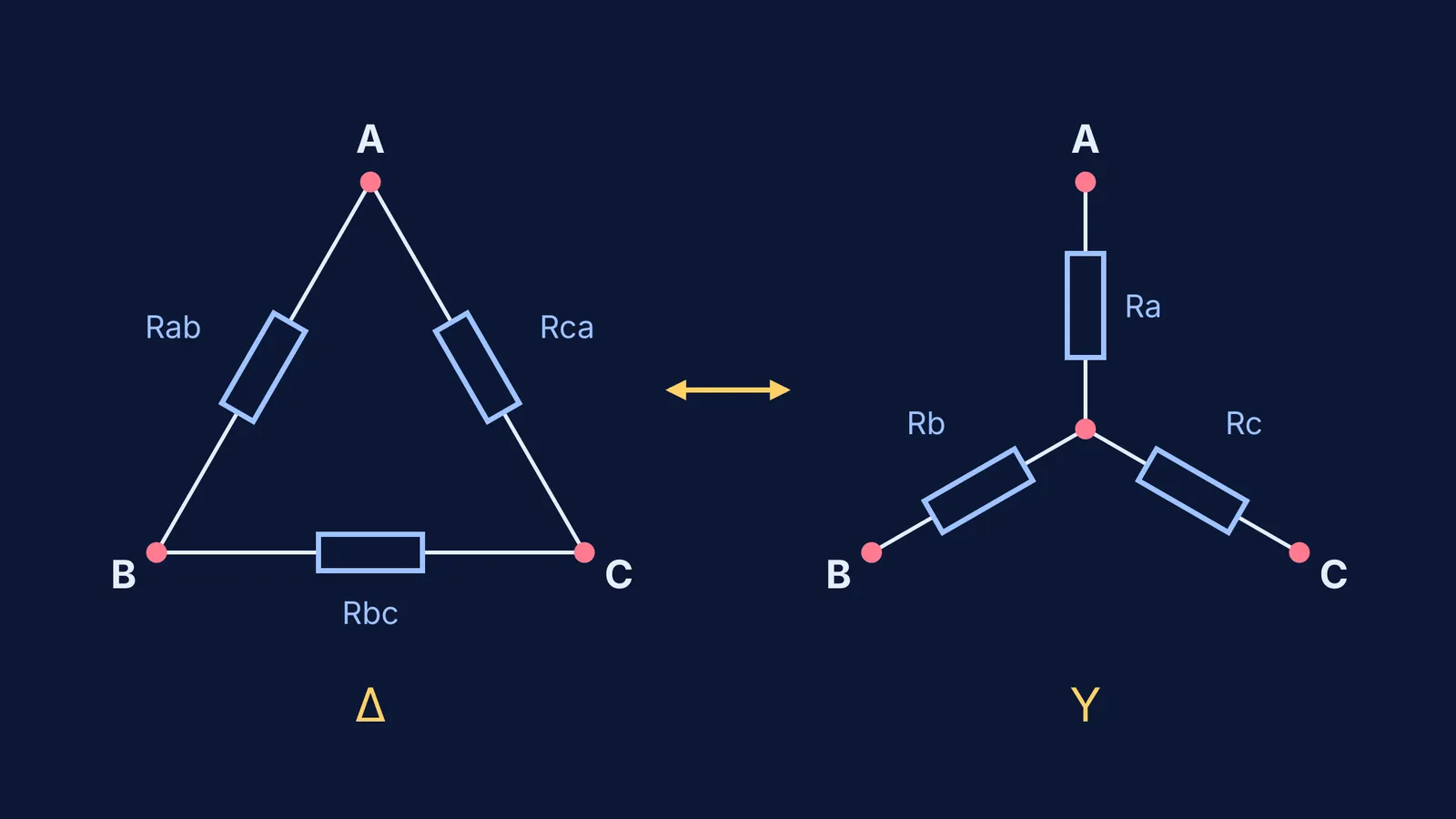
A delta: three resistors forming a closed triangle between three nodes.
A star: three resistors meeting at one node that has no other connection.
Check for a balanced bridge first: if the ratios match, the middle resistor carries no current and can go. If not, convert. The node-potential method for unbalanced capacitor bridges works as a cross-check.
What are the star-delta formulas?
Arthur Edwin Kennelly published the star-delta (Y-Δ) transform in 1899 in Electrical World and Engineer, vol. 34, pp. 413-414 (Y-Δ transform, Wikipedia).
Label the corners A, B and C. Name each delta resistor after the two corners it joins (Rab, Rbc, Rca) and each star arm after the corner it touches (Ra, Rb, Rc).
Delta to star: Ra = (Rab × Rca) / (Rab + Rbc + Rca). Each arm is the product of the two delta resistors touching that corner, divided by the sum of all three.
Star to delta: Rab = (Ra × Rb + Rb × Rc + Rc × Ra) / Rc. Each delta resistor is the sum of the pairwise products, divided by the star arm opposite it.
Equal resistors: a delta of three R becomes a star of three R/3, and back.
Network 1: an unbalanced Wheatstone bridge (delta to star)
Find the resistance between A and B. A to C is 10 Ω, A to D is 20 Ω, the bridge C to D is 20 Ω, C to B is 12 Ω and D to B is 8 Ω. Since 10/12 ≠ 20/8, the bridge is unbalanced.
Convert the delta A, C, D (10, 20 and 20 Ω; sum 50 Ω).
Star arms: at A, 10 × 20 / 50 = 4 Ω; at C, 10 × 20 / 50 = 4 Ω; at D, 20 × 20 / 50 = 8 Ω.
From the new centre to B: 4 + 12 = 16 Ω in parallel with 8 + 8 = 16 Ω, giving 8 Ω.
Add the arm at A: R = 4 + 8 = 12 Ω.
Quick check: with 1 A in, A sits at 12 V, C at 6 V and D at 4 V, and the currents in the original bridge balance at every node.
Network 2: a star hidden in the middle (star to delta)
Node O joins A by 1 Ω, B by 2 Ω and C by 2 Ω. Also, A to C is 2 Ω and C to B is 8 Ω. Find the resistance between A and B.
Star arms Ra = 1, Rb = 2, Rc = 2 give pairwise products 2 + 4 + 2 = 8.
Delta: Rab = 8/2 = 4 Ω, Rbc = 8/1 = 8 Ω, Rca = 8/2 = 4 Ω.
Add the resistors already there: A to C is 4 ∥ 2 = 4/3 Ω; C to B is 8 ∥ 8 = 4 Ω.
Path A-C-B is 16/3 Ω, in parallel with 4 Ω: R = 16/7 ≈ 2.29 Ω.
Quick check: removing the O-C resistor can only raise the resistance, to (1 + 2) ∥ (2 + 8) ≈ 2.31 Ω. Shorting O to C can only lower it, to (1 ∥ 2) + (2 ∥ 8) ≈ 2.27 Ω. The answer sits between them.
Network 3: a triangle with a centre point
Triangle ABC has a resistor R on each side, and the centre O joins each corner through another R. Find the resistance between A and B.
The centre resistors form a star of R, which becomes a delta of 3R. Each side is now R ∥ 3R = 3R/4. Between A and B: 3R/4 in parallel with 3R/2 gives R/2.
Quick check: by symmetry C and O sit at the same potential, so the O-C resistor carries no current. Removing it leaves R ∥ 2R ∥ 2R = R/2.
Which mistakes cost marks most often?
Dividing by the wrong arm in star to delta. The divisor is the arm opposite the delta resistor you want.
Converting a "star" whose centre has an outside connection.
Forgetting resistors already in parallel with the new delta, as in Network 2.
For more, see current through a zero-resistance wire and how to check a circuit answer with a free simulator.
If you keep choosing the wrong triangle, the Fermi Problem Library has worked problems with a step-by-step solver that explains the reasoning rather than printing an answer. If Kirchhoff's laws feel shaky, start with their lessons in the Fermi Concept Library.


