

On this page
If a wire has zero resistance (R = 0 Ω), any current passing through it creates a voltage drop of exactly zero volts (V = 0 V). This is why students are taught that all points connected by an ideal wire are at the same potential.
Why does Ohm's law break down for a zero-resistance wire?
If you want to find the current flowing through that ideal wire, Ohm's law hits a mathematical wall. Trying to calculate I = V/R for a short circuit gives I = 0/0, an indeterminate form.
In a real circuit, a short, thick copper wire might have a tiny resistance like 0.01 Ω. If you pass 5 A through it, the voltage drop is a measurable 0.05 V. However, in textbook circuit diagrams, we use "ideal" wires with exactly zero resistance to simplify the math and focus on the components that matter. This means the tiny voltage drop disappears completely, leaving us with an indeterminate equation when trying to work backwards from voltage to current. It is impossible to use the standard formula because dividing by zero offers no specific current value.
The wire itself imposes no limit on the current; the current is determined entirely by the rest of the circuit. According to OpenStax University Physics, wires in an ideal circuit have negligible resistance and keep the voltage constant. Because current is the flow of charge, and charge is conserved, you must apply Kirchhoff's Current Law (KCL)—which states that the total current entering a junction equals the total current leaving it—to find how charge flows through the network. This foundational principle lets you compute the precise current demanded by the surrounding branches.
How do you find the current through a short circuit?
To solve this, you must look outside the wire. Since no charge can build up inside the wire, every ampere of current that enters it from one end must leave it at the other. Instead of calculating the current within the wire directly, you can analyse the nodes it connects.
Here is the standard method:
Combine the nodes: Treat the two ends of the zero-resistance wire as a single "supernode" or combined node. Because the wire has no resistance, both ends share the exact same voltage.
Find the node voltage: Write a KCL equation for this combined node, summing all the currents from the normal resistors connected to it. Solve this equation for the node's voltage.
Isolate one boundary: Once you know the voltage, pick one end of the zero-resistance wire. Use KCL at just that point to find the short-circuit current flowing through the wire.
How do you apply this to a network?
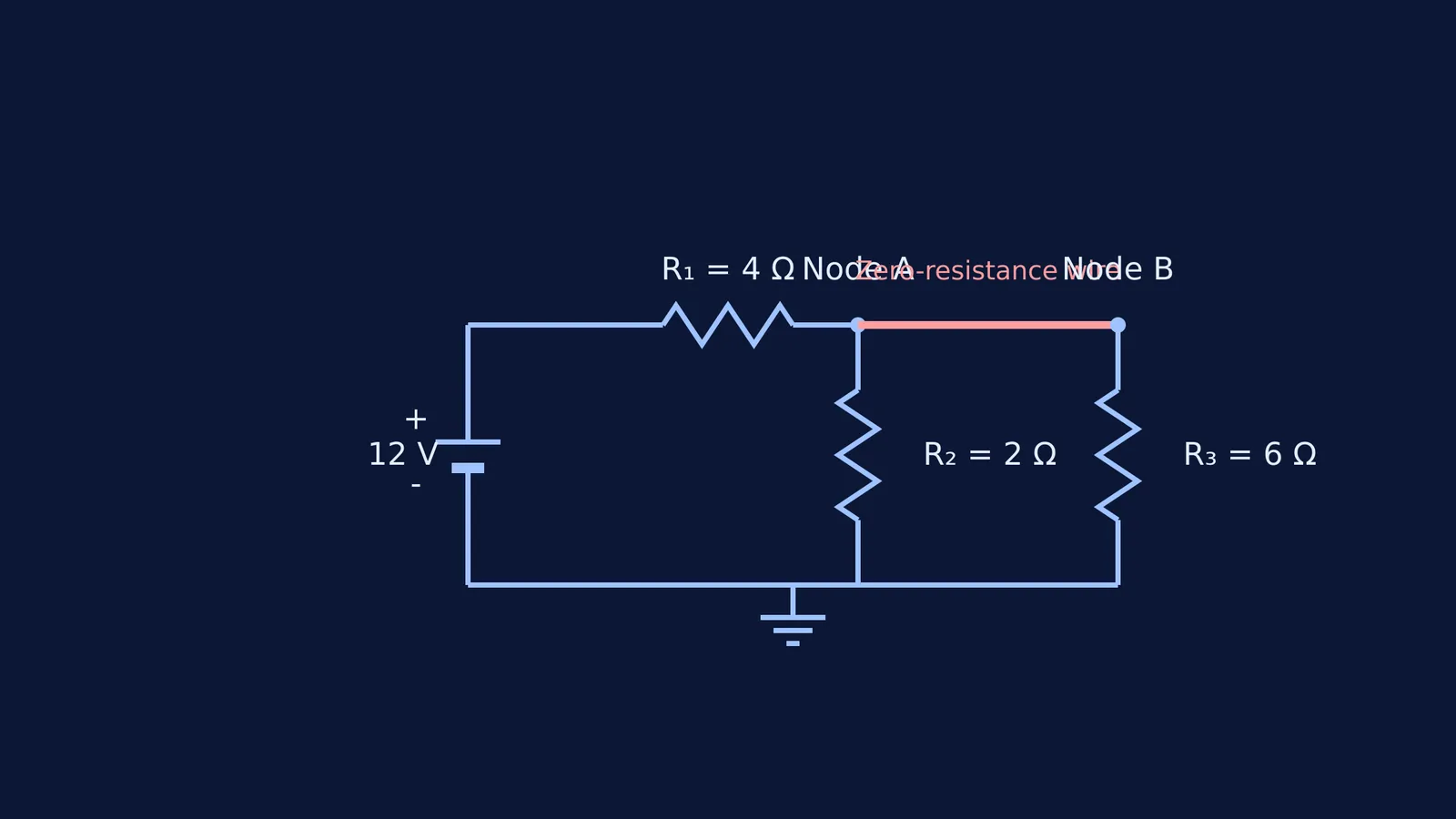
Imagine a 12 V battery connected to a resistor R₁ = 4 Ω, which leads to Node A. Node A connects to ground through R₂ = 2 Ω. A zero-resistance wire connects Node A to Node B. Finally, Node B connects to ground through R₃ = 6 Ω.
What is the current flowing from Node A to Node B through the ideal wire?
First, because Node A and Node B are connected by a zero-resistance wire, they are at the exact same voltage (V_AB). We treat them as one large node and write the KCL equation for the currents entering and leaving it.
Current entering from the battery through R₁: (12 - V_AB) / 4
Current leaving through R₂: V_AB / 2
Current leaving through R₃: V_AB / 6
Setting the current entering equal to the current leaving: (12 - V_AB) / 4 = V_AB / 2 + V_AB / 6
Multiplying the entire equation by 12, the lowest common multiple of the denominators, clears the fractions and makes the algebra much simpler: 3 × (12 - V_AB) = 6 × V_AB + 2 × V_AB 36 - 3 × V_AB = 8 × V_AB 11 × V_AB = 36
So, the voltage at the combined node is 36/11 V (about 3.27 V).
Now, to find the current through the short wire (I_wire), we look only at Node B. The only current entering Node B comes from the wire, and the only current leaving Node B goes through R₃. Therefore: I_wire = V_AB / 6 I_wire = (36/11) / 6 = 6/11 A (about 0.545 A).
We bypassed the 0/0 problem entirely by looking at what the surrounding resistors demanded.
Where does the Fermi Problem Library fit in?
Circuit problems with short wires, supernodes and missing currents often catch students out because they require abandoning a trusted formula (Ohm's law) for a different principle based on charge conservation.
When you get stuck on a homework question like this, the Fermi Problem Library acts as a one-to-one AI tutor. It provides worked problems with a step-by-step solver that explains the reasoning rather than printing an answer. It shows you how to set up the node equations and why the zero-resistance wire is treated as a single node.
This approach builds a solid intuition for circuit analysis, preparing you for more complex problems like the node potential method in your JEE or NEET revision.


