

On this page
An AI chatbot can hand you a neat, confident solution to a circuit numerical that is still wrong. Reading it again often misses the slip, because you repeat the same reasoning. A circuit simulator gives you an independent check: it applies Kirchhoff's laws to whatever you build, and it has no idea which answer the AI wanted.
Why do AI answers to circuit problems go wrong?
In JEEBench, a 2023 study by Daman Arora, Himanshu Gaurav Singh and Mausam, language models were tested on 515 mathematics, physics and chemistry problems from JEE Advanced, and the best score was less than 40%, even with chain-of-thought prompting. These were 2023 models; newer ones may score higher. The authors list GPT-4's typical failures as "errors in algebraic manipulation, difficulty in grounding abstract concepts into mathematical equations accurately and failure in retrieving relevant domain-specific concepts."
Circuit problems are exposed because the solution is a chain: combine resistances, find the total current, then split it between branches. One flipped ratio spoils every number after it. We cover the wider pattern in why AI gets physics problems wrong.
Which free circuit simulator should you use?
All three are free browser tools:
PhET Circuit Construction Kit: DC, from the University of Colorado Boulder, lets you build circuits with batteries, resistors, bulbs and switches and "take measurements with an ammeter and voltmeter".
PhET Circuit Construction Kit: AC adds capacitors and inductors and graphs current and voltage against time, which is what you need for RC problems.
Paul Falstad's circuit simulator shows voltage as colour and current as moving dots, and describes a part's current state when you move the mouse over it.
In a 2005 study by N. D. Finkelstein and colleagues, introductory physics students who used a circuit simulation instead of real bulbs, meters and wires did better on a conceptual survey, and at assembling a real circuit and describing how it worked. See also how circuit simulations help you understand electricity.
How do you check an AI answer for a circuit problem, step by step?
List every number the AI gave: equivalent resistance, each current, each voltage, any charge.
Build exactly the circuit in the question, with the same values. If the question says the battery and wires are ideal, check the simulator's settings for any battery or wire resistance.
Put an ammeter in series in each branch and a voltmeter across each part.
Compare each AI number, in order, with the reading.
The first number that disagrees is where the error starts. Find the line in the AI's working that produced it.
Fix that line by hand, then solve the whole problem again without the AI.
Worked example: where exactly did the AI go wrong?
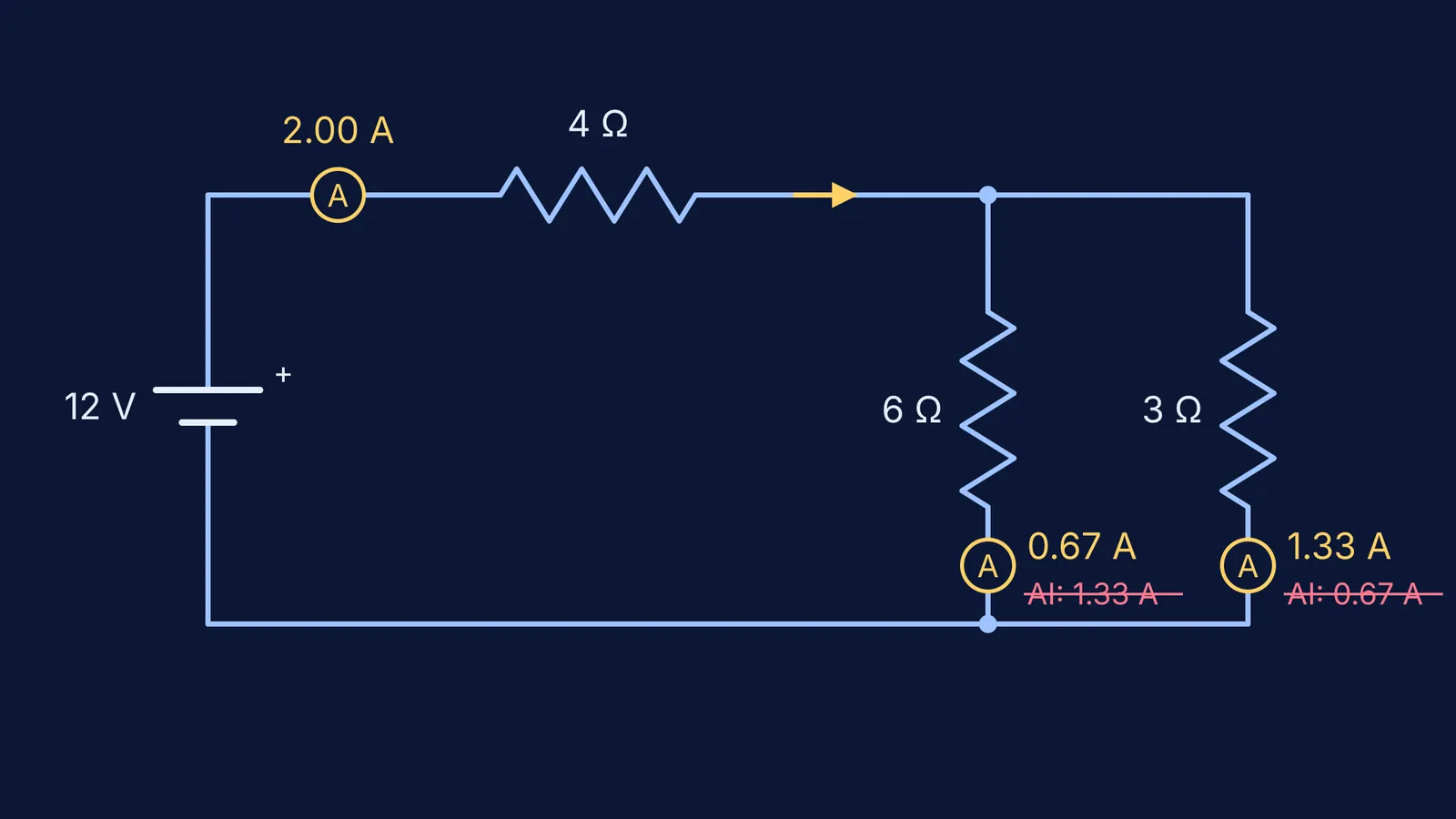
The problem: a 12 V ideal battery drives a 4 ohm resistor in series with a parallel pair of 6 ohm and 3 ohm resistors. Find the current in each resistor.
The AI's answer: the parallel pair is 2 ohms, the total is 6 ohms, the battery current is 2 A, the 6 ohm resistor carries 1.33 A and the 3 ohm resistor carries 0.67 A.
The simulator reads 2.00 A from the battery, but 0.67 A through the 6 ohm resistor and 1.33 A through the 3 ohm resistor. A voltmeter shows 4 V across both branches. So the first three steps are right, and the error is in the current split: the AI multiplied by its own branch's resistance instead of the other branch's, which sends more current down the harder path.
The junction check would not catch this, because 1.33 A plus 0.67 A still makes 2 A. The voltmeter does: the AI's numbers imply 8 V across the 6 ohm branch and 2 V across the 3 ohm branch.
What changes if there is a capacitor in the circuit?
Put an uncharged 10 microfarad capacitor in series with the 3 ohm branch and ask for the steady state. A common slip is to treat the capacitor as a plain wire, which only describes the moment the switch closes. In a simulator with capacitors you can watch that branch's current fall to zero; any capacitance gives the same steady-state voltages. With no current there, the circuit is just 4 ohms plus 6 ohms: 1.2 A flows, the capacitor sits at the 7.2 V across the 6 ohm resistor, and it holds 72 microcoulombs. Our guide to capacitors in DC steady state walks through more cases.
What should you do after you find the mistake?
Write a one-line note in your error log, such as "current divider: use the other branch's resistance". Then try two fresh problems of that type without help. If the slip was in a method, the Fermi Problem Library has worked problems with a step-by-step solver that explains the reasoning rather than printing an answer. If you could not picture the current split, the Fermi Simulation Lab has interactive simulations for ideas that are easier to see than to read, and Fermi's AI tutor notices where you are stuck and decides whether to explain, ask or show.
Tonight, take one circuit answer an AI gave you, build it, and see if the meters agree.


