

On this page
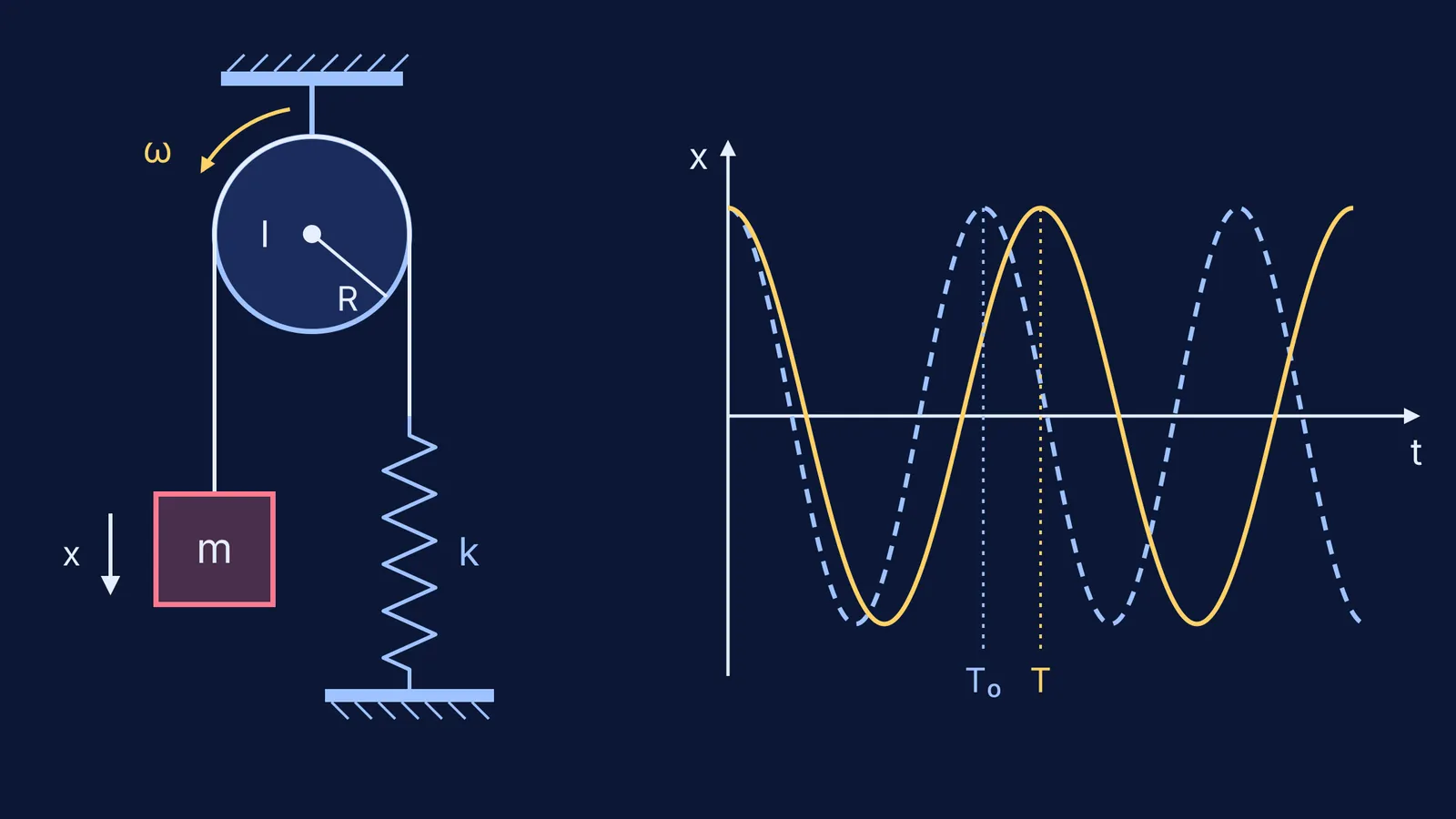
A block hangs from a string that runs over a pulley to a spring fixed to the floor. With a light pulley, you use the ordinary spring-mass period. Give the pulley a mass M and radius R and the period gets longer, because the spring must also spin the pulley up and slow it down. Here is the energy derivation, a worked example and the variants common in JEE-style problems.
What is the time period of a spring and massive pulley system?
Start from the plain case. For a mass m on a spring of force constant k, the period is T = 2π√(m/k), and it does not depend on the amplitude (OpenStax University Physics Volume 1, section 15.1).
Add a pulley of moment of inertia I and radius R in the string's path, with no slipping, and the period becomes T = 2π√((m + I/R²)/k). The term I/R² is the pulley's effective mass as the string feels it.
For a solid disc or cylinder turning about its own axis, I = ½MR², and for a thin hoop, I = MR² (OpenStax University Physics, section 10.4). So a disc pulley gives T = 2π√((m + M/2)/k), and a ring pulley gives T = 2π√((m + M)/k).
How do you derive T = 2π√((m + I/R²)/k)?
Use energy, so you never need the tensions. The total energy of a simple harmonic oscillator stays constant while kinetic and potential energy trade back and forth (OpenStax University Physics, section 15.2).
Let x be the block's displacement from equilibrium and v its speed.
The string does not slip, so the pulley's rim moves at v. Rim speed is Rω (OpenStax University Physics, section 10.3), so ω = v/R.
Kinetic energy is ½mv² + ½Iω² (rotational energy from section 10.4), which becomes ½(m + I/R²)v².
Measured from equilibrium, the spring stores ½kx². Gravity only shifts the equilibrium position (OpenStax, section 15.1).
Match the total to ½m_eff v² + ½k_eff x². Here m_eff = m + I/R² and k_eff = k, so T = 2π√(m_eff/k_eff).
Step 5 is the template for every variant: write every speed and every stretch in terms of one coordinate.
Worked example: how much does the pulley slow it down?
Take a block of m = 2 kg, a disc pulley of M = 2 kg (so I/R² = ½M, OpenStax section 10.4) and a spring with k = 200 N/m.
Light pulley: T₀ = 2π√(2/200) = 2π × 0.1 ≈ 0.63 s.
Disc pulley: m_eff = 2 + 1 = 3 kg, so T = 2π√(3/200) ≈ 0.77 s.
Ring pulley of the same mass: m_eff = 2 + 2 = 4 kg, so T = 2π√(4/200) ≈ 0.89 s.
The disc makes the period √1.5 ≈ 1.22 times longer, about 22% more. The diagram at the top plots both motions with these numbers.
What changes in the string-over-pulley variants?
Block on a table, mass hanging. Block m₁ on a smooth table is tied to a wall spring, and a string runs over an edge pulley to a hanging mass m₂. Both masses and the rim share one speed, so T = 2π√((m₁ + m₂ + I/R²)/k).
Spring on a smaller hub. The block hangs from radius R, but the spring pulls on a string wound on a hub of radius r. When the block moves x, the spring stretches (r/R)x, so k_eff = k(r/R)² and T = 2π√((mR² + I)/(kr²)).
Spring holding the pulley's axle. A ceiling spring holds the pulley; the string passes over it, one end tied to the floor, the block on the other. If the pulley drops y, the block drops 2y and the pulley turns at ω = (dy/dt)/R, rolling along the fixed strand. That gives m_eff = 4m + M + I/R², so T = 2π√((4m + M + I/R²)/k). With a light pulley this reduces to T = 4π√(m/k).
The same effective-mass idea gives the period of a rolling cylinder attached to a spring, and the energy bookkeeping matches a block on a string unwinding from a pulley.
Where do students usually lose marks?
Adding I instead of I/R². A unit check catches it: I/R² is in kg.
Forgetting that a moving pulley also translates, so M appears alongside I/R².
Adding mg as an extra restoring term. Gravity only moves the equilibrium point.
Using the formula when the string slips or the axle has friction.
To test the recipe on more set-ups, the Fermi Problem Library has worked problems with a step-by-step solver that explains the reasoning rather than printing an answer. If moment of inertia feels shaky, the Fermi Concept Library gives each concept its own lesson. For how m and k alone set the period, try the mass-spring SHM simulation.


