

On this page
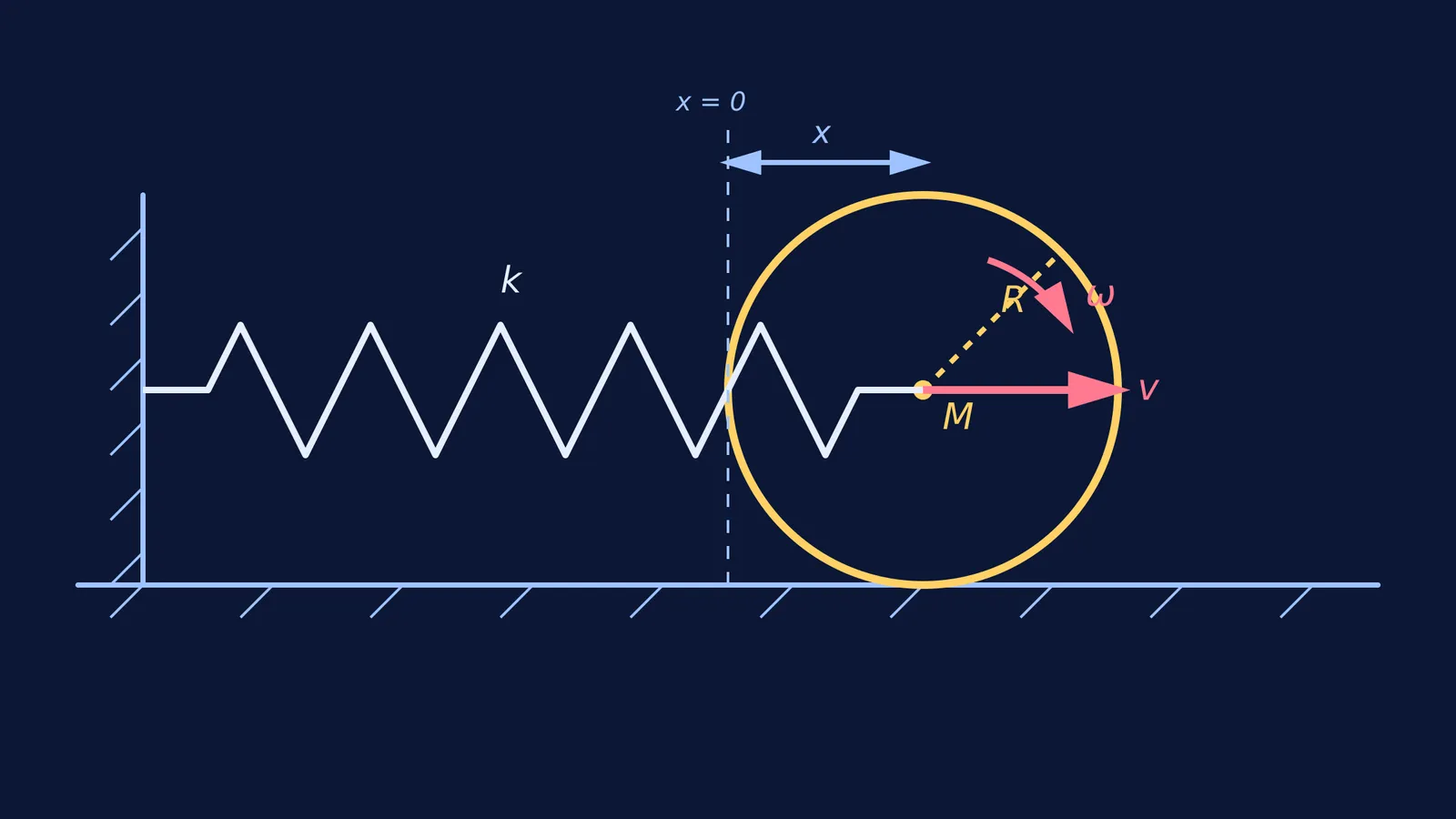
A standard spring-mass system with a sliding block has a time period of T = 2π√(M/k). But when the mass is a solid cylinder that rolls without slipping, it moves more slowly.
Why does a rolling cylinder oscillate slower than a sliding block?
When a block slides, all the spring's potential energy converts into translational kinetic energy (½ M v²). When a cylinder rolls, the energy is shared. Some of it goes into moving the cylinder's centre of mass forward, and the rest goes into spinning it around its axis.
Because the cylinder has to "spend" energy to rotate, its linear speed v at any given displacement is lower than that of a sliding block. A lower speed means the cycle takes longer to complete, increasing the time period. The most reliable way to find this new time period is the energy method, which builds on the principle of conservation of energy.
How do you set up the energy equation?
In a conservative system where no energy is lost to friction, the total mechanical energy E remains constant throughout the oscillation. For a spring-mass system oscillating on a horizontal surface, this energy is the sum of three parts:
The elastic potential energy of the spring.
The translational kinetic energy of the cylinder.
The rotational kinetic energy of the cylinder.
The formula for the total energy is:
E = ½ k x² + ½ M v² + ½ I ω²
Here, k is the spring constant, x is the displacement from equilibrium, M is the mass, v is the linear velocity, I is the moment of inertia, and ω is the angular velocity.
To solve this, we need to express the rotational terms in terms of linear motion. For a solid cylinder rotating about its central axis, the moment of inertia is I = ½ M R², where R is the radius. When the cylinder rolls without slipping, its angular velocity is ω = v/R.
Substituting these into the rotational kinetic energy term:
½ I ω² = ½ (½ M R²) (v/R)² = ¼ M v²
Now, add this to the translational kinetic energy:
E = ½ k x² + ½ M v² + ¼ M v²
E = ½ k x² + ¾ M v²
This equation shows that the cylinder acts like a sliding block with an "effective mass" of ¾ M.
What is the time period formula?
To find the period, take the derivative of the energy equation with respect to time t. Remember that dx/dt = v and dv/dt = a (acceleration):
dE/dt = d/dt (½ k x² + ¾ M v²) = 0
½ k (2x v) + ¾ M (2v a) = 0
k x v + (3/2) M v a = 0
Divide the entire equation by v (since velocity is not zero everywhere):
k x + (3/2) M a = 0
a = - (2k / 3M) x
This is the defining equation of simple harmonic motion (SHM), which takes the form a = - ωₙ² x. By comparing the two, we find the natural angular frequency ωₙ:
ωₙ = √(2k / 3M)
The time period T is 2π / ωₙ, which gives the final result:
T = 2π √(3M / 2k)
If you get stuck trying to remember which inertia formula to use in an exam, the Fermi Problem Library can step you through rolling-motion problems, showing you exactly how the geometry of an object changes its kinetic energy.
What if the cylinder is hollow instead?
The formula changes based on the object's shape because the moment of inertia changes. If the object attached to the spring is a thin hollow cylinder (or a hoop), its mass is concentrated at the edge.
Its moment of inertia is I = M R². Following the exact same steps, the rotational kinetic energy becomes ½ M v². The total kinetic energy is then ½ M v² + ½ M v² = M v².
Taking the time derivative of E = ½ k x² + M v² yields a = -(k/2M)x. The time period for a hollow hoop rolling on a spring is T = 2π√(2M/k).
How to solve any rolling oscillator problem
You can use this same energy framework for any object that rolls while attached to a spring, whether it is a solid sphere, a spherical shell, or a custom shape. Here is the step-by-step plan:
Identify the moment of inertia. Look up or derive I for the specific shape. For a solid sphere, it is (2/5) M R²; for a hollow sphere, it is (2/3) M R².
Write the total energy. Add the spring's potential energy (½ k x²), the object's translational kinetic energy (½ M v²), and its rotational kinetic energy (½ I ω²).
Substitute the rolling condition. Replace ω with v/R to get the entire equation in terms of linear velocity v.
Combine the kinetic terms. Add the translational and rotational parts to find the effective mass.
Differentiate with respect to time. Set dE/dt = 0, replace dx/dt with v, and replace dv/dt with a.
Solve for acceleration. Divide by v and rearrange the equation to isolate a.
Find the period. The coefficient in front of -x is ωₙ². Take its square root, then use T = 2π/ωₙ.
This energy approach works for any rolling shape, including those in radius of gyration problems. You can apply the same logic to a solid sphere, or use it when pulling a spool by its string to find its equations of motion. By treating the rotating object as a simple block with a heavier "effective mass", you can bypass complex force and torque equations entirely.


