

On this page
In introductory mechanics, you often assume pulleys are massless and only change the direction of a string. But a real pulley has mass and a moment of inertia (I). When a block unwinds a heavy pulley, some of the block's potential energy must go into spinning the pulley.
According to OpenStax University Physics, the rotational kinetic energy of a rigid body is ½Iω². When a falling block unwinds the string, the system's total mechanical energy is conserved. This means the block's initial potential energy is shared between the block's downward speed and the pulley's rotation.
Why does the pulley's moment of inertia matter?
If a pulley were perfectly massless, dropping a block from a height h would convert all its potential energy (mgh) into translational kinetic energy (½mv²). The block would fall exactly as it does in free fall, reaching a final speed of v = √(2gh).
However, a real pulley takes energy to spin. Because energy cannot be created from nothing, the rotational energy "steals" from the block's kinetic energy. As a result, the block falls slower. The more massive the pulley, the greater its moment of inertia, and the slower the block will accelerate downward.
If your physics foundations feel shaky, the Fermi Concept Library contains every concept in physics, chemistry, biology, mathematics and computing.
How do you apply the energy method to a block on a pulley?
To find the block's final speed, you set the initial mechanical energy equal to the final mechanical energy.
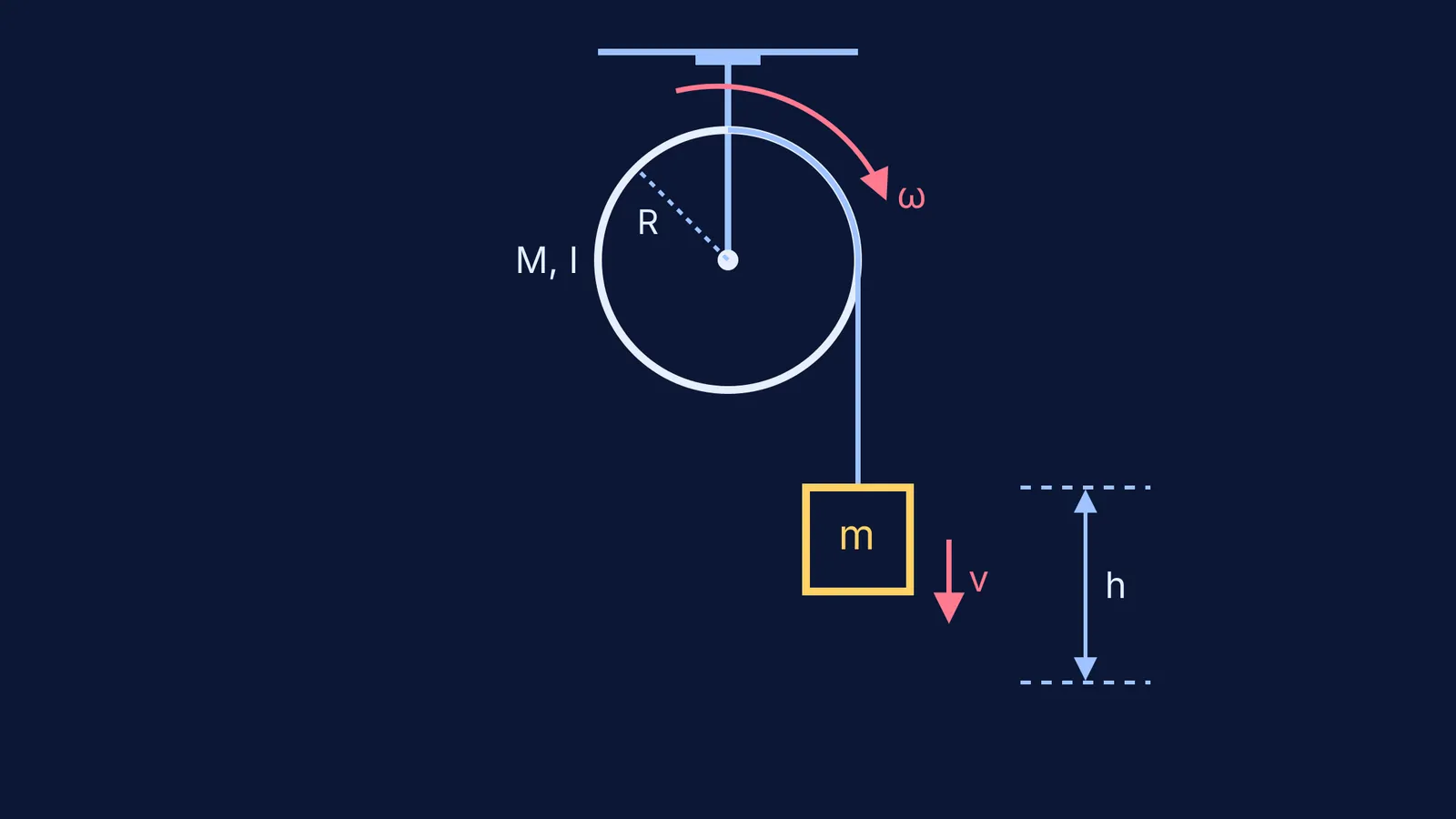
Initial State: The block starts from rest at height h. The pulley is stationary. The total initial energy is entirely gravitational potential energy: E_initial = mgh.
Final State: After falling distance h, the block has a downward speed v, giving it translational kinetic energy (½mv²). The pulley has angular speed ω, giving it rotational kinetic energy (½Iω²). The total final energy is E_final = ½mv² + ½Iω².
Just as you must account for all force components to find the simple pendulum string tension at any angle, you must account for all energy components when a pulley has mass.
This constraint of matching linear speed to rotational speed is the exact same geometry you use when predicting which way a spool pulled by its string will roll.
Worked Example: Finding the final speed
Consider a block of mass m attached to a uniform solid disk pulley of mass M and radius R. The block is released from rest. What is its speed after falling a distance h?
For a solid disk, the moment of inertia is I = ½MR².
Setting the initial energy equal to the final energy: mgh = ½mv² + ½Iω²
Substitute the moment of inertia (I = ½MR²) and the angular speed (ω = v/R): mgh = ½mv² + ½(½MR²)(v/R)²
Notice that the R² in the numerator and denominator cancel out perfectly: mgh = ½mv² + ½(½M)(v²) mgh = ½mv² + ¼Mv²
Factor out v² on the right side: mgh = v²(½m + ¼M)
Finally, isolate v: v = √( mgh / (½m + ¼M) ) v = √( 2mgh / (m + M/2) )
Because the denominator (m + M/2) is larger than just the block's mass (m), the final speed is strictly less than √(2gh).
Energy method vs. Newton's second law: Which is faster?
You can solve this exact same problem using forces and torques (Newton's second law), but the energy method is usually faster when you only need the final velocity.
If you use forces, you have to draw two free-body diagrams: one for the falling block and one for the rotating pulley. For the block, the net force is gravity minus the string tension (mg - T = ma). For the pulley, the tension creates a torque that drives the angular acceleration (TR = Iα). You then have to solve this system of equations for the acceleration (a), and plug that acceleration into a kinematic equation (v² = u² + 2ah) to find the speed.
The energy method skips the intermediate steps. Because tension is an internal force that does no net work on the system as a whole, it drops out of the energy equation entirely. You simply compare the start state to the end state, making the algebra much less prone to sign errors.
Are you stuck on rotational energy?
It is common to get tangled in substituting the radius R and angular velocity ω. When you are stuck on setting up the energy terms, the Fermi Problem Library has worked problems with a step-by-step solver that explains the reasoning rather than printing an answer.
If you need to build intuition for rotation, Fermi's AI tutor can work out what you already know and build a plan for the session, so you sit down to a clear next step.


