

On this page
Pull a block on a spring across a rough floor and let go. It slides back and forth, each swing shorter, then sticks, often not at the spring's natural length. JEE problems ask how far it travels, how many half-oscillations it makes and where it rests. Energy answers all three once you know one rule about kinetic friction.
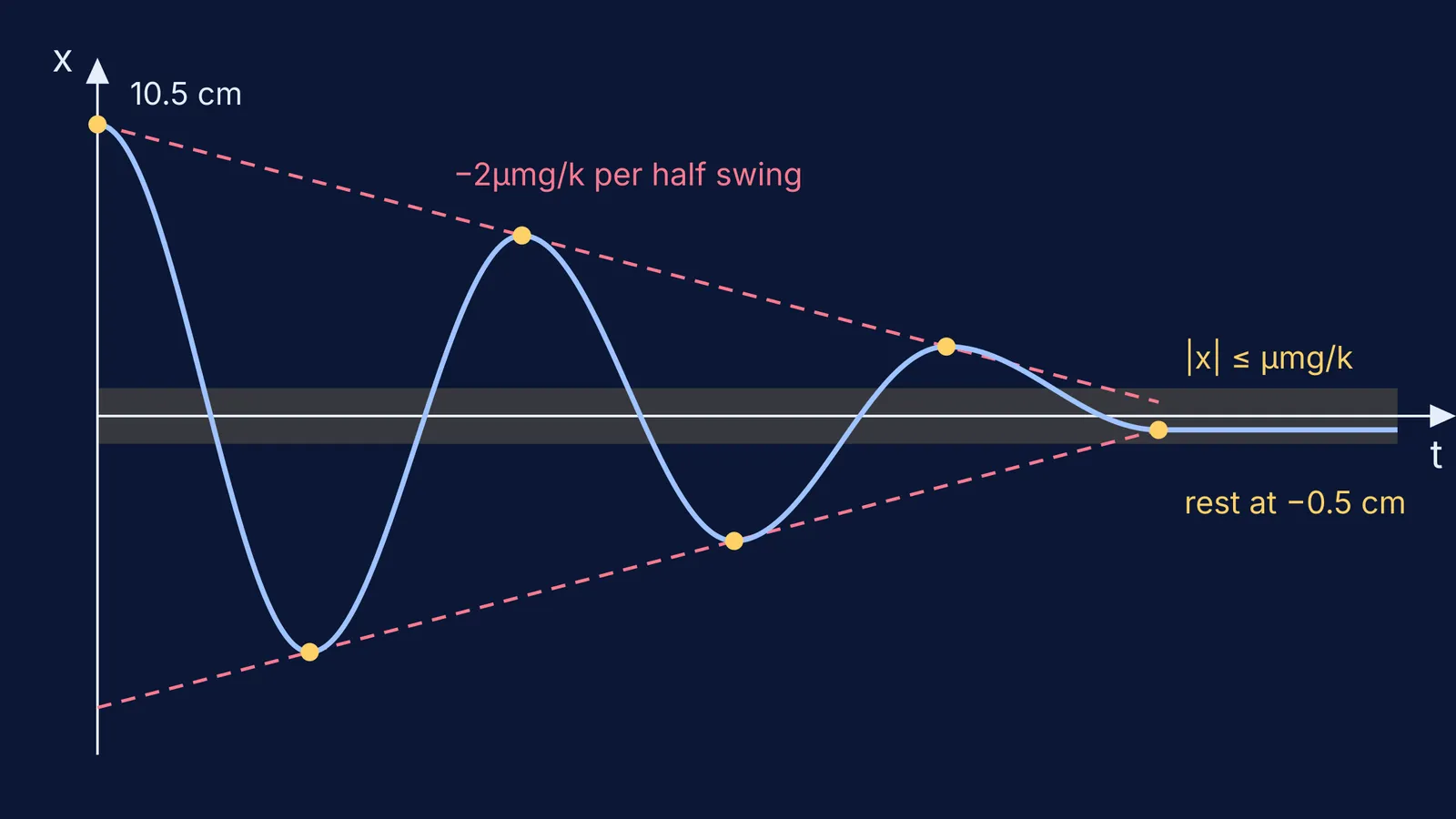
Why does each swing get shorter by exactly 2μmg/k?
Call the kinetic friction force f = μmg. It has a constant size and opposes the motion, unlike the viscous damping in most textbooks. Measure x from the natural length, and suppose the block stops for an instant at x = +A₁ and next at x = −A₂ on the other side. Speed is zero at both ends, so the spring energy lost equals the work done against friction over the distance A₁ + A₂:
½kA₁² − ½kA₂² = f(A₁ + A₂)
Factor the left side as ½k(A₁ − A₂)(A₁ + A₂) and cancel (A₁ + A₂). You get A₁ − A₂ = 2f/k.
In a 2019 paper in the European Journal of Physics, Joseph Rizcallah states the same result: the distance between turning points contracts "by the fixed amount 2f/k every half cycle", a linear decay rather than an exponential one (Rizcallah, 2019). The same paper shows that each half cycle still takes exactly half the period of the undamped oscillator, so friction changes the amplitude but not the timing (arXiv version of the paper).
Each half swing is simple harmonic motion about a centre shifted to ±f/k, opposite to the direction of motion; the solution in LibreTexts' chapter on friction-damped vibrations/15:_Vibrations_with_One_Degree_of_Freedom/15.3:_Friction_(Coulomb)_Damped_Free_Vibrations) is a cosine plus a μmg/k offset that flips sign each half cycle.
Where does a block on a spring with friction finally stop?
At every turning point the block is momentarily at rest, so ask: can the spring beat friction? If the spring force k|x| is more than the largest static friction, μ_s mg, the block sets off again. If not, it stays for good.
So the block stops at the first turning point inside the band |x| ≤ μ_s mg/k. The same LibreTexts chapter notes that the system "does not return to zero", because the friction force does not shrink as the amplitude does (LibreTexts/15:_Vibrations_with_One_Degree_of_Freedom/15.3:_Friction_(Coulomb)_Damped_Free_Vibrations)). Stopping exactly at x = 0 is a coincidence.
If a problem gives μ_s and μ_k separately, use μ_k for the 2μ_k mg/k shrink and μ_s for the stopping test.
Worked example: how far does the block travel?
A 0.5 kg block on a spring with k = 100 N/m sits on a floor with μ = 0.2 (take μ_s = μ_k and g = 10 m/s²). It is pulled 10.5 cm from natural length and released from rest.
Friction: f = μmg = 0.2 × 0.5 × 10 = 1 N, so f/k = 1 cm. Each half swing loses 2 cm, and the stopping band runs from −1 cm to +1 cm.
Turning points: +10.5, −8.5, +6.5, −4.5, +2.5, −0.5 cm.
Test each one. At +2.5 cm the spring's 2.5 N beats 1 N, so the block moves on. At −0.5 cm its 0.5 N does not, so the block stays.
Answer: five half-oscillations, ending 0.5 cm on the compressed side, opposite to where it started.
Distance: 19 + 15 + 11 + 7 + 3 = 55 cm.
Energy check: ½ × 100 × (0.105² − 0.005²) = 0.55 J, and the friction work is 1 N × 0.55 m = 0.55 J. They match.
Time: each half swing takes π√(m/k) = π√0.005 ≈ 0.22 s, so the block stops after about 1.11 s.
Step 6 is the shortcut: once you know the final position x_f, the distance is d = k(x₀² − x_f²)/(2f). For more on picking energy over forces, see when to use energy conservation instead of Newton's laws.
How many half-oscillations will it make?
Taking μ_s = μ_k, you want the smallest whole number n for which x₀ − 2n(f/k) ≤ f/k. Rearranged, n is the smallest whole number at least (kx₀/f − 1)/2.
In the example, (10.5 − 1)/2 = 4.75, so n = 5. Rizcallah's paper gives the same window for the half cycle in which motion ends, from kx₀/2f − 1/2 to kx₀/2f + 1/2 (Rizcallah, 2019). If kx₀ ≤ μ_s mg at the start, n = 0: the block never moves.
For practice, the Fermi Problem Library has worked problems with a step-by-step solver that explains the reasoning rather than printing an answer.
What mistakes cost marks here?
Using exponential decay. That belongs to viscous damping; compare the amplitude of a damped oscillation after n oscillations and damped versus forced oscillations.
Assuming the block always stops at the natural length.
Writing ½kx₀² = f × d, which only works if the block ends at x = 0.
Using μ_s for the per-swing loss.
Changing the period. Each half swing still takes π√(m/k).
If the shifted centre still feels shaky, the Fermi Concept Library has a lesson for every concept in physics, chemistry, biology, mathematics and computing.


