

On this page
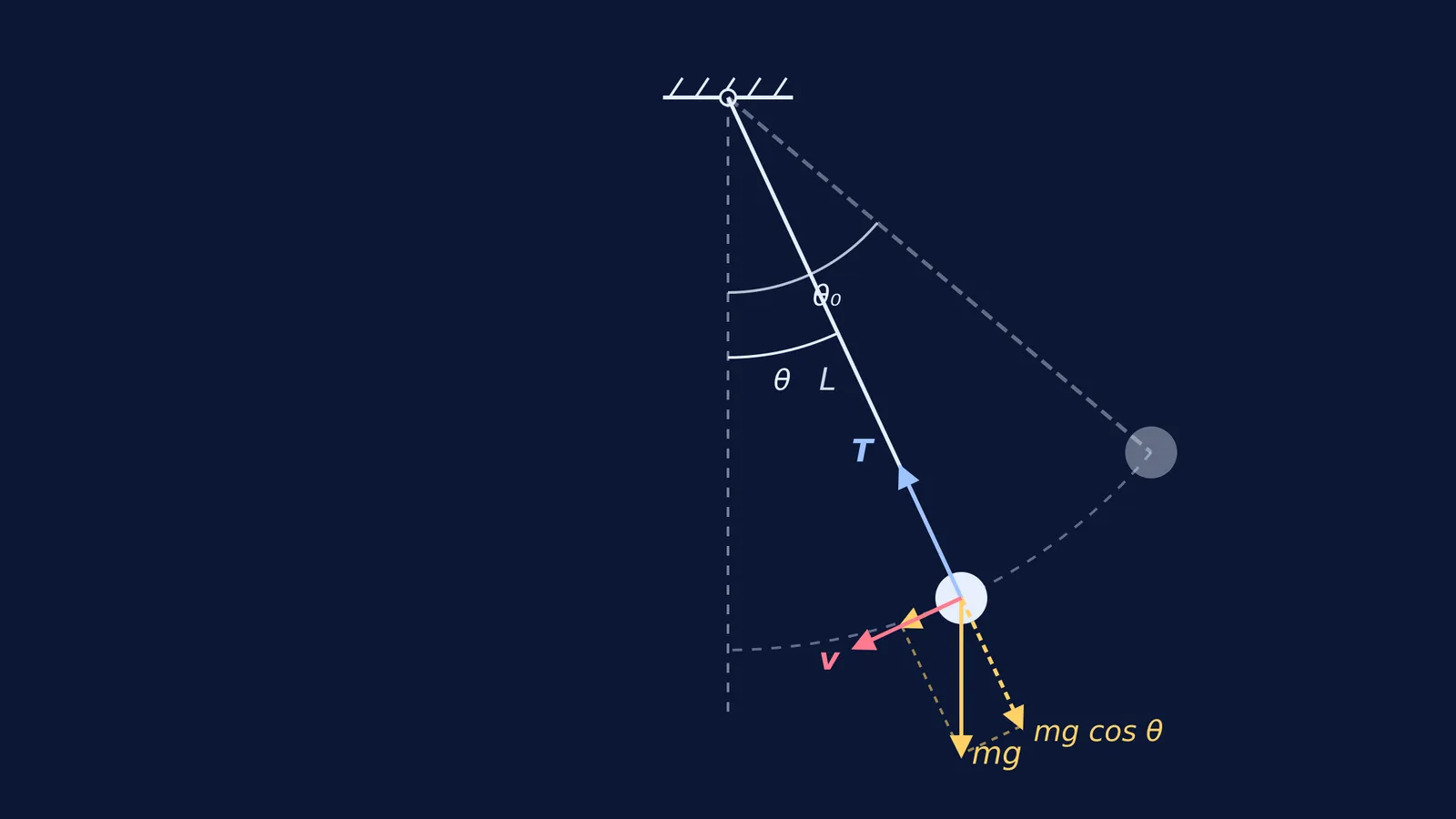
When you pull a pendulum back to an initial angle θ₀ and let it go, it swings down, gaining speed until it reaches the bottom. To find its exact speed and the tension in the string at any intermediate angle θ, you need two fundamental tools of physics: the conservation of energy and Newton's second law.
How do you find the speed of a pendulum bob at angle theta?
To find the speed, we use the conservation of mechanical energy). Because the tension in the string is always perpendicular to the direction of motion, it does no work on the bob. Only gravity does work, which means the total mechanical energy of the system remains constant.
Imagine a pendulum of length L and mass m, released from rest at an initial angle θ₀. As it swings down to a new, smaller angle θ, it loses height. We can calculate this vertical drop, h, using a bit of trigonometry:
h = L(cos θ − cos θ₀)
The potential energy lost by the bob (mgh) is entirely converted into kinetic energy (½mv²). By equating these two, we can solve for the speed:
½mv² = mgL(cos θ − cos θ₀)
Cancelling the mass m from both sides and multiplying by 2 gives:
v² = 2gL(cos θ − cos θ₀)
Taking the square root, the speed of the bob at angle θ is:
v = √[2gL(cos θ − cos θ₀)]
What is the tension in a simple pendulum string?
While energy conservation gives us the speed effortlessly, it cannot tell us the tension. Tension is a force, and to find it, we must look at the forces acting on the bob at the exact instant it reaches angle θ.
Two primary forces act on the bob: the downward pull of gravity (mg) and the tension (T) acting upwards along the string. Because the bob is moving in a circular arc, the net force along the string must equal the required centripetal force (mv² / L).
The component of gravity acting outwards along the line of the string is mg cos θ. Therefore, the tension T must balance this outward component and provide the centripetal pull:
T − mg cos θ = mv² / L
Now, we substitute the expression for v² we found earlier from energy conservation:
T = mg cos θ + (m / L) × [2gL(cos θ − cos θ₀)]
The length L cancels out:
T = mg cos θ + 2mg(cos θ − cos θ₀)
Expanding and grouping the terms gives the final equation for tension:
T = mg(3 cos θ − 2 cos θ₀)
If you want to review all the fundamental concepts in this system, the Fermi Concept Library holds every concept in physics, chemistry, biology, mathematics and computing, each with its own lesson and its place in the map.
When should you use energy conservation instead of Newton's laws?
This pendulum derivation perfectly illustrates a core strategy in mechanics. Energy is a scalar quantity. It only cares about the starting and ending positions, not the time taken or the complicated, changing forces along the path. This makes it the fastest way to find speeds from positions.
You can read more on when to use energy conservation instead of Newton's laws to build a reliable instinct for these problems. A similar logic applies when finding the speed of a falling block with the pulley energy method.
However, to find the tension — a vector force that changes every millisecond — energy alone is not enough. You have to freeze the motion at angle θ and apply Newton's second law. If you struggle to know which method to pick, the Fermi Problem Library has worked problems with a step-by-step solver that explains the reasoning rather than printing an answer.
How can you verify your pendulum formulas at the extremes?
You can always test your formulas by checking the extreme points of the swing:
At the release point (θ = θ₀), the speed is zero. The tension equation becomes T = mg(3 cos θ₀ − 2 cos θ₀), which simplifies to T = mg cos θ₀. This makes sense, as there is no centripetal force required yet.
At the lowest point (θ = 0°), cos(0°) = 1. The tension becomes T = mg(3 − 2 cos θ₀). If you released the bob from a horizontal position (θ₀ = 90°), cos(90°) = 0, meaning the tension at the bottom hits exactly 3mg.
Testing these limits is a great way to verify your derivations during an exam, or you can watch them play out in a vertical circular motion simulation to see the tension peak at the lowest point.


