

On this page
Special-value substitution means testing the question and each option at one easy value of the variable and discarding every option that gives a different answer. It is a version of the "specialization" heuristic from George Pólya's How to Solve It, first published in 1945, which asks what happens if a given value were zero (summary of the heuristic list). It works because the correct option must hold for every allowed value, so one failure is enough to throw an option out.
Why does plugging in values matter in JEE Main?
In Paper 1, each of mathematics, physics and chemistry has 20 MCQs in Section A and 5 numerical-value questions in Section B, according to NTA's JEE (Main) 2027 Information Bulletin. The same bulletin sets the marking: four marks for a correct answer, minus one for an incorrect answer, and zero for an unanswered question, in both sections.
That scheme makes elimination worth real marks. A blind guess among four options is worth 4 × 1/4 − 1 × 3/4 = +0.25 marks on average. If substitution removes two options and you guess between the last two, the average rises to 4 × 1/2 − 1 × 1/2 = +1.5 marks. (Our arithmetic from the bulletin's scheme, assuming both survivors are equally likely.) Section B has no options, so there substitution only checks your answer.
How do you substitute values in sequences, functions and integrals?
For a sequence, start with n = 1. Question: 1·2 + 2·3 + … + n(n + 1) equals (A) n(n+1)(n+2)/3 (B) n(n+1)(2n+1)/6 (C) n(n+1)(n+2)/6 (D) n²(n+1)/2.
At n = 1 the sum is just 1·2 = 2. Option A gives 6/3 = 2. Options B, C and D all give 1. Only A survives.
For a functional equation, pick the value that maps to itself. Question: if f(x) + 2f(1/x) = 3x for x ≠ 0, then f(x) is (A) 2/x − x (B) x + 1/x (C) 1/x − 2x (D) x − 2/x.
Put x = 1, because 1/x is also 1. Then 3f(1) = 3, so f(1) = 1. Option A gives 1; B gives 2; C and D give −1. Only A is left.
For an integral with a parameter, pick the easiest n. Question: if Iₙ = ∫ tanⁿx dx from 0 to π/4, then Iₙ + Iₙ₋₂ equals (A) 1/(n−1) (B) 1/(n+1) (C) n/(n−1) (D) 1/n.
Take n = 2. Then I₂ + I₀ is the integral of tan²x + 1 = sec²x from 0 to π/4, which is tan(π/4) − tan 0 = 1. At n = 2 the options give 1, 1/3, 2 and 1/2, so A is the answer. For more ways to pin down an integral without solving it, see our guide to bounding definite integrals.
When does substituting values give the wrong answer?
The shortcut is only as good as the value you choose.
The value makes options collapse. For 1³ + 2³ + … + n³, the options n²(n+1)²/4, n(n+1)(2n+1)/6 and n(n+1)/2 all equal 1 at n = 1. At n = 2 the sum is 9 and they give 9, 5 and 3. Avoid 0 and 1 when they make several options look the same.
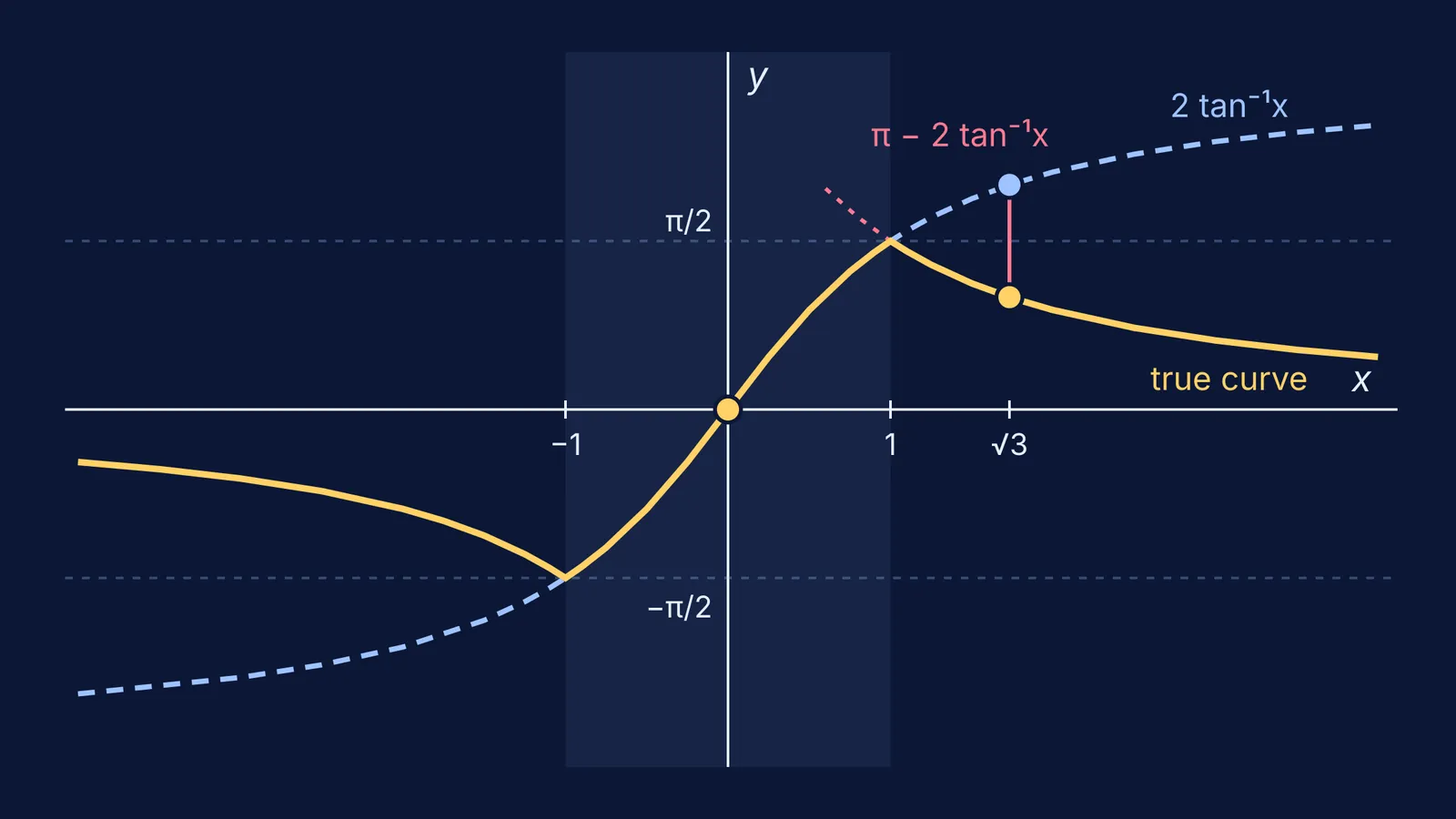
The value is outside the stated range. "For x > 1, sin⁻¹(2x/(1+x²)) equals?" If you test x = 0, you pick 2tan⁻¹x. Test x = √3 instead: the left side is sin⁻¹(√3/2) = π/3, 2tan⁻¹√3 = 2π/3, and π − 2tan⁻¹x gives π/3, the real answer. The hero diagram shows why: the two curves agree only between −1 and 1.
The value breaks the formula. In the integral example, n = 1 makes 1/(n−1) undefined, and x = 0 breaks any option with log x or 1/x. Read the conditions (n ≥ 2, x > 0) before choosing.
More than one option survives. One value proves options wrong, not right. In JEE Advanced multi-correct questions, a survivor may still be false, so read how partial marking works in multi-correct questions before ticking everything left. For indefinite integrals, two options that differ only by a constant are both valid antiderivatives.
What should you check before you substitute a value?
Read the conditions first: domain, n ≥ 2, x > 0, a < b.
Choose the simplest allowed value that keeps the options different.
Work out the question's value once, carefully, and write it down.
Put the same value into every option, not just the one you like.
If more than one survives, test a second value.
If every option fails, your first calculation is probably wrong; redo step 3.
For step 6, the slip is usually a sign or an expansion; our list of common algebra mistakes in JEE covers the usual culprits.
Substitution finds the option but does not teach the method. For the full route, the Fermi Problem Library has worked problems with a step-by-step solver that explains the reasoning rather than printing an answer.
This week, redo ten MCQs from a past paper by substitution alone, and note which ones the shortcut cannot settle.


