

On this page
Some JEE questions never ask you to evaluate an integral. They give four options such as "1 < I < e" and ask which one is true. Often the integrand, like e^(x²), has no standard antiderivative, so trying to evaluate it wastes time. The plan is to bound it instead. Properties of definite integrals are listed in Unit 8 of the JEE (Main) 2026 syllabus published by NTA, and increasing and decreasing functions, maxima and minima are in Unit 7.
How do you estimate a definite integral using inequalities?
Three facts do all the work. OpenStax Calculus Volume 1, section 5.2 states them in Theorem 5.2, its comparison properties of integrals:
If f(x) ≥ 0 on [a, b], then ∫f dx ≥ 0.
If f(x) ≥ g(x) on [a, b], then ∫f dx ≥ ∫g dx.
If m ≤ f(x) ≤ M on [a, b], then m(b − a) ≤ ∫f dx ≤ M(b − a).
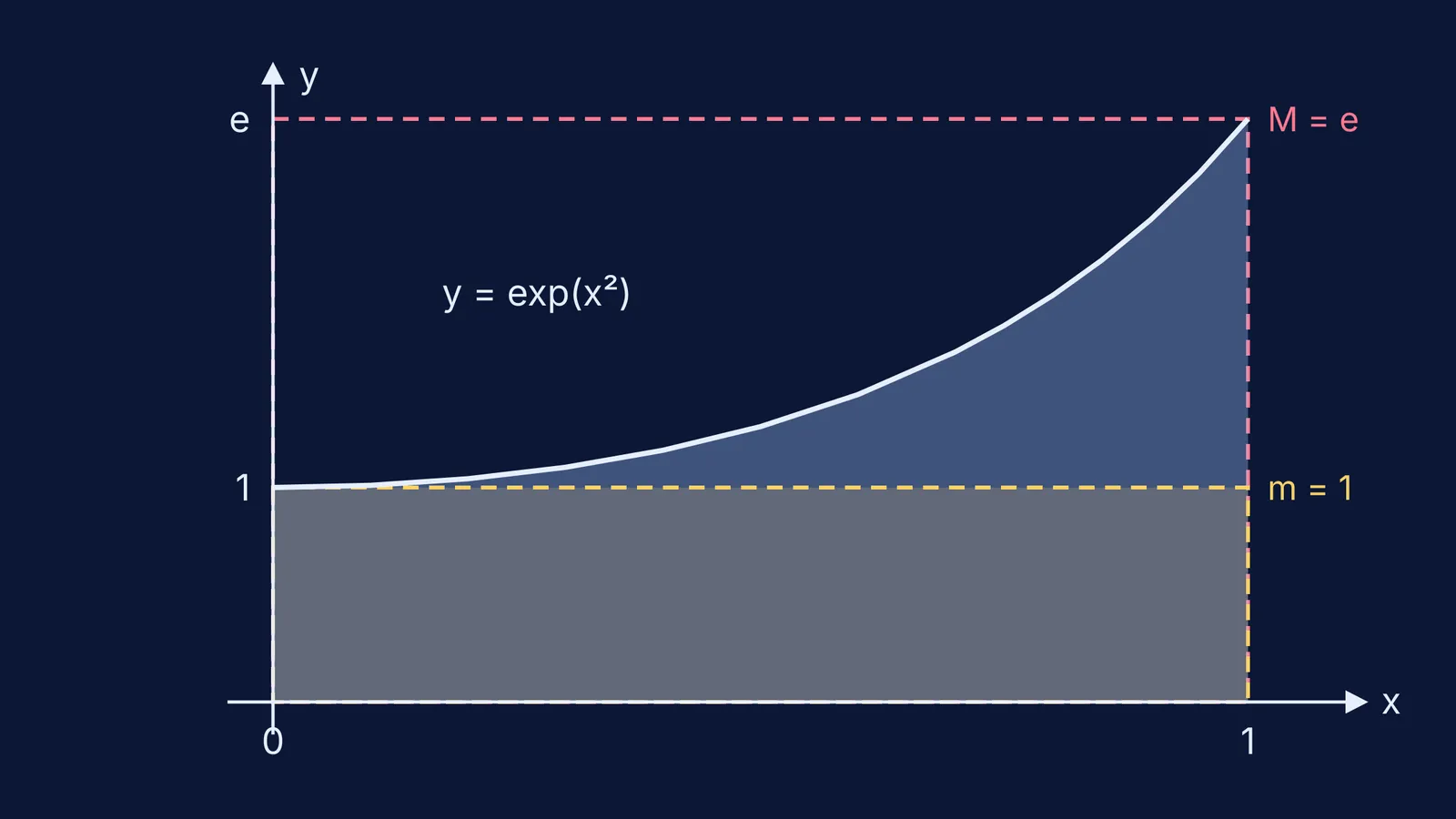
The third property is the picture at the top of this post. The area under the curve sits between a short rectangle of height m and a tall rectangle of height M, both of width b − a. If f is continuous and not constant, and m and M are its minimum and maximum, the area misses part of each rectangle. That makes both inequalities strict, which matters when the options use "<".
How do you find m and M quickly?
Monotonic on [a, b]: check the sign of f′(x). If f is increasing, m = f(a) and M = f(b). If it is decreasing, swap them.
Not monotonic: solve f′(x) = 0, then compare f at the critical points and at both endpoints.
Piecewise behaviour: split the interval where the formula changes, as you would for definite integrals with modulus and floor functions, and bound each piece separately.
A quick example of the second case. Take f(x) = x·e^(−x) on [0, 2]. Then f′(x) = (1 − x)e^(−x), which is zero at x = 1. Compare f(0) = 0, f(1) = 1/e and f(2) = 2/e². So m = 0 and M = 1/e, which gives 0 < I < 2/e. Integration by parts gives the exact value 1 − 3/e², inside that range.
Worked JEE-style question: which option is true?
Let I = ∫ from 0 to 1 of e^(x²) dx. Which is true? (A) I < 1 (B) 1 < I < 4/3 (C) 4/3 < I < e − 1 (D) I > e
Step 1, the max-min bound. On [0, 1], x² increases, so e^(x²) increases. That gives m = e⁰ = 1 and M = e¹ = e, so 1 < I < e. This rules out (A) and (D), but (B) and (C) both survive.
Step 2, compare with simpler functions. For every real t, e^t ≥ 1 + t, so e^(x²) ≥ 1 + x². Integrating from 0 to 1 gives I ≥ 1 + 1/3 = 4/3. For an upper bound, note that x² ≤ x on [0, 1], so e^(x²) ≤ e^x and I ≤ e − 1. Both inequalities are equalities only at an endpoint, so 4/3 < I < e − 1. The answer is (C).
When two options survive the max-min test, sandwich f between simpler functions you can integrate. The AM-GM inequality is another source of such bounds.
Which of two definite integrals is larger?
A common variant gives I₁ = ∫ from 0 to 1 of 2^(x²) dx and I₂ = ∫ from 0 to 1 of 2^(x³) dx and asks which is larger. On (0, 1), x³ < x², and 2^t is an increasing function, so 2^(x³) < 2^(x²). By the second comparison property, I₁ > I₂. Change the limits to 1 and 2 and the order flips, because x³ > x² when x > 1. Always check which side of 1 your interval is on before comparing powers.
If the integrand repeats over a long interval, use the rule for integrating over n periods to shorten the interval first, then bound a single period.
A checklist for bound-the-integral questions
Read the options first. If they are inequalities, plan to bound rather than evaluate.
Find the sign of f′ on [a, b]. If f is monotonic, m and M are at the endpoints.
If it is not monotonic, compare f at its critical points and endpoints.
Write down m(b − a) and M(b − a), and strike out every option outside that range.
If two options remain, compare f with a simpler function: e^t ≥ 1 + t, sin x ≤ x for x ≥ 0, or x³ ≤ x² ≤ x on [0, 1].
Check whether the answer needs strict or non-strict inequalities.
If your bounds keep landing on the wrong option, work through a few in the Fermi Problem Library. Its step-by-step solver explains the reasoning rather than printing an answer, so you can see which step went wrong. If monotonicity itself is shaky, the Fermi Concept Library gives every concept in mathematics its own lesson.


