On this page
On a sticky monsoon afternoon in Chennai or Mumbai, the air feels heavy, so most students guess sound slows down in it. It does the opposite, and the reason is a quantity you already use in chemistry: molar mass.
Why does sound travel faster in humid air?
For an ideal gas, the speed of sound is c = √(γRT/M), where γ is the heat capacity ratio, R is the gas constant, T is the absolute temperature and M is the molar mass (Wikipedia: Speed of sound). The same article notes that, at a fixed temperature, pressure has no effect: pressure and density rise together and cancel.
That leaves M. Dry air has a mean molar mass of about 28.97 g/mol, while water vapour has a molar mass of about 18.02 g/mol (Wikipedia: Density of air). When water molecules move into the air, they push out an equal number of nitrogen and oxygen molecules (same pressure, same temperature, so the same number of molecules per litre). Each swap replaces a heavier molecule with a lighter one. The average M drops, and since M sits in the denominator, c goes up.
If the formula still feels like magic, our post on the Laplace correction to Newton's formula explains where the γ comes from.
Isn't humid air heavier than dry air?
No. This is the common trap. Humid air may feel heavy, but that feeling is not about density. The Density of air article puts it directly: adding water vapour reduces the density of air, because water vapour (18 g/mol) is lighter than the dry air it replaces (about 29 g/mol) (Wikipedia: Density of air).
How much faster is sound in humid air?
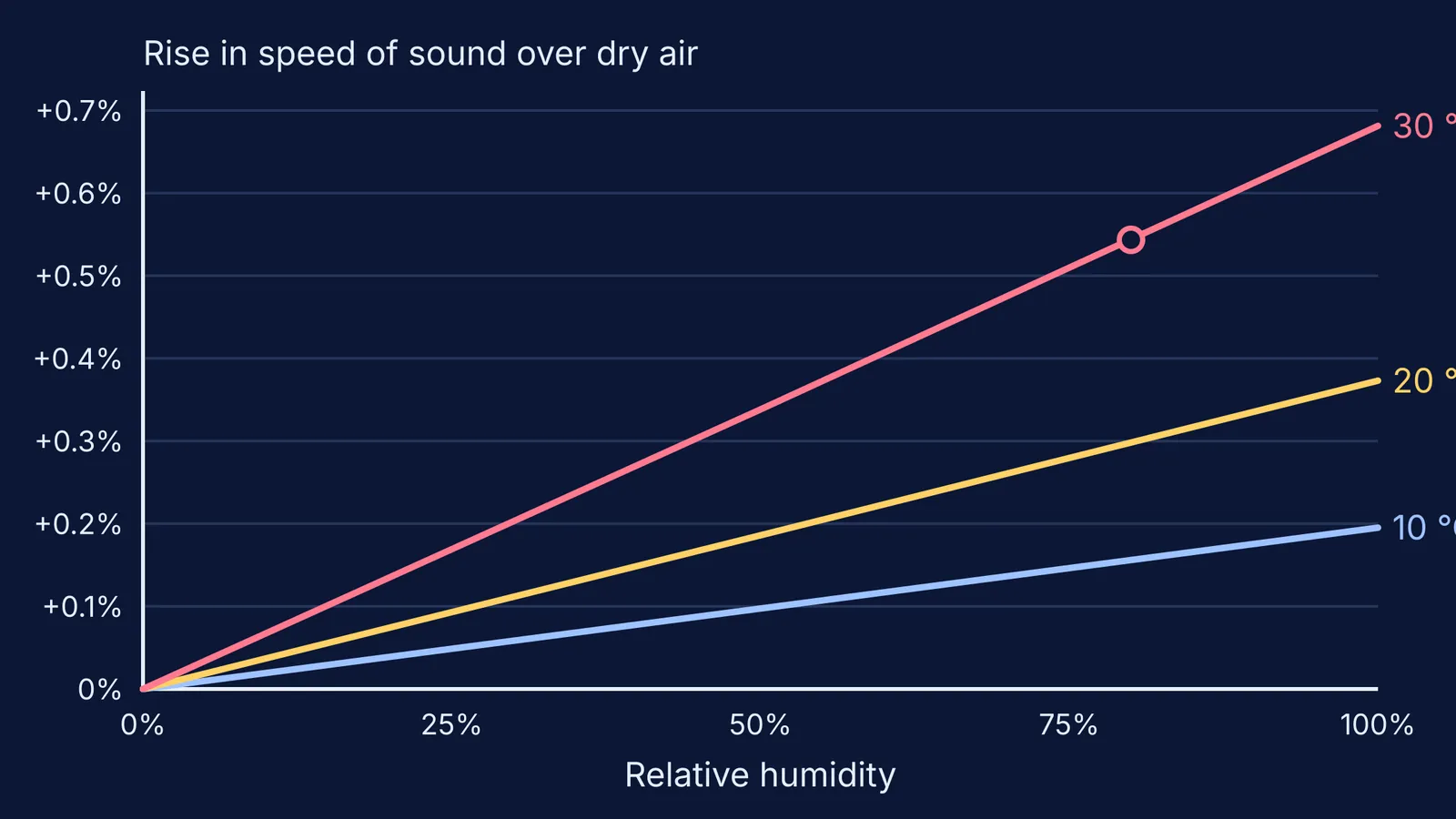
Sources put the effect at about 0.1–0.6% (Wikipedia: Speed of sound). Here is a worked example you can redo with a calculator, using molar masses from Density of air and the vapour pressure table in Vapour pressure of water. The setting: a 30 °C day at 80% relative humidity and normal pressure (101.3 kPa).
Saturation vapour pressure of water at 30 °C is 4.247 kPa, so at 80% humidity the water vapour pressure is 0.8 × 4.247 ≈ 3.40 kPa.
Mole fraction of water: 3.40 ÷ 101.3 ≈ 0.0335. About 3 molecules in every 100 are water.
Average molar mass: M = 0.9665 × 28.97 + 0.0335 × 18.02 ≈ 28.60 g/mol, which is 1.27% lighter than dry air.
Dry air at 30 °C: c = √(1.4 × 8.314 × 303.15 ÷ 0.02897) ≈ 349.0 m/s.
Lighter gas alone: speed scales as 1/√M, so c rises by √(28.97 ÷ 28.60) ≈ 1.0064, a 0.64% rise.
After the γ correction in the next section, the rise is about 0.54%, so c ≈ 350.9 m/s.
That is about 1.9 m/s faster. Over 100 m, the sound of a cricket bat arrives roughly 1.5 milliseconds sooner. You will never hear that, but careful lab measurements must correct for it.
Does water vapour's lower γ cancel the effect?
Partly, but not fully. A diatomic gas such as N₂ or O₂ has γ = 7/5 = 1.4, while a non-linear molecule like H₂O has 3 translational and 3 rotational degrees of freedom, giving γ = 8/6 ≈ 1.33; measured values are 1.400 for dry air and 1.330 for water vapour (H₂O) at 20 °C (Wikipedia: Heat capacity ratio).
Mixing the two at the 3.35% mole fraction above lowers γ from 1.400 to about 1.397, which trims the speed by about 0.1%. The molar mass effect (+0.64%) wins, so the net change is still positive. If you want the mixing rule itself, see our post on finding γ for a gas mixture, and our explainer on the average molar mass of a gas mixture for step 3.
Precise work uses real-gas calculations instead: Owen Cramer's 1993 paper in the Journal of the Acoustical Society of America computed the speed of sound in air as a function of temperature, pressure, humidity and CO₂ over 0–30 °C (Cramer 1993, DOI 10.1121/1.405827).
How should you write this answer in an exam?
A full-marks answer has four parts:
State the formula: v = √(γRT/M) for a gas.
Say what is held fixed: same temperature (and pressure does not matter).
Give the cause: water vapour (M ≈ 18 g/mol) is lighter than dry air (M ≈ 29 g/mol, per Density of air), so humid air has a lower average M and lower density.
Conclude: lower M gives a higher v, so sound travels faster in humid air.
Watch the two traps: "humid air is denser" (false) and "pressure changes it" (false for an ideal gas at fixed temperature). If you lose marks on questions like this through method rather than the idea, the Fermi Problem Library has worked problems with a step-by-step solver that explains the reasoning rather than printing an answer. If the gap is the idea itself, start with molar mass and the speed of sound in the Fermi Concept Library.
Next time it is humid outside, try steps 1 to 6 with your own city's temperature and humidity.