

On this page
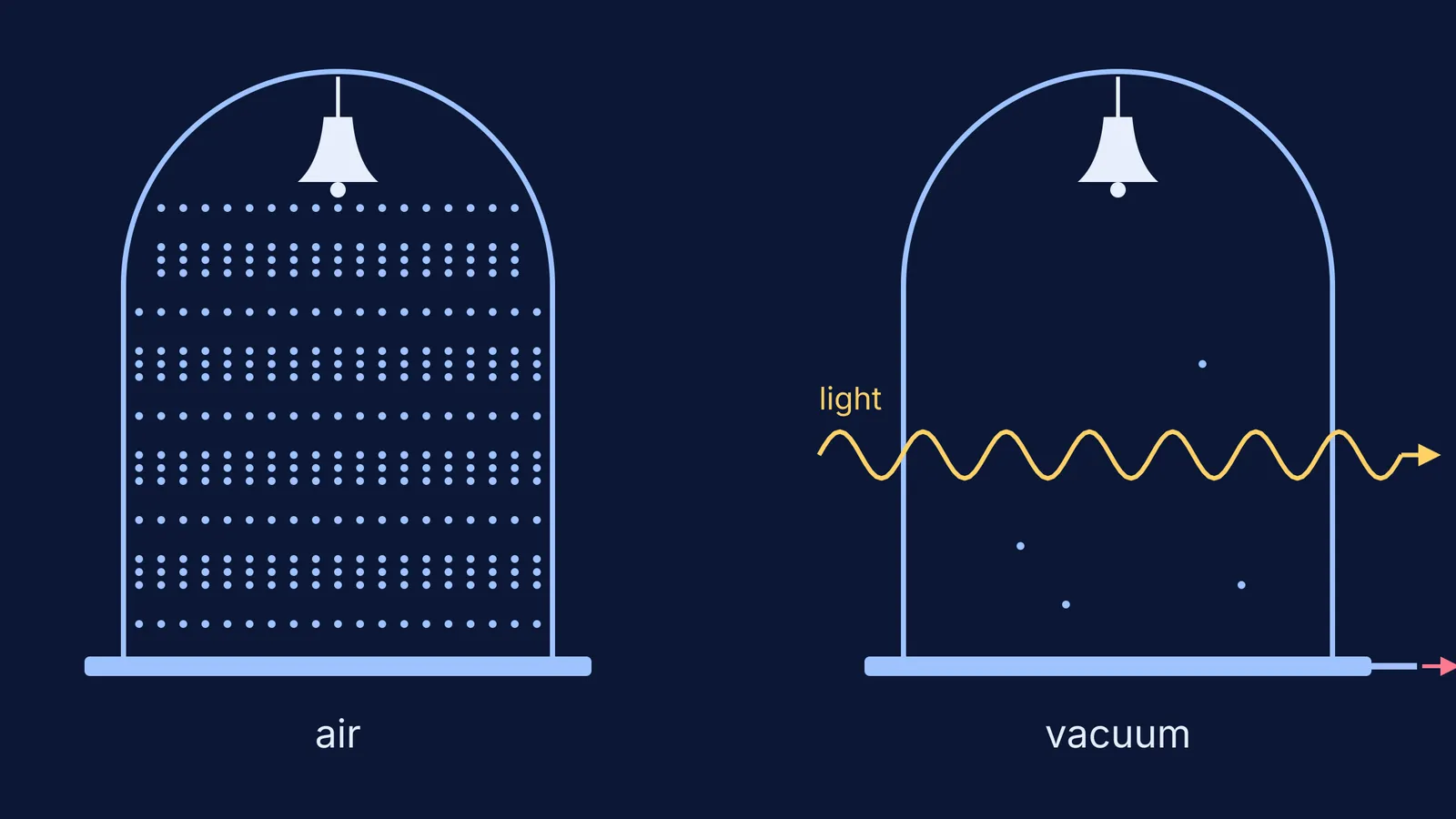
An electric bell rings inside a glass jar. A pump draws the air out, and the ringing fades until you can barely hear it, though you can still see the hammer striking the gong. The bell has not changed; what lies between the bell and your ear has.
Why can sound not travel through a vacuum?
Sound is a mechanical wave: a vibration handed from particle to particle through a medium. A vibrating gong pushes the air molecules next to it, they push their neighbours, and a pattern of crowded regions (compressions) and spread-out regions (rarefactions) moves outward. NASA's Glenn Research Center puts it simply: disturbances travel through a gas "as a result of collisions between the randomly moving molecules in the gas" (NASA Glenn Research Center). The same page gives the speed of sound in sea-level air as about 1,100 feet per second, roughly 335 m/s.
Take the molecules away and nothing is left to collide, so the chain is broken. Each air molecule only moves back and forth around its own position: the disturbance travels, the air does not. If that trips you up, our post on particle velocity versus wave velocity works through it.
What does the bell-jar experiment actually show?
The idea goes back to the 1600s. Robert Boyle, with the help of Robert Hooke, built an air pump and described his experiments in New Experiments Physico-Mechanical, Touching the Spring of the Air and Its Effects in 1660, as the Science History Institute recounts. The same article describes a later demonstration air pump in the Institute's collection whose maker, the Franklin Educational Company, offered a bell as an accessory, to be rung in the emptied chamber "to show that without air, it would make no sound".
Two details are worth noticing, because examiners like them:
The sound fades gradually, not all at once. As fewer molecules remain, less of the vibration is passed on.
In a school lab you rarely reach complete silence. An ordinary pump leaves some air behind, and some vibration leaks through the bell's support and the base plate, because solids carry sound too.
So how does light cross empty space?
Light is a different kind of wave. NASA's guide to the electromagnetic spectrum says that "electromagnetic waves differ from mechanical waves in that they do not require a medium to propagate", so they can travel through the vacuum of space, while sound waves cannot (NASA Science). The same page explains why: a changing magnetic field produces a changing electric field and the other way round, and these linked changing fields are the wave. Nothing material has to move.
In a vacuum, light travels at exactly 299,792,458 m/s, a value fixed by definition in the SI (NIST). That is how sunlight reaches us across space; our post on how long sunlight takes to reach the Earth does the arithmetic.
Space is not perfectly empty, but it comes close. Astronomer Chris Impey of the University of Arizona writes that beyond Earth's atmosphere there are about five particles in a typical cubic centimetre, and the air you breathe is 10^19 times denser (The Conversation). That is far too thin to carry a sound to anyone's ears. The bell jar shows both ideas at once: you stop hearing the bell, yet you keep seeing it.
How do you write this answer in a Class 9 exam?
For "Why can sound not travel through vacuum? Describe an experiment to show this," use four steps: claim, reason, evidence, contrast.
Claim: Sound needs a material medium to travel. It cannot travel through vacuum.
Reason: Sound is a mechanical, longitudinal wave. It travels when particles of the medium vibrate and pass the disturbance to neighbouring particles, forming compressions and rarefactions. A vacuum has no particles.
Evidence: Place an electric bell inside an airtight glass bell jar connected to a vacuum pump. Switch on the bell; the sound is heard. Pump out the air gradually; the sound becomes fainter, though the hammer is still seen striking the gong. When almost all the air is removed, a very faint sound or none is heard.
Contrast and conclusion: The bell remains visible because light does not need a medium. Therefore sound needs a medium to travel; light does not.
Add a labelled diagram: the bell jar, the electric bell, the connection to the vacuum pump, the switch and battery, and the base.
If compressions and rarefactions still feel abstract, the Fermi Simulation Lab has interactive simulations for ideas that are easier to see than to read, and the Fermi Concept Library gives each physics concept its own lesson and its place in the map.
Next, find out how fast sound moves through a medium by measuring the speed of sound using an echo.


