

On this page
When you look up at the Sun, you are not seeing it as it is right now. You are seeing it as it was over eight minutes ago (Source). Because space is vast and light has a finite speed, every look into the night sky is a look back in time.
How long does sunlight take to reach the earth?
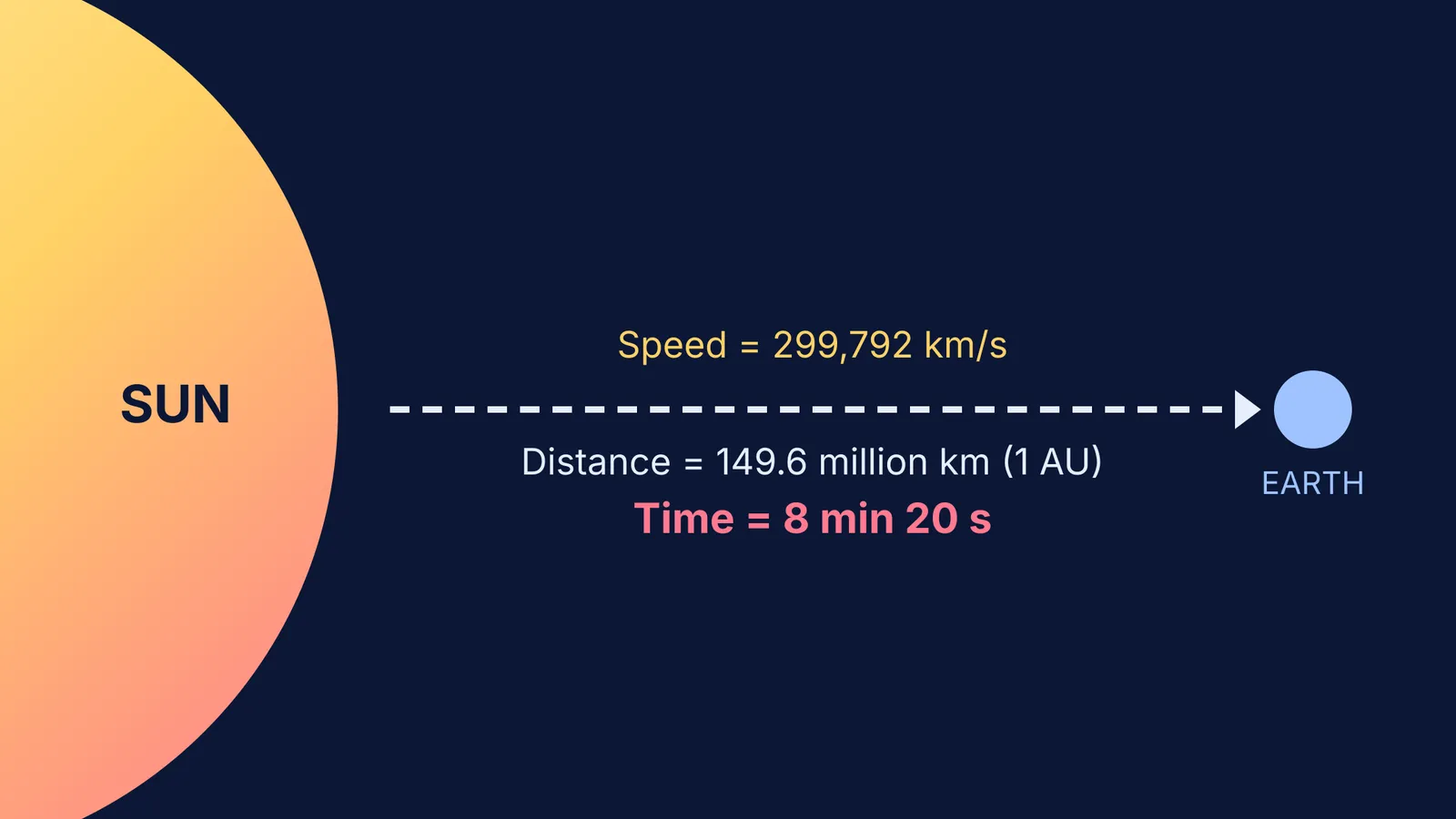
Sunlight takes an average of 8 minutes and 20 seconds to reach the Earth. This gap exists because light must travel across an average of 150 million kilometres of empty space (Source) to get here.
While the journey from the Sun's surface to Earth is a quick sprint, a photon's full lifespan is much longer. The energy that makes up sunlight is created through nuclear fusion deep in the Sun's core. Because the Sun's interior is incredibly dense, a newly created photon cannot travel in a straight line. It constantly collides with protons and electrons, taking a jagged "random walk" outwards. According to astrophysical models like those by Mitalas and Sills (Source), it takes a photon roughly 170,000 years to struggle through the radiative and convective zones. Only after reaching the photosphere—the Sun's surface—can it finally escape and make the swift dash to Earth.
The speed of light and the astronomical unit
To understand why the journey across space takes eight minutes, we need two exact numbers: speed and distance.
The speed of light in a vacuum (c) is exactly 299,792,458 metres per second. This value is absolute and defined by the National Institute of Standards and Technology and the SI system (Source). For quick calculations in physics problems, we usually round this to 300,000 kilometres per second, or 3 × 10⁵ km/s (3 lakh km/s).
The average distance from the Earth to the Sun is approximately 149.6 million kilometres (Source). Astronomers use this average distance as a standard yardstick called the astronomical unit (AU). In 2012, the International Astronomical Union defined the AU as exactly 149,597,870,700 metres (Source).
Before these exact modern definitions, astronomers spent centuries refining their measurements of both the speed of light and the scale of the solar system, as seen in the work of Ole Romer and the speed of light from Jupiter's moon Io and Albert Michelson: measuring light speed and finding no ether.
Does the time change during the year?
Yes, because the Earth's orbit is an ellipse, not a perfect circle. The distance between the Earth and the Sun changes slightly as we move through the year, which alters the time light takes to reach us.
Perihelion (Closest): In early January, Earth reaches perihelion. The distance drops to about 147 million kilometres. At this point, sunlight takes roughly 490 seconds, or 8 minutes and 10 seconds, to arrive (Source).
Aphelion (Farthest): In early July, Earth is at aphelion. The distance stretches to about 152 million kilometres. Sunlight then takes about 507 seconds, or 8 minutes and 27 seconds (Source).
How to calculate the time yourself
In kinematics, problems involving constant speed rely on the fundamental equation: distance = speed × time. Here is a worked example of how to compute the travel time of sunlight yourself.
Write down the distance (d): 149.6 million km (Source), which is 149,600,000 km.
Write down the speed (v): The exact speed is 299,792.458 km/s (Source), which we approximate as 299,792 km/s here.
Rearrange the formula: To find time, divide distance by speed (t = d / v).
Calculate the seconds: t = 149,600,000 / 299,792 ≈ 499 seconds.
Convert to minutes: Divide 499 seconds by 60 to get 8.31 minutes. This translates to 8 minutes and 19 seconds.
If you use the slightly rounded figure of 150 million kilometres for the distance and 300,000 km/s for the speed, the math simplifies nicely to exactly 500 seconds, which is precisely 8 minutes and 20 seconds.
If you are studying orbital mechanics, optics, or electromagnetism, visualising these vast scales and invisible phenomena can be tricky. This is where the Fermi Simulation Lab helps. You can run interactive simulations to see how changing an orbit's eccentricity affects distances, or how electromagnetic waves propagate through space, making the mathematics of physics easier to grasp.


