On this page
Quadratic inequalities look harder than quadratic equations, but they only add one step. Once you can factorise, the rest is a number line and one question about the sign of the x² term.
OpenStax's Intermediate Algebra 2e, section 9.8 defines it simply: a quadratic inequality is an inequality that contains a quadratic expression, written in a standard form such as ax² + bx + c < 0 or ax² + bx + c ≥ 0.
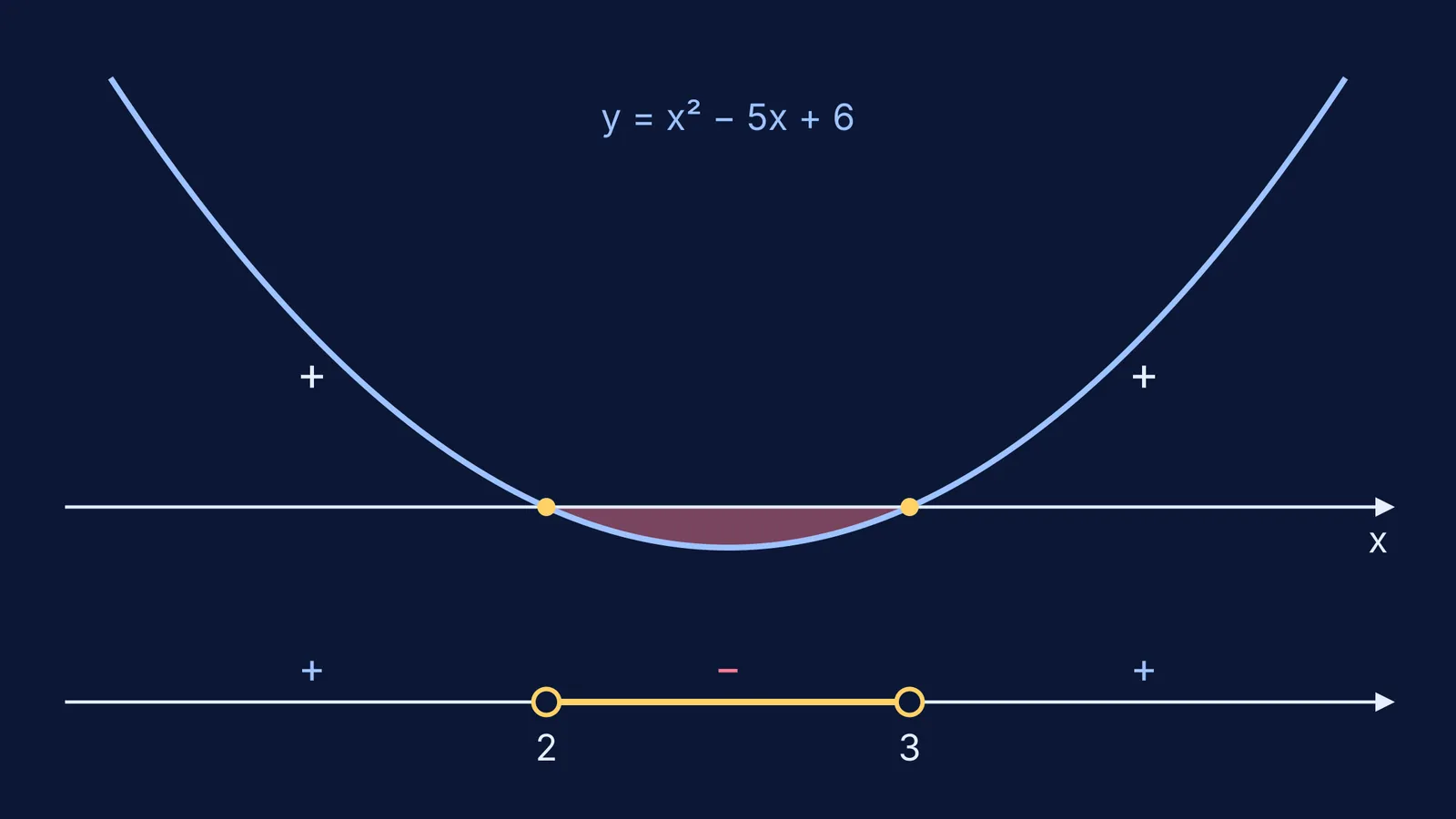
How do you solve x² − 5x + 6 < 0?
Work through it in four steps.
Check standard form. Everything is on one side and 0 is on the other. Here a = 1, b = −5, c = 6.
Factorise. Find two numbers that multiply to 6 and add to −5: −2 and −3. So x² − 5x + 6 = (x − 2)(x − 3), and the inequality becomes (x − 2)(x − 3) < 0.
Mark the roots. Set each factor to zero: x = 2 and x = 3. These are the critical points. Put them on a number line. Use open circles, because the sign is strict (<), so 2 and 3 themselves are not in the answer.
Choose the interval. a = 1 is positive, so the parabola opens upward. Its only negative part is the dip between the roots. Answer: 2 < x < 3, written (2, 3).
Check with one test value per region. At x = 0 you get 6 (positive). At x = 2.5 you get 6.25 − 12.5 + 6 = −0.25 (negative). At x = 4 you get 2 (positive). The pattern is plus, minus, plus, and you want the minus region.
How do you know whether to take the inside or the outside interval?
OpenStax states the rule behind this: an upward-opening parabola is positive outside its x-intercepts and negative between them, and a downward-opening one does the opposite. If the roots are p < q and a > 0, you get this decision list:
< 0: inside, p < x < q
≤ 0: inside with the ends included, p ≤ x ≤ q
> 0: outside, x < p or x > q
≥ 0: outside with the ends included, x ≤ p or x ≥ q
If a is negative, multiply the whole inequality by −1 first and flip the sign. Then a is positive and you can use the list above. For example, −x² + 5x − 6 > 0 becomes x² − 5x + 6 < 0, which has the same answer, (2, 3).
A second example with the ends included
Try 2x² − x − 3 ≥ 0. It factorises as (2x − 3)(x + 1) ≥ 0. Expand it to check: 2x² + 2x − 3x − 3. The roots are x = −1 and x = 3/2. Here a = 2 is positive and the sign is ≥, so you take the outside interval and include the roots: x ≤ −1 or x ≥ 3/2. In interval notation that is (−∞, −1] ∪ [3/2, ∞). Draw closed circles this time, because the expression equals 0 at the roots and 0 ≥ 0 is true.
What are the common mistakes with quadratic inequalities?
Dividing by x or by a bracket. Its sign is unknown, so you lose solutions. Bring everything to one side and factorise.
Forgetting the flip. Multiplying or dividing by a negative number reverses the inequality sign. This is the usual slip when a < 0.
Writing 2 > x > 3. No number is both less than 2 and greater than 3. An outside answer needs "or", not a chain.
Mixing up open and closed circles. Use open circles for < and >, closed circles for ≤ and ≥.
Stopping when it will not factorise. Use the quadratic formula to find the roots, then apply the same rule. If there are no real roots and a > 0, as with x² + x + 1, the expression is positive for every x, so "> 0" is true for all real numbers and "< 0" has no solution.
How should you practise this?
Practise in a set order: five factorisable cases with a > 0, five with a < 0, five with ≤ or ≥, then a few that need the quadratic formula. Before you calculate, say which interval you expect.
If you keep landing on the wrong interval, the Fermi Problem Library has worked problems with a step-by-step solver that explains the reasoning rather than printing an answer, so you can see the exact step where your sign went wrong. If the problem is the idea underneath, such as how a parabola's shape depends on a, the matching lesson in the Fermi Concept Library lets you go back to it before the next practice set.