

On this page
In the NCERT chapter Metals and Non-metals, one in-text question asks "Why is sodium kept immersed in kerosene oil?", and Exercise 12(b) asks why sodium, potassium and lithium are stored under oil (NCERT Class 10 Science, Chapter 3).
What happens when sodium meets air and water?
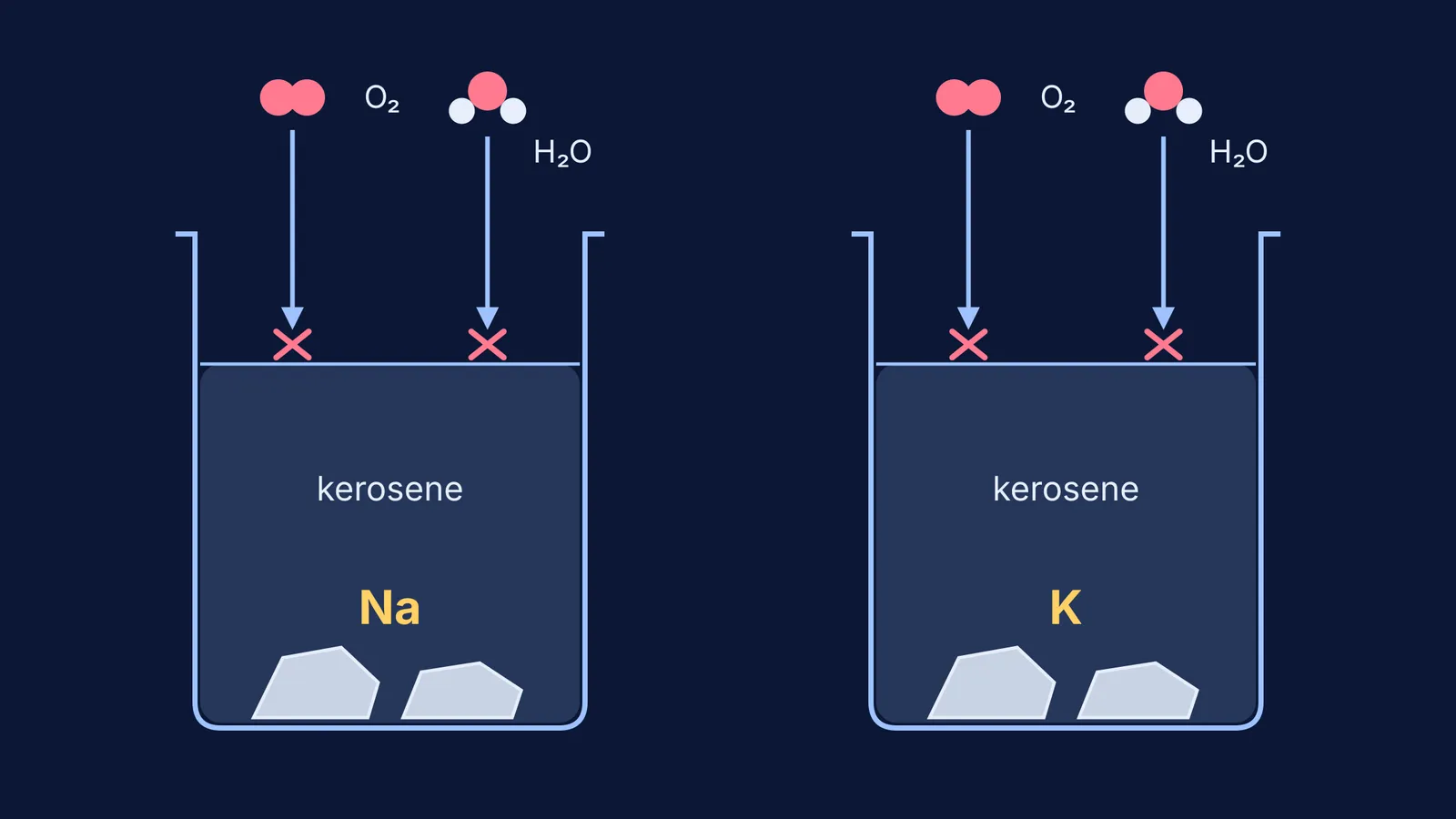
NCERT puts it plainly: potassium and sodium "react so vigorously that they catch fire if kept in the open", so they are kept immersed in kerosene oil "to protect them and to prevent accidental fires" (NCERT Class 10 Science, Chapter 3).
With cold water it is worse. The same chapter says that for sodium and potassium the reaction "is so violent and exothermic that the evolved hydrogen immediately catches fire":
2Na(s) + 2H₂O(l) → 2NaOH(aq) + H₂(g) + heat energy
2K(s) + 2H₂O(l) → 2KOH(aq) + H₂(g) + heat energy
The International Chemical Safety Card for sodium says the metal "reacts violently with water", which "generates fire and explosion hazard", and that it "decomposes rapidly under the influence of air and moisture" (ICSC 0717, sodium).
Why does kerosene not react with sodium?
Kerosene is a mixture of hydrocarbons with roughly 9 to 16 carbon atoms per molecule, and alkanes generally make up at least 70% of it by volume, according to a Government of Canada screening assessment of kerosenes.
That is the key. In water, hydrogen is bonded to oxygen, and sodium pushes it off as hydrogen gas by giving away its outer electron. In kerosene, hydrogen is bonded to carbon and is not released that way, and the oil holds almost no water for the metal to attack. Sodium sits in it unchanged.
Kerosene is also insoluble in water (ICSC 0663, kerosene), so a layer of it keeps moist air off the metal. Safety cards use the same logic with another hydrocarbon: for sodium they say "Keep under mineral oil. Dry. Well closed" (ICSC 0717). Water is exactly the liquid that must be kept away.
Research labs go further. A National Research Council safety summary warns that potassium stored under mineral oil can form shock-sensitive peroxides if oxygen is present, and recommends an inert gas such as argon (LCSS: Potassium, hosted by Stanford EHS).
Why is potassium more reactive than sodium?
Potassium sits above sodium at the top of NCERT's activity series in Table 3.2, which runs K, Na, Ca, Mg, Al, Zn, Fe, Pb, [H], Cu, Hg, Ag, Au (NCERT Class 10 Science, Chapter 3).
The Class 10 reason is electron arrangement. NCERT's Table 3.3 gives sodium (atomic number 11) as 2, 8, 1 and potassium (atomic number 19) as 2, 8, 8, 1. Both have a single outer electron to lose. In potassium that electron sits one shell further out, with more inner electrons between it and the nucleus, so it is held less tightly and leaves more easily.
The numbers back this up. Potassium's atomic radius is 202 pm against 157 pm for sodium, and its first ionisation energy is 0.425 MJ/mol against 0.502 MJ/mol for sodium, according to the ChemPRIME chapter on alkali metals at LibreTexts. Needing less energy to lose its outer electron helps explain why potassium reacts more fiercely, and the safety card for potassium also says "Keep under mineral oil" (ICSC 0716, potassium).
To see how this list grows into Class 12 electrode potentials, read our post on the activity series and the electrochemical series. Losing that outer electron is oxidation, covered in oxidation and reduction in Class 10.
How do you write the board answer?
A strong answer gives a chain of reasons, not a single line. Use four links:
Property: sodium is highly reactive, near the top of the reactivity series.
Hazard: it reacts vigorously with oxygen and moisture in air and can catch fire; with water it gives hydrogen, which ignites.
Protection: kerosene covers the metal and keeps air and moisture away.
Why kerosene is safe: it is a mixture of hydrocarbons and does not react with sodium.
A model answer for 2 to 3 marks:
"Sodium is a highly reactive metal. It reacts vigorously with oxygen and moisture in the air and can catch fire if kept in the open. With water it reacts violently: 2Na + 2H₂O → 2NaOH + H₂, and the heat produced ignites the hydrogen. Sodium does not react with kerosene, so it is kept immersed in kerosene to keep air and moisture away and prevent accidental fires."
Common ways to lose marks:
Writing that kerosene cools the sodium.
Mentioning oxygen but leaving out moisture.
Leaving H₂ out of the equation, or not balancing it.
Forgetting potassium when the question names both.
The same four steps work for many give-reason questions, and our guide to getting AI feedback on give-reason chemistry answers shows how to check yours. For more practice, the Fermi Problem Library has worked problems with a step-by-step solver that explains the reasoning rather than printing an answer. If shells or ionisation energy feel shaky, the Fermi Concept Library gives each concept its own lesson.


